The Humanitarian Paradox
Richard Jordan Gatling graduated from Ohio Medical College in 1850, having spent years inventing agricultural equipment before turning to weapons. In 1877, he put his reasoning on paper: a more efficient killing machine would reduce army size, and smaller armies meant fewer soldiers dying from disease in camp, by a considerable margin the leading cause of military deaths at the time.
The logic has a certain internal consistency. It also produced the opposite of what he intended. By the time his gun reached the battlefield, it had become one of the most lethal infantry weapons of its era. There is no evidence Gatling ever practiced medicine. His lasting contribution was not saving lives but vastly accelerating the rate at which they could be taken.
The Identity Crisis
Ask who invented the machine gun and you’ll get at least four defensible answers, depending entirely on how you define the term.
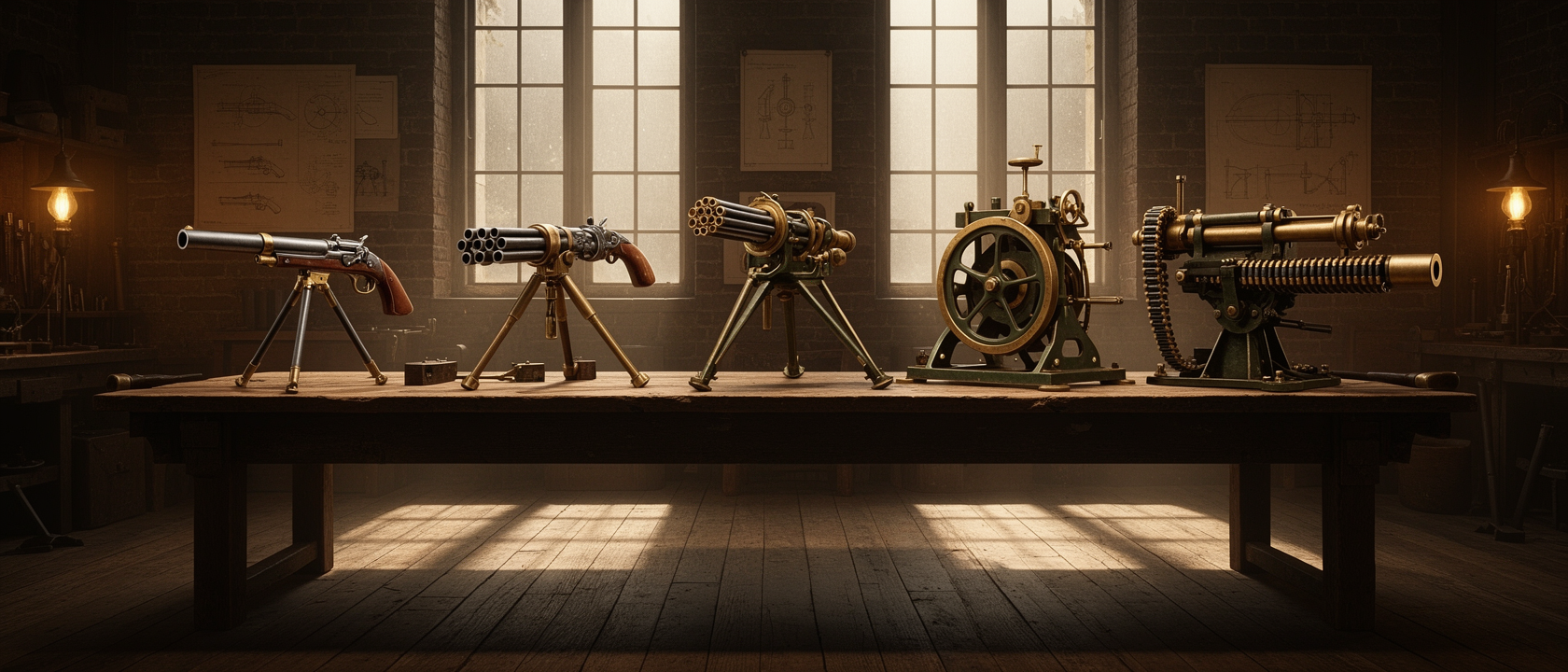
Leonardo da Vinci sketched multi-barrel artillery and rotating crossbow arrays in the late 15th century, visually compelling, and almost certainly never built. In 1718, a London lawyer named James Puckle received Patent No. 418 for a tripod-mounted, single-barreled weapon with a manually operated revolving cylinder. At a public trial in 1722, it fired 63 shots in seven minutes, in a driving rainstorm, roughly nine rounds per minute, achieved entirely by hand.
Puckle’s gun came with one of the stranger features in weapons history: two different bullet shapes. Round bullets were intended for Christian enemies; square ones were designated for Muslim Turks, described in the patent as a means of making them appreciate Christian civilization. The British military was unimpressed. The gun was never adopted, never used in combat, and possibly only two were ever produced. The term “machine gun” itself first appeared in a 1722 shipping manifest referencing the Puckle Gun, the name arrived before the thing it would eventually describe.
Volley Guns vs. Machine Guns
Calling the Puckle Gun a machine gun, by modern standards, is a stretch. The same goes for the mitrailleuse, first built in 1851 by Captain Toussaint Fafchamps with 50 barrels. A French 25-barrel version designed by Jean-Baptiste Verchère de Reffye was adopted by the French Army around 1865.
These are volley guns. A soldier loads a cluster of rounds, fires them, then loads again. A true machine gun handles its own reloading: apply the trigger and the weapon chambers, fires, and ejects each round through a mechanical cycle, with no manual intervention between shots. That distinction is the whole argument.
The Mechanism of Automation
The Gatling gun, patented on November 4, 1862, was the first weapon to make that cycle work reliably. Multiple rotating barrels arranged around a central axis were driven by a hand crank. As each barrel rotated to the top, a cartridge dropped from a gravity-fed hopper into the chamber; the barrel fired at the bottom of the arc and ejected the spent casing as it came back around. The multiple-barrel arrangement also allowed each barrel time to cool. Early versions could sustain up to 200 rounds per minute, with no manual loading between shots.
From Prototype to Battlefield
Designed during the Civil War, the Gatling gun was never officially adopted by the Union Army during that conflict. General Benjamin F. Butler acquired 12 privately, at $1,000 each, for use at the siege of Petersburg in 1864. Official U.S. Army adoption came in 1866. The mitrailleuse reached its first major engagement on September 1, 1870, at the Battle of Sedan during the Franco-Prussian War.
None of these, by the modern definition, was a fully automatic machine gun. That designation belongs to the Maxim gun, whose prototype was demonstrated in October 1884. Hiram Maxim’s design used recoil energy from each fired shot to eject the spent casing and load the next round automatically, no cranking required. Gatling had built something new, and the mechanical logic inside it survived well into the 20th century. He just hadn’t quite removed the person from the process.