The Blueprint Had Been Sitting in a Filing Cabinet Since 1925
On June 30, 1948, Bell Laboratories held a press conference to announce an invention that would reshape electronics. The New York Times covered it the following day, a few paragraphs on page 46, tucked inside a column called “The News of Radio.” That was it.
The indifference was almost fitting. The road to that press conference had been anything but tidy.
A Chain Nobody Planned
The transistor’s ancestry stretches back to 1880, when Thomas Edison noticed something strange while trying to understand why his light bulb filaments kept breaking. Electrons were leaping across empty space inside the glass bulb, crossing from a heated wire into nothing. Edison filed a patent application on November 15, 1883, U.S. patent 307,031, described as the first American patent for an electronic device, and largely moved on. The effect got his name anyway.
In 1904, the English physicist John Ambrose Fleming built the first practical vacuum tube from that same principle: two electrodes inside a glass bulb, letting current pass in one direction only. Two years later, the American inventor Lee de Forest added a third electrode, a metal grid, to create the triode. Apply a small voltage to the grid, and it controls a much larger current. That meant amplification: the ability to boost a weak signal into a strong one. It made long-distance phone calls and radio broadcasting practical for the first time.
These “valves” were remarkable for their era, but they were also fragile, power-hungry, and ran hot enough to burn fingers. They needed time to warm up before they worked at all. They were the best option available, not a good one.
The Right Idea, the Wrong Century
In October 1925, an Austro-Hungarian physicist named Julius Lilienfeld filed a patent in Canada for a device that used a solid semiconductor material, no glowing filament, no vacuum, to control electrical current. The mathematics held up. U.S. patent No. 1,745,175 was granted on January 18, 1930.
Nothing came of it. The crystal samples available in the 1920s were far too impure for the device to function. Lilienfeld never managed to build a working prototype. He had drawn an accurate map to a place the technology of his time could not reach.
His work surfaced again, decades later, in an unexpected way. When the team at Bell Laboratories in Murray Hill, New Jersey, tried to patent their own field-effect design, the company’s lawyers found that Lilienfeld had already described the core concept. William Shockley, the group’s leader, was left off the initial patent applications as a result.
Two Gold Contacts and a Slab of Germanium
The Bell Labs research group, John Bardeen, Walter Brattain, Robert Gibney, Gerald Pearson, Hilbert Moore, and others, spent years on a design that the physics said should work but stubbornly didn’t. Shockley and Brattain had tried something similar in 1939, and it had failed outright. After World War II paused the program entirely, research resumed and Bardeen worked out why the device kept misbehaving: electrons were accumulating on the surface of the semiconductor crystal, forming a layer that blocked the electric field the team was trying to push through.
Their attempted fixes were improvised. They flooded the surface with distilled water to strengthen the field’s reach into the crystal. Then they tried glycol borate, a thick liquid that produced some amplification, but the device was too sluggish for high-frequency signals. They also switched materials, moving from silicon to germanium to avoid particular barrier effects that silicon introduced.
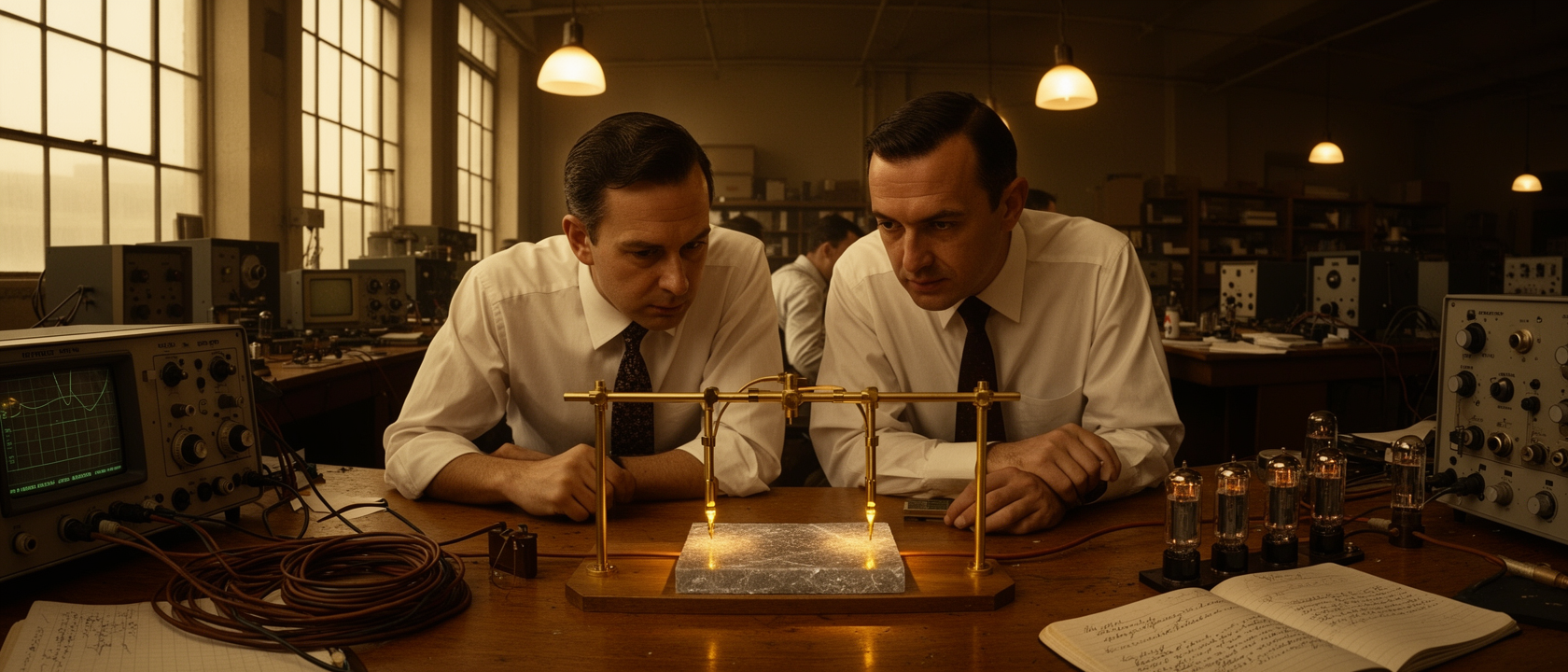
On December 16, 1947, Bardeen and Brattain got their first clean, solid-state amplification. The device was two closely spaced gold contacts pressed onto a small slab of high-purity germanium. A week later, on December 23, they demonstrated it to Bell Labs management as a speech amplifier. The power gain was 18.
In 1956, Bardeen, Brattain, and Shockley shared the Nobel Prize in Physics. Bardeen returned to Stockholm in 1972 for a second Nobel, this time for work on superconductivity, the only person ever to win the physics prize twice. The word “transistor” had been coined eight years earlier, in May 1948, by Bell Labs engineer John Robinson Pierce, who fused “transfer” and “resistor” into a single word. The Times put the whole story on page 46.