Three Plans, One Moon, and the Engineer Nobody Wanted to Listen To
On May 25, 1961, President Kennedy gave NASA an eight-year deadline to land humans on the Moon and bring them home safely. The agency had a problem: it had no agreed plan for how to actually do it. The engineers couldn’t even agree on the basic mission architecture.
The Brute-Force Option
The most instinctive solution was also the most impractical. Direct Ascent meant building one enormous rocket, launching it straight at the Moon, landing the whole thing on the surface, and bringing it all back. The rocket needed, engineers called it the Nova, would have dwarfed the Saturn V, which stood 111 meters tall and weighed 2.8 million kilograms fully fueled. The Nova existed only on paper; no launch pad could handle it, and building one in time was essentially a separate megaproject.
A Three-Way Argument
Earth Orbit Rendezvous (EOR) broke the problem into pieces: launch several smaller rockets, assemble the spacecraft in Earth orbit, then depart for the Moon. Wernher von Braun favored this route, but orbital docking hadn’t been demonstrated yet, and cryogenic fuels would start evaporating while crews waited for all the pieces to arrive.
Lunar Orbit Rendezvous (LOR) was the counterintuitive option. The whole stack leaves Earth on one rocket, enters lunar orbit, and a small lander drops two astronauts to the surface while a third stays in the orbiting spacecraft. The lander returns, docks in orbit, and the crew heads home. A Langley Research Center engineer named John Houbolt was its loudest champion, and kept getting shot down.
Why Leaving Part of the Ship Behind Was the Smart Move
The case for LOR comes down to mass. Every kilogram on the lunar surface first has to be accelerated from Earth, slowed into lunar orbit, and slowed again to touchdown, then the process runs in reverse. The key was that the lander never returns to Earth, so it needs no heat shield. That one omission, worked through the whole mass equation, shaved a substantial fraction from total mission weight. It was the difference between needing a Nova-class rocket and being able to use the Saturn V.
Houbolt pitched LOR approximately 19 times over roughly 18 months and met resistance at nearly every level. In November 1961 he bypassed his management chain and wrote directly to Associate Administrator Robert Seamans. Seamans convened high-level review groups, and by spring 1962 von Braun had publicly switched his support to LOR. NASA formally committed to the approach in July 1962.
The Design That Refused to Shrink
Settling on LOR didn’t end the friction. NASA was already committed to a three-person Apollo capsule through the work of engineer Maxime Faget, and the prime contractor for the Command Module, North American Aviation, had committed enormous design effort to that configuration and had little appetite for starting over. More efficient two-person alternatives existed but were never seriously considered. The result was a spacecraft heavier and more complex than a purely engineering-driven process would have produced.
The Fire, and What Came After
On January 27, 1967, during a launch rehearsal at Cape Kennedy, a fire broke out inside the Apollo Command Module. Astronauts Virgil Grissom, Edward White, and Roger Chaffee died. The investigation exposed workmanship problems at North American Aviation and serious design flaws: a cabin pressurized with pure oxygen and a hatch that could not be quickly opened from the inside. The spacecraft was substantially redesigned, and the clock kept running.
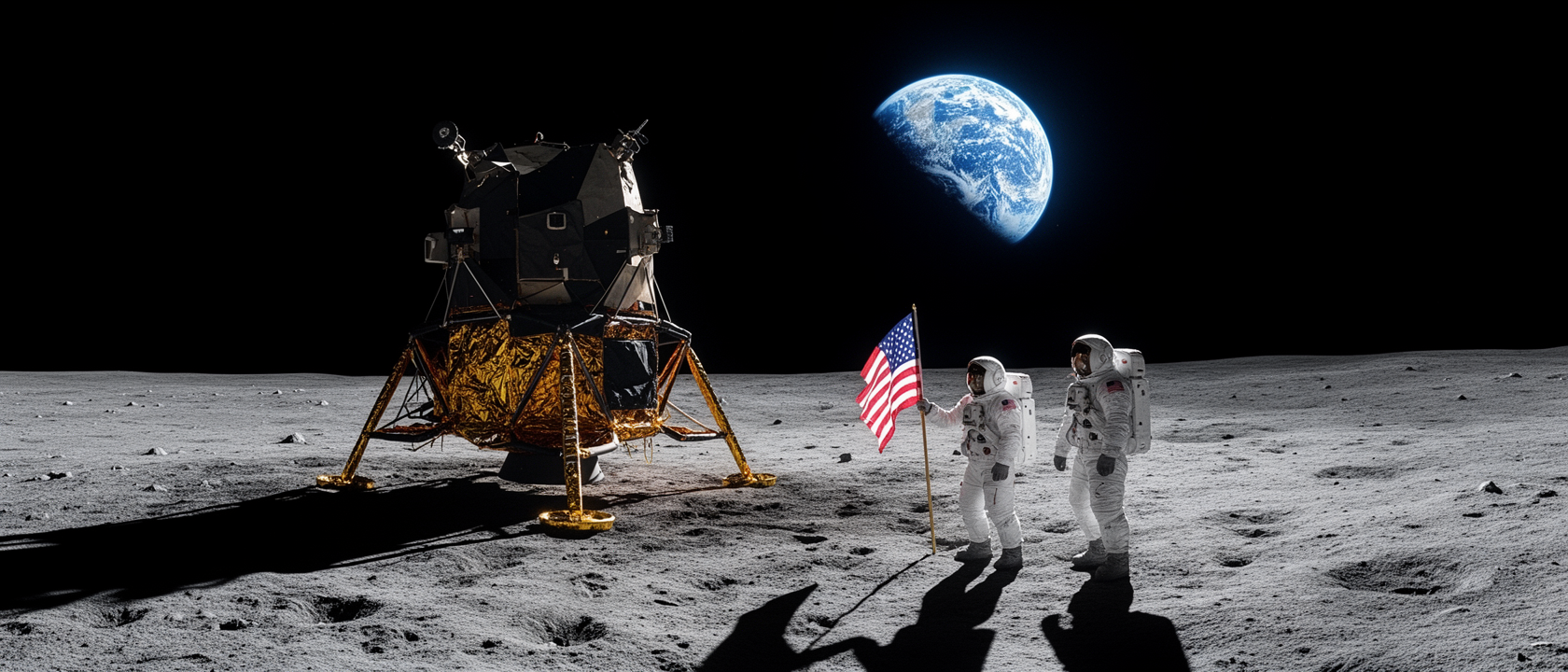
Apollo 11 landed on the Moon on July 20, 1969, just inside Kennedy’s decade, using the Lunar Orbit Rendezvous architecture that Houbolt had spent the better part of two years fighting to keep alive, aboard a Saturn V already remarkable, and still considerably smaller than the rocket NASA had once imagined it would need.