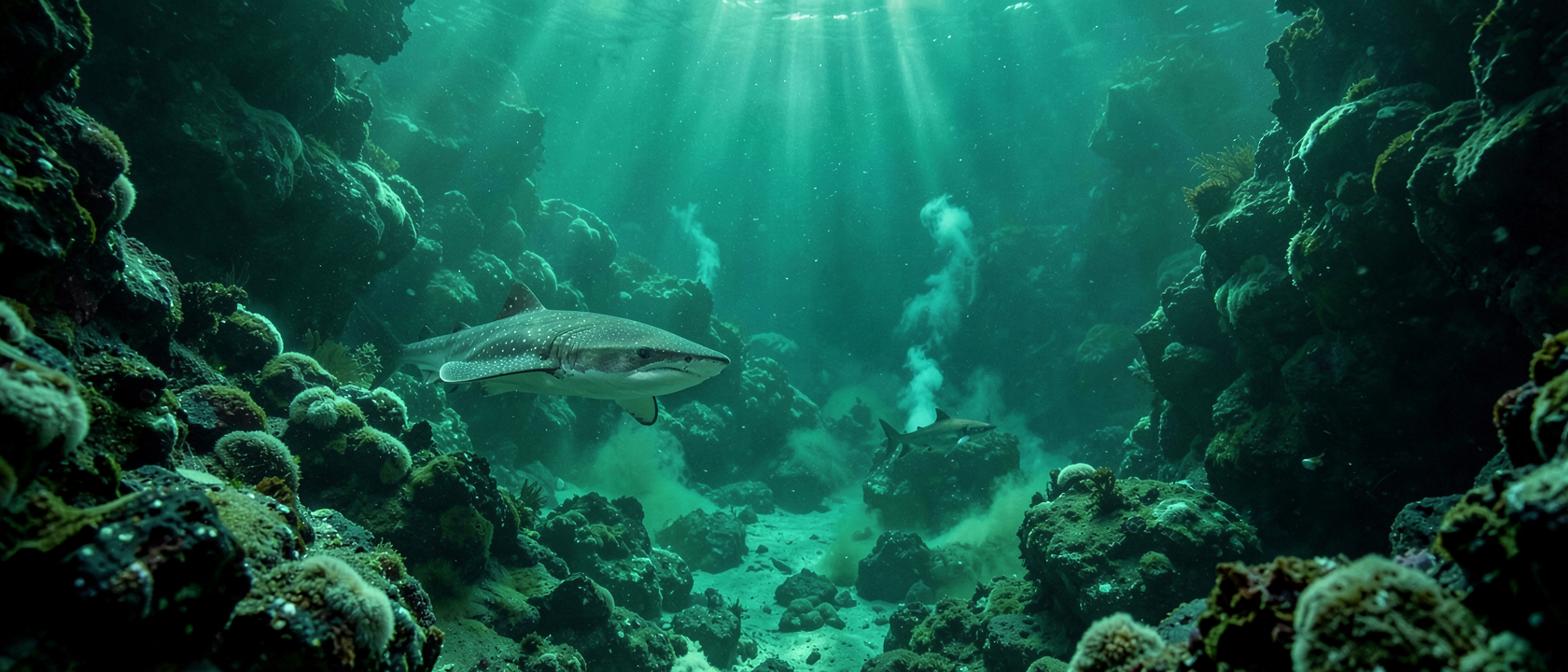
A Camera Goes Where No Diver Can
In 2015, ocean engineer Brennan Phillips led a National Geographic expedition to Kavachi, an active submarine volcano in the Solomon Islands, roughly 15 miles (24 kilometers) south of Vangunu Island. Its summit sits just 65 feet (20 meters) below the surface, while its base runs down to the seafloor at 0.75 miles (1.2 kilometers). Since its first recorded eruption in 1939, Kavachi has occasionally pushed new islands above the waves, only to have the ocean wash them away again. Locals call it Rejo Te Kvachi, “Kavachi’s Oven.”
During a lull in eruptions, the team lowered a deep-sea robotic camera into the crater and waited. About an hour later, it resurfaced with footage nobody expected: scalloped hammerhead sharks and silky sharks moving through the water as if it were any ordinary stretch of open ocean, the find that later got the volcano nicknamed “Sharkcano.”
The Water That Burns
That calm footage is exactly what made it strange. Kavachi isn’t a dormant crater, it’s one of the most active submarine volcanoes in the Pacific, having erupted as recently as 2014 and venting heat and sulfur almost continuously. Divers and researchers near its rim reported having to pull back from water too hot to tolerate, and some came away with burns from its acidity.
Measurements over the crater found temperatures spiking 13°C (23°F) above the surrounding sea, reaching roughly 42°C (108°F), with a pH near 6.1, acidic enough to irritate human skin on contact. That’s just the edge. Hammerheads and silky sharks were filmed well inside the crater, in conditions presumably even hotter and more acidic.
No One Actually Knows Why
Phillips has floated the idea that these sharks might carry some built-in tolerance for heat and acidity, but he’s framed it as a question, not an answer. No one has done the blood work or tissue studies that would show what’s actually happening inside these animals.
One hypothesis involves the ampullae of Lorenzini, gel-filled pores sharks use to sense electrical and magnetic signals. The idea is that the same organs sharks rely on for migration might also help them detect danger, the way some species seem to sense an approaching hurricane and move out of its path before it arrives. It’s a reasonable guess, not a confirmed mechanism, nobody has tested it.
Why This Still Isn’t a Closed Case
Even the basic facts here have gaps. Researchers confirmed hammerheads and silky sharks inside the crater, but whether this tolerance is unique to those two species, or whether other sharks could manage it too, is still unanswered. One blurry shape in the footage looked like something larger and different altogether, though its identity has never been confirmed and remains disputed.
Nobody recorded how long any of the sharks actually stayed, minutes passing through, hours resting, or something closer to permanent residence. And nobody knows what the crater is for, from a shark’s point of view: a feeding ground, a nursery, a shortcut between deeper water and the reef, or something nobody has guessed at yet. Kavachi only opens to a camera in the narrow windows between eruptions, which is a big part of why so little of its interior has become settled science.
What This Says About How Much Ocean We Haven’t Seen
The deeper point of Kavachi has less to do with sharks shrugging off acid and more to do with how much of the ocean still runs on rules nobody’s written down. The sharks were there all along. What changed is that someone finally lowered a camera into a crater everyone else had good reason to avoid. Researchers also found colonies of sulfur-eating bacteria, Sulfurimonas, thriving in the same water that burns human skin, a quiet reminder that “uninhabitable” often just means “nobody checked.”
Noticing that gap, between what we assume about a place and what’s actually been confirmed, is rarer than it sounds. It’s the same instinct that sent an engineer and a robotic camera into an active volcano instead of walking past it. The sharks never announced themselves. Someone just had to go looking inside a hole in the ocean that everyone else was content to leave alone.