One Detail Decides Everything
Every Halloween party has that moment: someone walks in dressed as a bearded lady, and you know instantly whether it works. It’s not the dress. It’s not the wig or the eyeshadow. It’s the chin. That one feature decides whether the costume reads as clever or just confusing, and there are really only a few ways to handle it: grow the beard, glue one on, or skip the realism question entirely and build something so strange on purpose that nobody expects it to look real in the first place.
Why Faces Get Scrutinized Like Nothing Else
Why does a fake beard fail so much faster, and so much more obviously, than a crooked cape or an off-kilter wig? Part of the answer is how people process faces in general. We read faces constantly, for emotion, for trust, for whether someone’s lying, and a large share of that attention lands right around the mouth and jaw. A static prop sitting in that zone, one that doesn’t move when the jaw moves or catch light the way real hair does, reads as wrong almost instantly, even before the viewer can explain why.
Option One: Grow It and Mean It
The most convincing version of a bearded lady costume is also the slowest: an actual, naturally grown beard. In one widely shared photo of this approach, credited to Kim Scarborough on Flickr, a man simply let his own beard do the work. Nothing can peel, slip, or slide sideways on the dance floor, because it isn’t attached to the face, it’s part of it.
The cost is time. A beard full enough to read clearly from across a room doesn’t happen in a week, so this route usually means planning months ahead, not days before the party. And once it’s finally grown in, a new problem shows up: facial hair grown specifically for a costume tends to be itchy and stubborn to style the way you want for the night. Full authenticity, zero risk of it falling off, and some real discomfort collected along the way.
Option Two: Glue It and Gamble
The fake beard is the opposite bet, and another well-circulated photo, credited to zoomar on Flickr, captures exactly that version: a removable beard worn just for the occasion. No months of growing anything out, no commitment past midnight. Put it on before the party, peel it off after, and go back to looking like yourself the next day as if nothing happened.
That ease is the entire appeal. The catch is that the whole costume’s credibility rests on adhesive, holding through heat, sweat, talking, laughing, and however many hours the night runs. A beard that survives all of it sells the illusion completely. One that starts sliding partway through the evening turns the costume into a different kind of memorable. Convenience is real here, and so is what’s sitting right underneath it.
Option Three: Stop Trying to Be Real
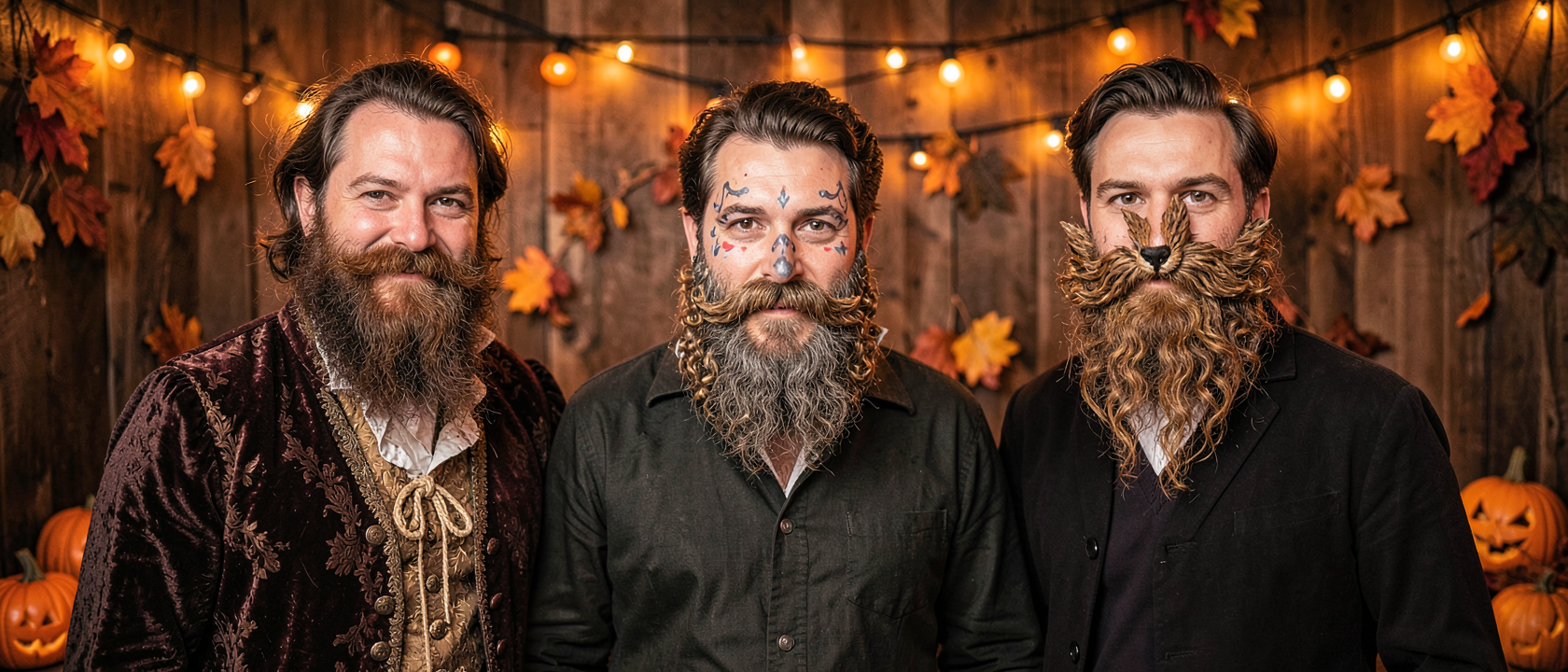
There’s a third path that sidesteps the grow-versus-glue argument altogether: build something so deliberately unrealistic that realism stops being the goal. One documented example is a custom “monkey beard,” a facial hair sculpture shaped and built up until it looks nothing like an actual beard and everything like its own small piece of art. Once a beard crosses that line, it stops being an accessory to the costume and becomes the costume. It’s a classic costume-design move: if you can’t win by being convincing, win by being impossible to ignore.
A Craft Bigger Than Halloween
Worth knowing: bearding isn’t just a once-a-year costume trick. There’s a documented world of competitive beard styling built around this exact idea, including groups like the RVA Beard League, founded by Chad Roberts, a bearding champion who has built novelty beard sculptures elaborate enough to earn their own names, including an “X-Wing Beard.” That’s a separate, year-round hobby rather than part of any single costume story, but it shows that the instinct to turn facial hair into deliberate design isn’t limited to one night in October.
The Tradeoff Hiding in Every Costume Choice
Step back, and growing, gluing, and sculpting are really three answers to the same question: do you optimize for authenticity, convenience, or spectacle? Maxing out all three at once almost never happens. That tension isn’t unique to beards, either. It’s the same calculation behind nearly every costume decision made without naming it: comfortable shoes versus the right silhouette, a store-bought mask versus a hand-painted one, extra time on makeup versus just showing up. Once you start noticing that tradeoff, you’ll see it in every costume at the party, not just the ones with chin hair.