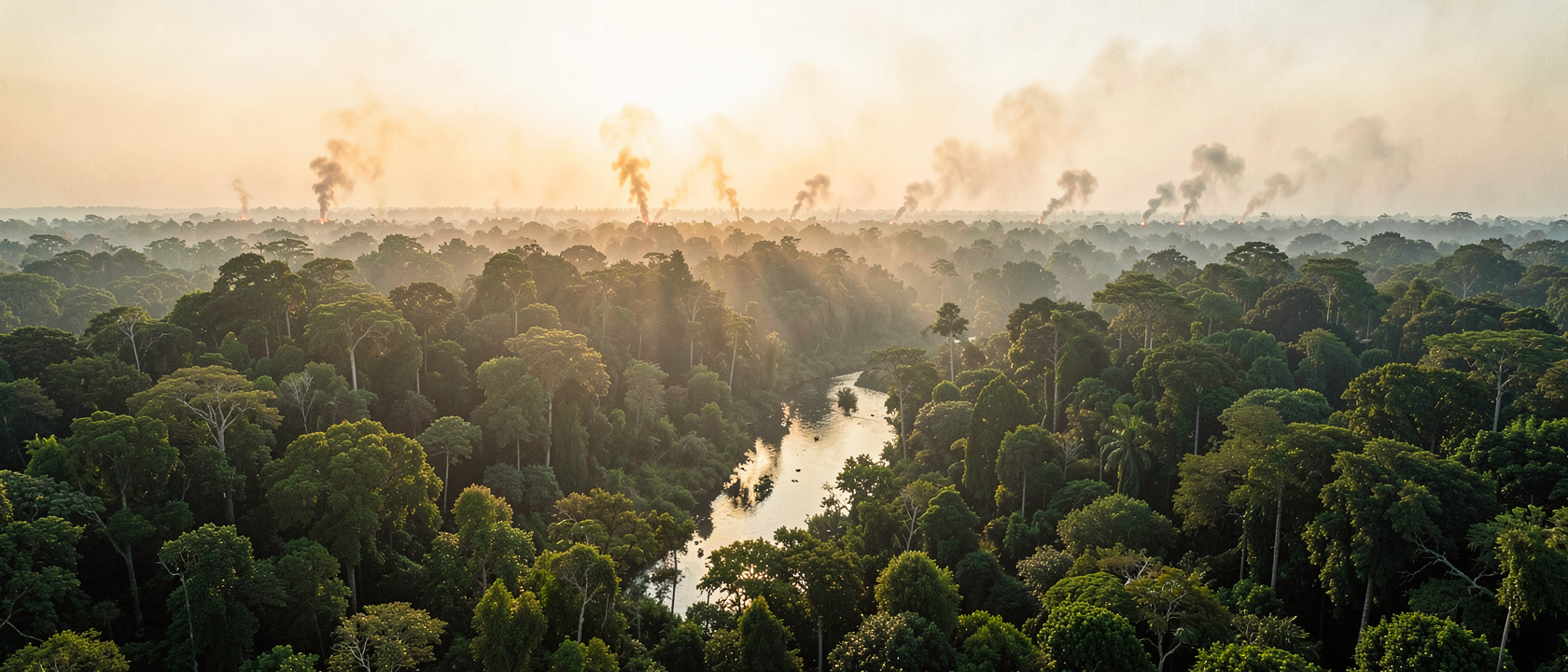
The Lungs of the Planet, Running Out of Breath?
Since grade school, most of us have heard some version of the same line: the Amazon is the planet’s lung, pulling carbon dioxide out of the air and pumping fresh oxygen back into it. A new look at fifteen years of atmospheric data over the Amazon basin complicates that picture. Even in the forest’s calmest, least disturbed years, measurements point to something unexpected: the Amazon may already be releasing slightly more carbon than it absorbs. Nobody is saying the forest is dying or collapsing overnight. What the data hint at is quieter and stranger, an ecosystem assumed to be an automatic carbon sponge that may have already tipped, just slightly, toward giving some of that carbon back.
Decades of Satellites, and Still a Blind Spot
It seems odd that something this basic stayed unmeasured so long, given how many satellites circle the planet. The issue is the Amazon’s own weather. The forest evaporates enormous volumes of water, which condenses into thick, near-constant cloud cover above the canopy, and optical satellites need a clear view to read vegetation from orbit. Ground stations exist too, but the region is so vast and remote they sit scattered thin across millions of square miles. For years, that left scientists with sharp pictures of the forest’s shape from above, but almost nothing on the actual gas exchange between canopy and sky.
Flying Straight Into the Answer
Luciana V. Gatti, of Brazil’s National Institute for Space Research, led a team that got around the cloud cover by flying above it. Aircraft traced repeated vertical spirals through the atmosphere at four sites covering roughly 95% of the Amazon region studied, climbing and descending to collect air samples at different altitudes. Over fifteen years that added up to 1,017 descents, each tested for carbon dioxide and carbon monoxide. Co-author Jennifer Johnson, an ecologist at the University of Kansas, described the question behind the project plainly: whether global climate or regional human activity, such as deforestation and fire clearing, was the stronger force behind the Amazon’s carbon balance. Comparing CO2 levels at different heights above the same stretch of forest over time let the team work out whether that patch had been a net source or sink, something no satellite photo could reveal.
Even the Wettest Years Leaned Toward Emission
The team sorted the fifteen years into three groups: wet years with little human disturbance, mild-climate years with heavy deforestation, and years where deforestation collided with drought, fire, or El Niño. The surprise sat in the first group: even during the wettest, least disturbed years, the Amazon came out as a small net source of carbon rather than the reliable sink an untouched rainforest is assumed to be. Averaged across all fifteen years, the forest released about 0.32 ± 0.08 petagrams of carbon a year (a petagram equals a billion metric tons), with yearly totals ranging from -0.12 to 0.75 petagrams. This doesn’t mean the Amazon has stopped storing carbon; it still holds an estimated 123 ± 23 petagrams in its trees, soil, and roots. But the net annual flow leaned toward emitting even in the forest’s best years.
Deforestation and Drought Compound the Damage
Deforestation adds another layer, and the numbers worsen fast. Cutting down trees removes carbon-storing biomass immediately and erases whatever future absorption those trees would have provided, so years with heavy clearing but ordinary weather already pushed emissions higher. Isolating human-caused activity, the researchers put emissions at about 0.49 ± 0.07 petagrams of carbon a year, with deforestation-heavy and fire-heavy years doing similar damage. Climate stress works through a separate channel: drought and heat need no chainsaw, since dried soil and stressed trees give up stored carbon on their own. The worst outcomes came when both forces struck together, and the researchers singled out 2024 as the most severe year on record. Even then nature offered some buffer, as La Niña conditions in milder deforestation years helped the forest absorb enough carbon in the rainy season to offset about 75% of what the dry season released.
Where the Threshold Might Lie
Johnson’s reading of the pattern was direct: human-driven land use, not global climate alone, is the dominant force steering the Amazon’s carbon balance, which makes the fix comparatively simple on paper, bring deforestation down to zero. Behind that sits a longer-running worry among researchers, the idea of a tipping point, where gradual drying and tree loss reinforce each other until the forest shifts toward a drier ecosystem storing far less carbon. This dataset does not prove that line has been crossed, nor does it say exactly when it might be. Separate modeling work, distinct from this aircraft study, has estimated a basin-wide shift could follow if deforestation reaches 22% to 28% combined with 1.5 to 1.9°C of global warming, a combination some projections place as early as the 2040s. About 17% to 18% of the Amazon is already deforested, and the 1.5°C mark itself is projected to arrive by 2030, the same window those models flag as the edge of that threshold.