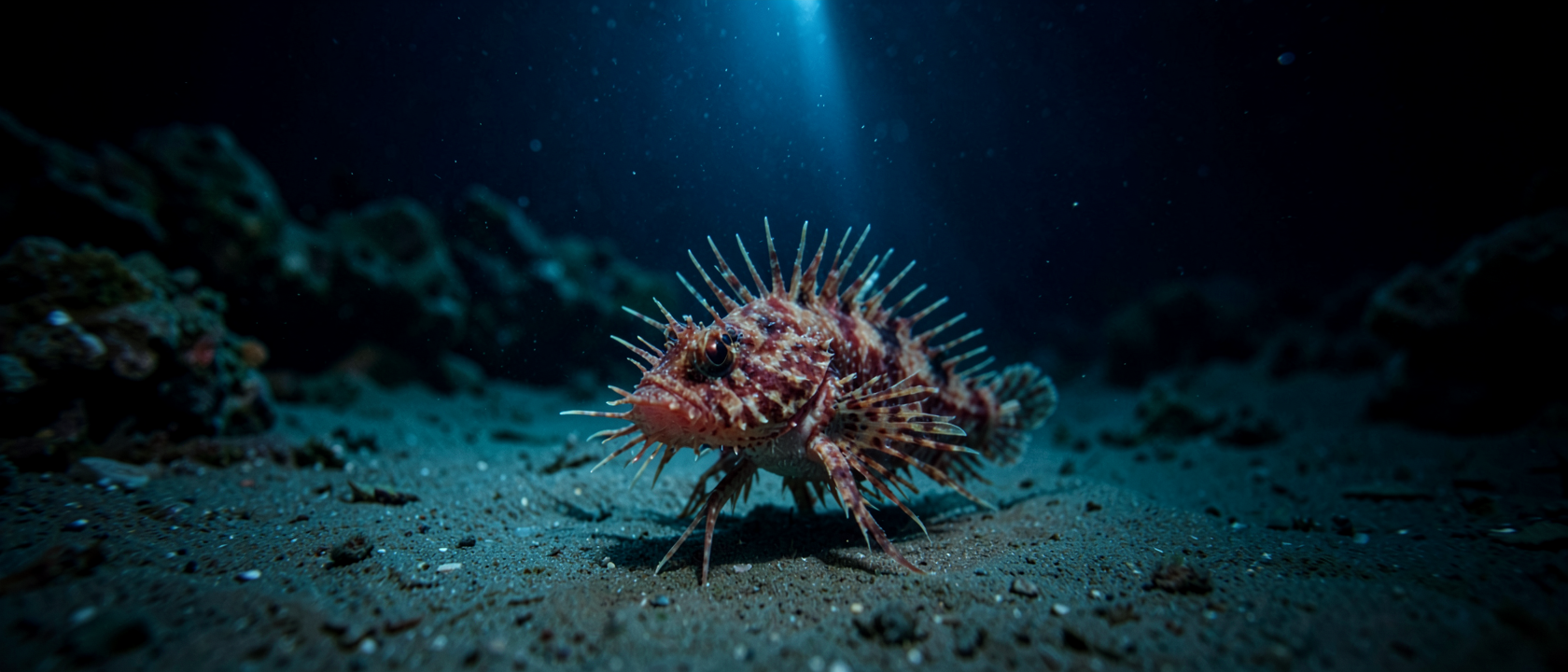
This Fish Doesn’t Swim. It Walks.
The footage is brief: a cone of torchlight off the coast of Bali, Indonesia, catching a fish that isn’t swimming, gliding, or flopping. It’s planting itself down and shoving forward, one awkward motion at a time, as if it’s feeling its way across the sand. The diver, Emeric Benhalassa, a French cook who dives in his free time, filmed it on a night dive. National Geographic shared the clip on June 2, 2017. Benhalassa later said the fish seemed to come toward him, probably drawn by his camera light, and that the scene struck him as odd enough to pass along.
It takes a beat to register why the motion looks wrong. Then it does: fish aren’t supposed to move like that.
Fish Aren’t Built for This
A typical fish is built for water, not ground. Fins push against fluid for thrust, a streamlined shape cuts drag, and a swim bladder, the gas-filled organ that controls buoyancy, keeps a fish hovering instead of resting on the bottom. None of that helps with pressing against sand and shoving forward. Walking needs points of contact that can bear weight and push off something solid, the kind of job joints and muscle usually do. Fish don’t typically have that. So the real question isn’t whether this fish is walking. It clearly is. It’s what’s standing in for legs.
Not Legs, Just Fins Doing the Job
The animal is identified as a stingfish, a bottom-dweller in the genus Minous. It has no legs, and doesn’t need any. According to Hiroyuki Motomura, a marine biologist at Japan’s Kagoshima University Museum, stingfish have pectoral fins, the pair just behind the gills, whose lower rays have split, over evolutionary time, into separate, finger-like strands called pectoral filaments. Instead of staying fused into one fan for swimming, those strands act like stiff little fingers the fish can plant and push against.
That’s different from the bony dorsal spines often linked to stingfish, which run along the back and carry venom glands at their base. Jeff Williams, an ichthyologist at the Smithsonian National Museum of Natural History, notes that when a spine pierces skin, venom goes straight into the wound. Those spines are for defense. The walking comes from the filaments underneath.
A Possible Reason: Hunting Low and Slow
Motomura notes that stingfish use these filaments to probe mud for worms and crustaceans, the way a hand might search a bag without looking inside. That suggests the walk isn’t separate from hunting, it may be part of it: each step doubling as a sensory sweep through the sand. It also fits a pattern seen in bottom-dwelling predators generally, staying low and moving minimally to avoid stirring water that nearby prey might detect. It’s a reasonable read of the footage, though this particular clip was never the subject of a dedicated study, just one good night dive.
A Striking Clip, Not a Finished Story
Scientists who reviewed the Bali footage couldn’t agree on a species. Jeff Williams leaned toward a striped stingfish, Minous trachycephalus. W. Leo Smith, an ichthyologist at the University of Kansas’ Biodiversity Institute, pointed to tail coloration and guessed painted stinger instead. Stuart Poss of the California Academy of Sciences wouldn’t rule out either, and raised a third option, the whitetail goblinfish, Minous quincarinatus. No one landed on a final answer.
That tracks with how rarely these fish are seen: stingfish spend most of the day buried in mud, and most known specimens come from fishermen’s nets, not dive footage. The clip is real, the fin mechanism is real, and the hunting idea is a sound read. The species isn’t settled, and that gap is worth noticing. A fact that travels fast online doesn’t always bring its sourcing with it, and clocking where confirmed fact ends and educated guess begins is a habit most people never bother to build.