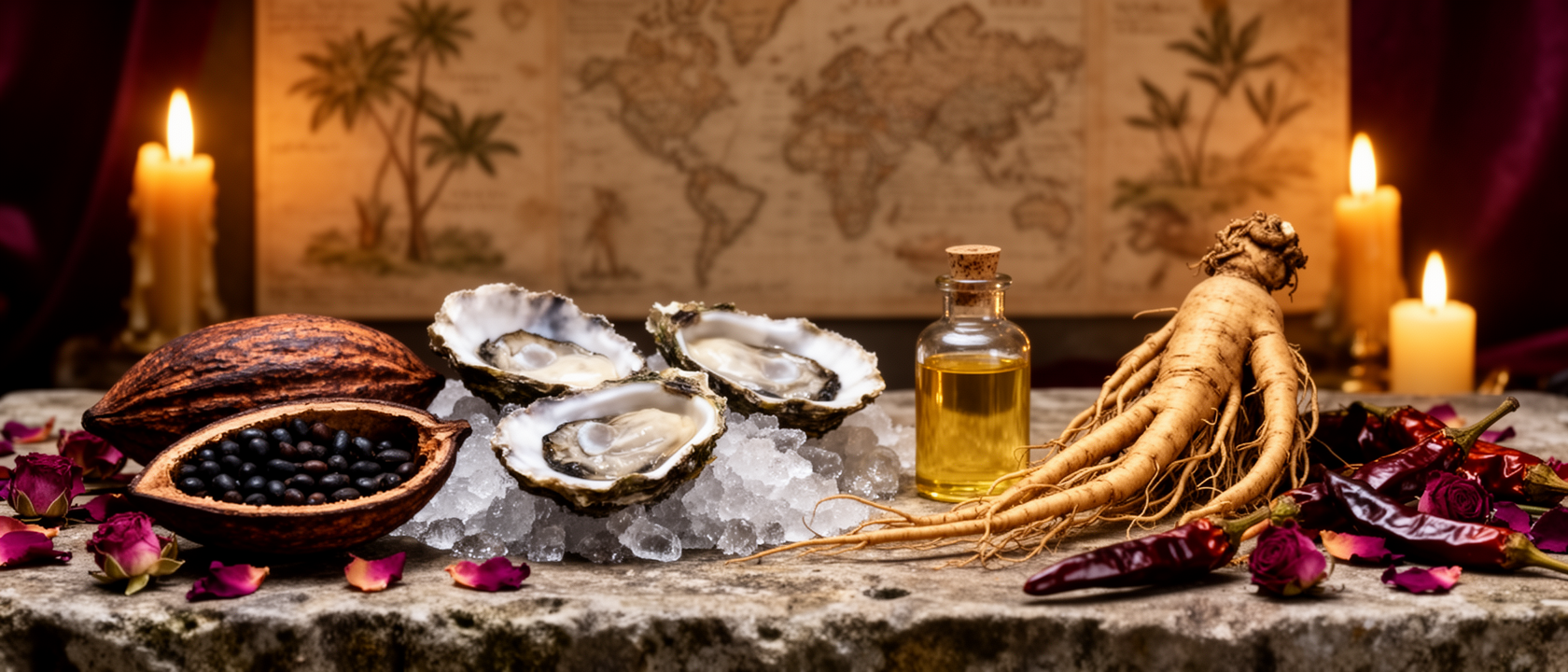
A Very Unusual Pantry
Somewhere out at sea, a sperm whale produces a lump of waxy, foul-smelling material in its gut. Expelled from the digestive end of the animal and bobbing on the ocean for years, it slowly transforms under sunlight and oxidation into a grey, mellow-scented substance. A beachcomber finds it. It sells for up to $35 a gram, roughly the price of platinum. Early Arab civilizations named it “anbar,” burned it as incense, and for centuries people across the Middle East believed it aroused desire.
This is ambergris, one of the tamer entries in the history of aphrodisiacs. The same tradition also made room for fried bull testicles and tiger penises consumed in parts of Asia. And then there is Spanish fly: powder ground from the blister beetle Lytta vesicatoria, with a centuries-old reputation as a stimulant and a far less flattering biological reality.
The Logic Behind the Belief
Anthropologists describe one organizing principle as sympathetic magic: consuming part of a powerful animal transfers its qualities to the eater. A tiger is virile, so its penis carries virility. The reasoning is internally consistent; it just has no biological mechanism to back it up.
Rhino horn illustrates how myths compound. Western media often report that it has long been used as an aphrodisiac in traditional Asian medicine, but researchers examining historical Chinese medical texts find no such use recorded there, the horn was used for fever treatment. Chemically it is pure keratin, the same protein as human fingernails, with no known pathway to libido. The aphrodisiac story appears to be a Western misattribution. Ancient Persians in the 5th century BC believed cups carved from rhino horn could detect poisoned liquids, an idea with a faint chemical basis, since many classical poisons are strongly alkaline and can react with keratin.
What the Chemistry Actually Does
Oysters have served as aphrodisiacs since at least Roman times. The most plausible explanation involves zinc: oysters are rich in it, zinc is essential to sex hormone production, and severe deficiency can lower testosterone. A 2005 study by American and Italian researchers found that oysters contain two rare amino acids, D-aspartic acid and NMDA, which when injected into rats triggered hormonal increases in testosterone and progesterone. Scientists at Harvard Medical School have noted that rat injection studies fall far short of proof in humans.
Chocolate contains phenylethylamine (PEA), sometimes called the “love molecule,” which raises heart rate and triggers dopamine release, plus trace anandamide and tryptophan. The problem is quantity: PEA breaks down largely during digestion before reaching the brain, and anandamide concentrations in cocoa are too low for psychoactive effect. Psychiatrist Dr. Michael Liebowitz first connected chocolate’s PEA to romantic feelings in his 1983 book “The Chemistry of Love,” and the idea has circulated ever since without supporting evidence.
Ginseng is a more interesting case. Its active compounds, ginsenosides, promote nitric oxide release in blood vessel tissue. Nitric oxide relaxes smooth muscle directly involved in erectile function, the same general pathway used by several modern prescription drugs. A 2000 study by Nocerino and colleagues in Fitoterapia linked ginsenosides to improved sexual activity in animal models, and subsequent research has connected ginseng to improvements in erectile function in men. The evidence is promising but incomplete.
Where the Story Turns Dangerous
Spanish fly is the clearest example of misread biology producing a dangerous myth. Cantharidin, the active compound, does produce a physiological effect, just not arousal. The body excretes it through the kidneys, causing severe irritation and burning in the urogenital tract, producing swelling historically mistaken for sexual response. Each beetle contains roughly 0.2 to 0.7 milligrams of cantharidin, first isolated by French chemist Pierre Robiquet in 1810. In sufficient doses it causes kidney damage, convulsions, and death. It is a poison, not a stimulant.
A pattern runs through most of these cases: when a substance produces a noticeable effect, the explanation gets simplified into a cleaner story than the data supports. Ginseng, working through nitric oxide in blood vessels, may be the closest thing to a scientifically plausible entry on this list. The mechanism isn’t poetic. But unlike cantharidin, it won’t kill you.