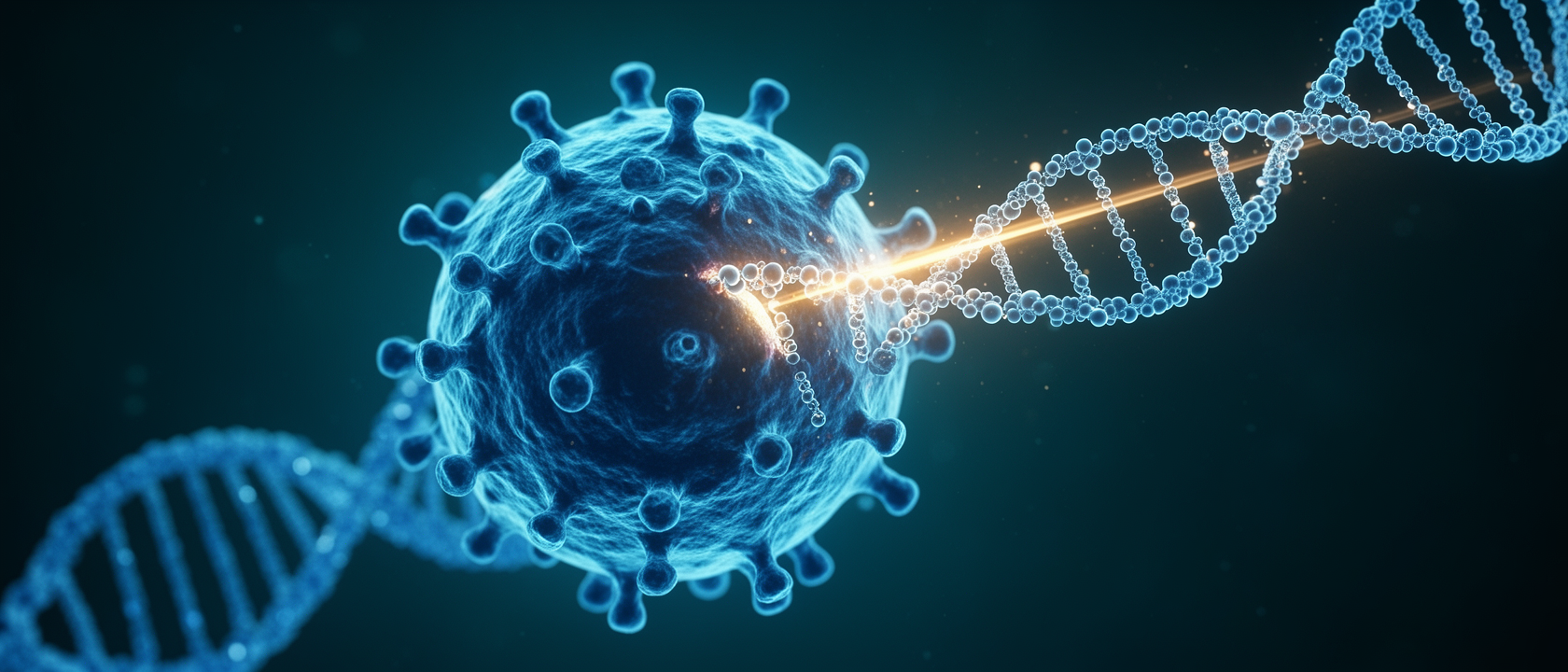
Cutting a Virus Out of Human DNA
Nearly every treatment for a viral infection works by interfering with the virus: blocking cell entry, stopping replication, neutralizing it in the bloodstream. What researchers at the Lewis Katz School of Medicine at Temple University did was structurally different. They used a gene-editing tool to physically remove HIV from the DNA of infected human immune cells. The study was published on March 4, 2016, in Scientific Reports, and it points toward thinking about HIV that goes beyond suppression.
The Hiding Trick That Makes HIV So Persistent
Antiretroviral drugs can reduce HIV levels in a patient’s blood to the point where the virus is undetectable, but not when it has gone quiet. HIV-1 writes its genetic instructions directly into the DNA of the CD4+ T-cells it infects, then often sits dormant. In this proviral state it produces nothing, triggers no immune alarm, and gives antiretroviral drugs nothing to act on. If treatment stops, the virus reactivates from these hidden reservoirs. This is why HIV currently requires lifelong medication rather than a finite course of treatment.
How the Molecular Scissors Work
CRISPR/Cas9 has two essential components: a guide RNA programmed to recognize a specific DNA sequence, and Cas9, an enzyme that cuts DNA precisely where the guide RNA directs it. Kamel Khalili’s team programmed guide RNAs to target the Long Terminal Repeats (LTRs) at each end of the HIV-1 proviral genome. With both ends identified, Cas9 cut at both sites, excising the entire viral sequence. The cell’s own repair system then closes the break, leaving the chromosome intact and the viral instructions gone.
Khalili, Laura H. Carnell Professor and Chair of Neuroscience at Temple University, had led an earlier version of this effort. On July 21, 2014, his team published a result in the Proceedings of the National Academy of Sciences showing HIV-1 could be eliminated from cultured human cells. That 2014 study used standard lab-grown cell lines; the 2016 paper moved to more demanding material.
Moving to Patient Cells
For the 2016 study, the team worked with latently infected CD4+ T-cells obtained directly from HIV-1-positive patients and grown in culture, far more variable than generic lab lines. The CRISPR/Cas9 system was delivered via a lentivirus. In patient-derived cultures, the approach significantly reduced viral load. In cells where Cas9 and the guide RNAs remained continuously active, those cells also resisted reinfection when subsequently exposed to HIV-1.
A Promising Result with Real Limits
Whole-genome sequencing confirmed no off-target DNA damage and no loss of cell viability, findings that matter as much as efficacy, since accidental cuts elsewhere in the genome could cause serious harm.
Every experiment was conducted in vitro or ex vivo. No living human patient was treated. Getting CRISPR machinery to every latently infected cell inside a living body is a problem of an entirely different scale. Later research, published in 2021 in the Journal of Virology, added further nuance: excised HIV-1 DNA can persist inside cells as circular molecules for weeks and may retain residual transcriptional activity, so the excised material does not simply vanish.
The Temple University work nonetheless formed the scientific basis for EBT-101, a CRISPR-based HIV therapy developed by Excision BioTherapeutics. That therapy received FDA Investigational New Drug approval and entered Phase 1/2 clinical trials, registered under identifiers NCT05144386 and NCT05143307.