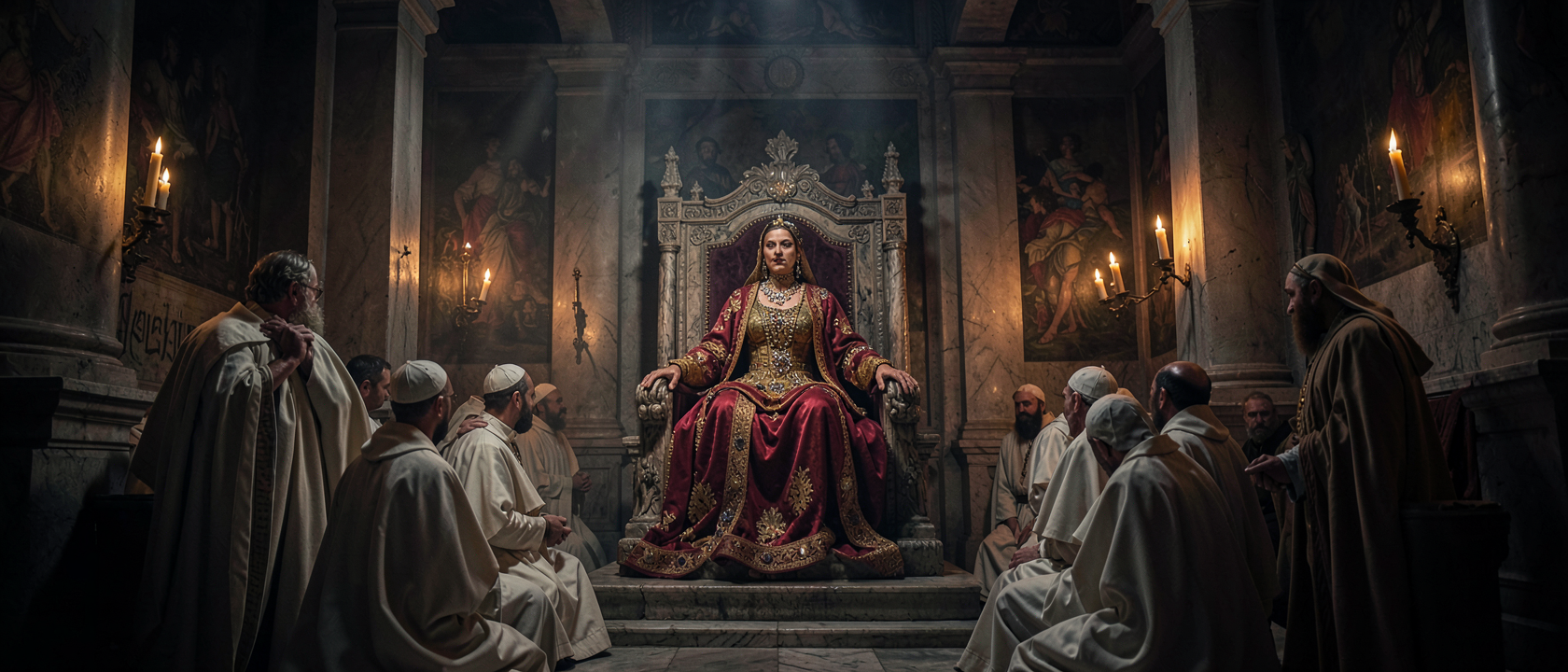
A Pope’s Illegitimate Son Became Pope. It’s Only Happened Once.
In the early 900s, a Roman noblewoman reportedly began an affair with a sitting pope. Their son grew up inside the Church and was eventually elected pope himself, taking the name John XI.
As far as anyone can tell, it’s the only time in papal history that a pope’s own child went on to hold the same office. Historians studying this stretch of Church history, roughly 904 to 964 AD, gave it a name that still unsettles people who hear it: Saeculum Obscurum, “the dark age,” or more bluntly, Pornocracy, rule by harlots.
The label is dramatic. The more interesting question is how something like that could ever happen inside an institution built on doctrine and councils.
The Church Was Supposed to Run on Councils and Scripture. Instead, It Ran on a Household.
On paper, the papacy worked through doctrine, clerical process, and the authority of church councils. A pope was supposed to rise through that machinery, not through who he happened to know in Rome.
So how does one private family end up, in practice, choosing and removing popes across two generations? That’s the real puzzle of the tenth century. Rome’s most powerful household in this period wasn’t a cardinal’s court. It was a count’s house, run in large part by his wife and his daughter.
It Started With One Woman Named Theodora in 904 AD
Theodora was married to Theophylact, Count of Tusculum and a Roman consul, which already placed her inside the city’s ruling elite. She later received the title senatrix, an honor with no real precedent, said to have been granted to her by Pope John X himself.
In 904, Sergius III was installed as pope, and Theodora became, by most accounts, the real power standing behind him. Her teenage daughter, Marozia, said to be just 15 years old at the time, became Sergius III’s mistress; he was 45. The two had a son, and that son later became Pope John XI, the literal child of a pope who went on to hold his father’s old office.
This wasn’t a private affair that stayed private. It became a direct line from a noblewoman’s household straight into the papal throne.
Three Generations, Same Playbook
Marozia didn’t stop at raising a future pope. She went on to wield power directly: when Pope John X fell out of favor with her, she reportedly had him deposed, imprisoned, and ultimately killed.
She later had a son, Alberic II, with Alberic I, Duke of Spoleto, and Alberic II effectively ruled Rome from 932 to 954. His own son, Octavian, became Pope John XII, making him Marozia’s grandson.
By the time John XII’s reign ended with his death in 964, the family’s grip on the papacy had lasted sixty years, longer than most modern political eras run from start to finish. John XII’s own conduct was, by several accounts, so unrestrained that contemporaries claimed his residence, the Lateran Palace, had effectively become a brothel. This wasn’t even the end of the bloodline’s reach: a son, two grandsons, two great-grandsons, and one great-great-grandson of Marozia would all eventually sit in the same chair.
Here’s the Catch: Nobody Can Fully Prove It
The word “pornocracy” sounds ancient, but it isn’t. It was coined by 19th-century Protestant German theologians, centuries after the events it supposedly describes.
Much of the lurid detail, including that brothel claim about the Lateran Palace, traces back to later writers like Cardinal Baronius, who was working during the Counter-Reformation, a period when Protestant authors had plenty of reason to highlight Catholic corruption. Even the end date is disputed: some sources place Pope John XII’s death in 963, others in 964 (the “sixty years” figure only lines up cleanly if you count from 904 to 964).
What historians do agree on is less sensational but still real: this was a chaotic, badly documented stretch of papal history in which one Roman noble family, the Theophylacts, held unusual and outsized control over who sat on the papal throne. The scandal may be exaggerated. The instability wasn’t.