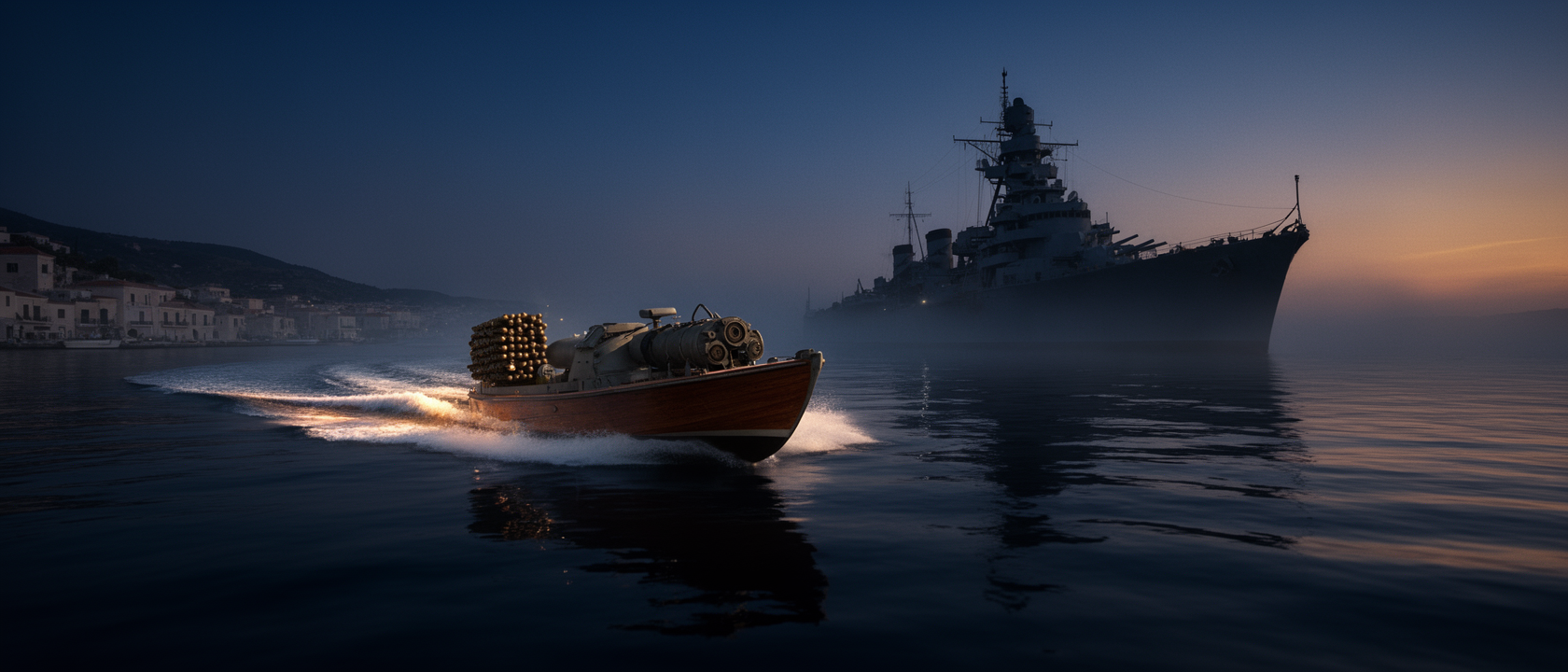
The Last-Second Exit
Picture this: a 5.62-meter wooden boat screaming across open water at 33 knots, aimed directly at the hull of a warship. The pilot locks the rudder, holds the course for one more second, then uses a primitive ejection mechanism to throw himself into the sea. The boat carries on without him.
This was not recklessness. It was a considered engineering solution to one of the harder problems in naval warfare.
The One Meter That Mattered
To punch through a steel warship’s hull, an explosion has to happen right against the metal, ideally below the waterline, where the blast has nowhere to go but through the plating. A bomb dropped at a distance wastes most of its energy on open water. But a high-speed boat cannot simply stop on cue at the last possible instant, the faster you go, the better your chances of reaching the target, and the less control you have over where you stop.
That gap between a successful approach and a wasted detonation is the problem every explosive-motorboat program in the Second World War was built around. Italy, Germany, and Japan each came up with a different answer. Their solutions say as much about military culture as about engineering.
Italy: The Jump
Italian engineers had been working this problem since 1918, when two naval officers pushed a converted torpedo called the Mignatta into the Austrian harbor at Pula, sinking the battleship SMS Viribus Unitis with two 175-kilogram limpet mines.
By the Second World War, that tradition had evolved into the MTM (Motoscafo da Turismo Modificato), nicknamed barchino. Powered by a 95-horsepower Alfa Romeo engine and carrying 300 to 330 kilograms of explosive in its bow, the barchino was a disposable missile with a pilot attached until the final moment. The pilot steered at full speed, locked the rudder, and bailed. The bow hit the hull and separated, releasing the main charge, which sank to about one meter of depth where a hydrostatic fuse triggered the detonation directly under the keel, where armor was thinnest.
The concept worked. On the night of March 25 to 26, 1941, six MTMs entered Souda Bay, Crete. Two struck HMS York badly enough that she had to be beached; a Norwegian tanker, the Pericles, was also hit and later sank under tow. All six Italian pilots were captured, but the boats had done exactly what they were designed to do.
Germany: The Remote
Germany’s instinct was to remove the pilot before impact entirely. The idea had roots in the First World War Fernlenkboot, a 17-meter drone carrying 700 kilograms of explosive guided by a 20-kilometer wire spool, one of which hit HMS Erebus on October 28, 1917, causing serious damage.
By 1944, the concept had been rebuilt around radio control as the Linsen (“lentils”). Each three-boat Rotte consisted of two explosive craft and one command boat. Attack pilots guided their boats toward the target, then jumped overboard; the command-boat operator took over by radio and steered the Linsen into the hull from a safe distance. More than 1,200 were built, though results were uneven, coordination between three boats in darkness and under fire proved difficult, and crew losses were heavy.
Japan: The Stay
Japan’s Shinyo (“Sea Quake”) cut through the problem of the last meter by eliminating the escape requirement altogether. These wooden boats carried up to 300 kilograms of explosive in the bow and were steered directly into their targets. There was no ejection mechanism, no radio handoff. The pilot remained in the boat.
The army’s parallel craft, the Maru-Ni, nominally allowed the pilot to drop two 120-kilogram depth charges and retreat, but the blast radius made survival, as the program’s own documentation acknowledged, practically impossible.
Italy built around 40 MTMs in total. Germany produced roughly 1,200 Linsen. Japan built 6,197 Shinyo for the Imperial Japanese Navy alone, mass production applied to a suicide campaign. Thousands were staged along the Japanese home islands, the Philippines, and Okinawa, held in readiness for an Allied invasion. The average age of the first training cohort of over 400 young men, originally training as aircraft pilots before the planes ran out, was 17. The invasion never came.