Your Jaw Probably Can’t Do What the Movies Say It Can
You’ve seen it in films: a character, caught in some desperate bind, grits their teeth and bites through their own finger to slip free of a restraint. Sheer willpower gets the job done. The scene cuts away, the character escapes, and nobody in the theater questions whether the physics held up.
They don’t.
The Hardware Looks Capable. The Engine Is the Problem.
Tooth enamel is the hardest substance the human body produces, harder than bone. If you pressed a molar against a finger bone hard enough, the bone would give before the tooth did. So the tool is theoretically up to the job.
But having a capable tool and being able to use it at full force are different things. The masseter and temporalis muscles determine how much force actually reaches the point where tooth meets bone, and when researchers measured what those muscles deliver, the numbers fell well short of what the task demands.
The Gap in the Numbers
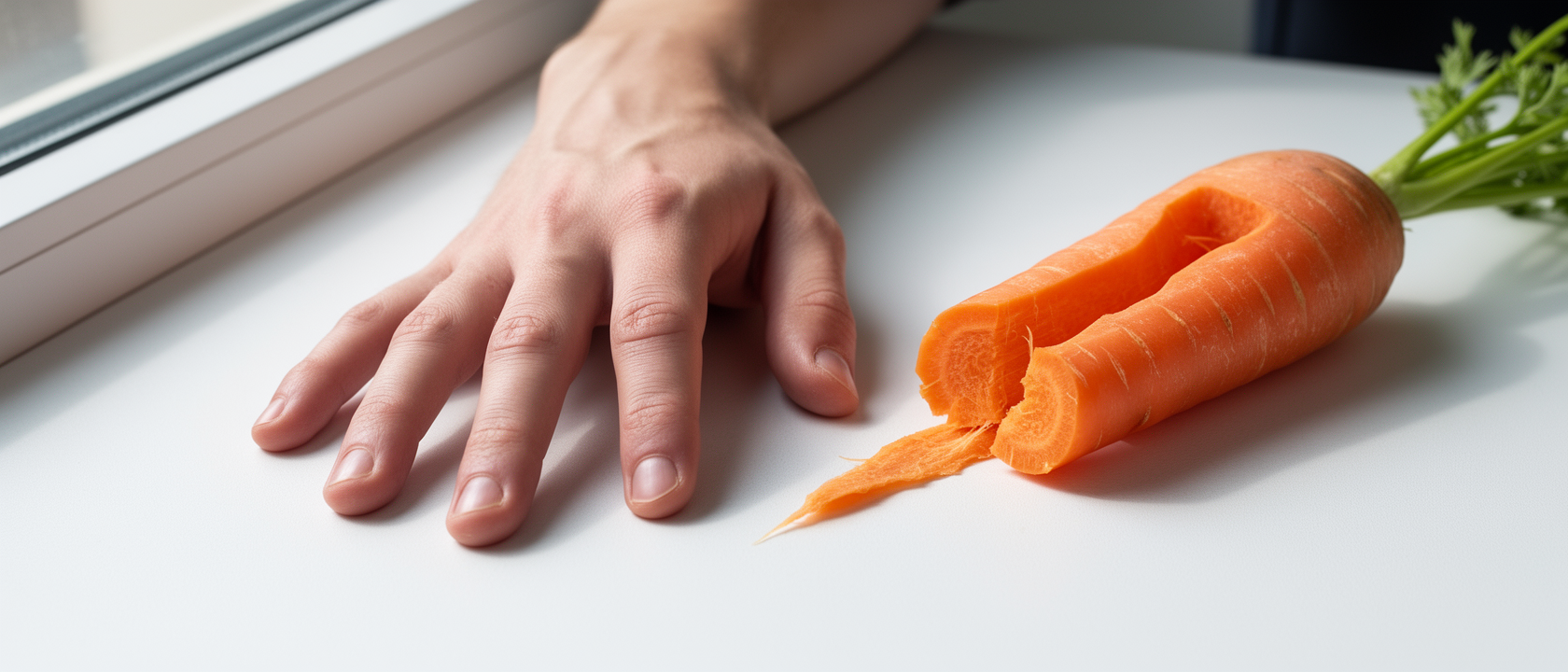
A 2012 study published in the Journal of Biomedical Engineering put the average force required to fracture a human finger bone at around 1,485 Newtons. Snapping a full-sized carrot takes roughly 200 Newtons. Finger bones are not remotely like carrots.
Human jaws fall well short of that threshold. Dr. G. E. Black’s research found the average maximum molar bite force at around 760 Newtons. Studies published in the European Journal of Orthodontics in 2010 found peak values of 777 Newtons in males aged 15 to 18 and 481 Newtons in females the same age. A 2014 study by Patricia Takaki and colleagues found adult men averaging around 284 Newtons and adult women around 304 Newtons. Even the strongest numbers in the literature sit at roughly half the force needed to fracture bone. For front teeth the gap widens further: Dr. Black’s measurements put maximum incisor force at about 370 Newtons for men and 253 Newtons for women.
What Happens When Pain Gets Out of the Way
Dr. Stephen Wroe at the University of New South Wales used three-dimensional computer modeling of human skull anatomy to estimate what jaw muscles could produce if nothing held them back: roughly 1,100 to 1,300 Newtons. Still below the 1,485 Newton fracture threshold, and that figure is a computer estimate, not a measurement of anyone actually biting.
In practice, the brain governs bite force using pain as a brake. As force builds, discomfort rises and the nervous system dials down muscle contraction before maximum output is reached. In both Dr. Black’s research and the Takaki study, participants stopped pressing before hitting their physical ceiling because their teeth started to hurt. Adrenaline, alcohol, or certain drugs can weaken that brake, but even then, Wroe’s theoretical maximum still falls short of the average fracture threshold.
When Fingers Do Get Bitten Off, the Bone Doesn’t Snap
Documented cases of bite-related finger amputations exist, but they are rare, and the mechanism consistently differs from what films depict. A 1999 case report in the British Dental Journal described a man whose fingertip was severed during a fight. The researchers, who between them had over 40 years of forensic experience, called it the most damaging bite injury they had encountered, yet it did not involve cleanly cracking through bone. It involved tearing through softer connective tissue and joint structures, with the victim’s pulling away contributing substantially to the separation. Another documented case showed the same pattern: biting and pulling forces combined, acting at a joint rather than mid-shaft.
Joint tissue and ligaments are far more vulnerable to tearing than compact bone is to snapping. The real-world scenario, on the rare occasions it has happened, is an avulsion (a tearing-away of tissue) at a weak point in the structure, not the bone-cracking chomp the movies sell you. The finger bone’s 1,485 Newton threshold remains safely out of reach for essentially everyone.