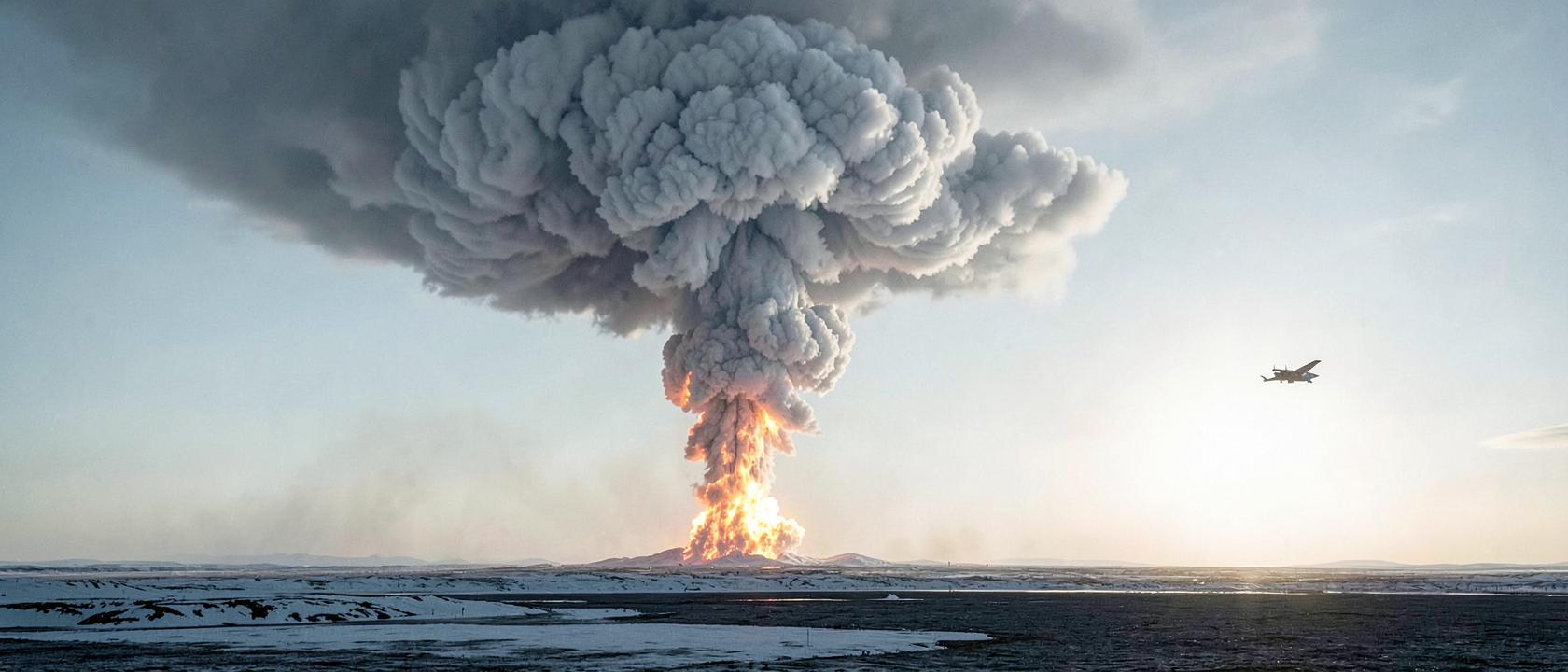
The Flash Over Novaya Zemlya, October 30, 1961
At 11:32 a.m. Moscow time on October 30, 1961, a Soviet bomber released a hydrogen bomb over the Mityushikha Bay testing range on Novaya Zemlya, a Russian island above the Arctic Circle. The bomb detonated automatically about 13,000 feet (4,000 m) above the ground near Sukhoy Nos cape. The flash was visible as far as 621 miles (1,000 km) away, and the mushroom cloud climbed roughly 37 miles (60 km) into the sky.
The shock registered on seismographs worldwide as an earthquake above magnitude 5.0, even though the bomb never touched the ground and exploded thousands of feet in the air instead. It was the most powerful explosion a human being had ever triggered on purpose.
Fifteen Weeks to Build the World’s Biggest Bomb
The order came from the top. In July 1961, Soviet premier Nikita Khrushchev told his engineers to build a hydrogen bomb with a design yield of 100 megatons, the largest weapon ever attempted. The timing was political: the Berlin Wall had gone up two months earlier, and the Soviet Union had just ended a three-year pause on atmospheric testing. That left the team roughly fifteen weeks to design, build, and test the weapon.
Modern engineering teams often need longer than that just to test a single product update. A team working this close to finishing something unprecedented would normally push for more power. Instead, in the final stretch, these engineers chose to pull back.
Trading Uranium for Lead
Ivan, as Soviet engineers called it (the nickname Tsar Bomba, “King of Bombs,” only caught on in the 1990s), was a three-stage hydrogen bomb; most thermonuclear weapons use just two. Working mostly from estimates rather than full modeling, the team couldn’t be certain the weapon would perform safely, or that the delivering crew would survive. So in the final stage, they made a deliberate trade.
Engineers replaced the uranium sleeve around the bomb’s third stage with one made of lead. Lead doesn’t undergo the same fission reactions as uranium, so the swap cut the yield from a planned 100 megatons to about 50 megatons while sharply reducing fallout. Only about 3 percent of the bomb’s energy, roughly 1.5 megatons, came from fission, the messiest part of the reaction; the rest came from cleaner fusion.
A second safeguard was a parachute weighing about 1,760 pounds (800 kg), meant to slow the bomb’s fall and give the Tu-95 bomber time to retreat. It worked, barely: the bomber was already about 28 miles (45 km) away when the bomb went off, and the shockwave still knocked it down roughly 3,300 feet (1 km) before it landed safely. The margin was that thin: without these fixes, the crew delivering the bomb might not have made it out alive.
A Bomber Modified to Carry a 29.8-Ton Bomb
Even at half strength, Ivan looked absurd for something meant to fly on a single aircraft. It weighed 29.8 short tons (27,000 kg) and measured about 26 feet (8 m) long, so large that the Tu-95 bomber carrying it, flown by Major Andrei Durnovtsev, had its fuel tanks and bomb bay doors removed just to fit it. Both the bomber and its escort were painted reflective white to limit thermal damage. It was released from 34,500 feet (10,500 m) and detonated at about 13,000 feet.
At 50 megatons, Ivan released about 3,800 times the energy of the Hiroshima bomb, and more than three times the yield of Castle Bravo, the largest weapon the United States had ever tested, at 15 megatons. Within about 15.5 miles (25 km) of the blast, nothing structural was left standing; up to 62 miles (100 km) away, the flash alone could cause third-degree burns, all from a bomb already cut to half its designed power.
| *Tsar Bomba | Castle Bravo | |
|---|---|---|
| Yield | 50 megatons | 15 megatons |
| Weight | 27000 kg | none |
| Length | 8 m | none |
Still the Largest Blast on Record
The test didn’t cool down the Cold War. The United States answered with its own extensive series of nuclear tests in the years that followed. Military strategy was already shifting toward smaller, more accurate warheads aimed precisely rather than simply scaled up, which made a device the size of Ivan, 29.8 short tons and 26 feet long, a dead end rather than a template. It had never been meant for actual combat: Ivan was never deployed and remained, by design, a one-time demonstration.
What the test really proved is a comparison worth keeping in your back pocket: at 50 megatons, Ivan still represented about a quarter of the estimated force of the 1883 Krakatoa eruption, one of the loudest events in recorded history. A single engineered device, built in fifteen weeks, came that close to a volcano that reshaped an island. No nation has matched or exceeded it since.