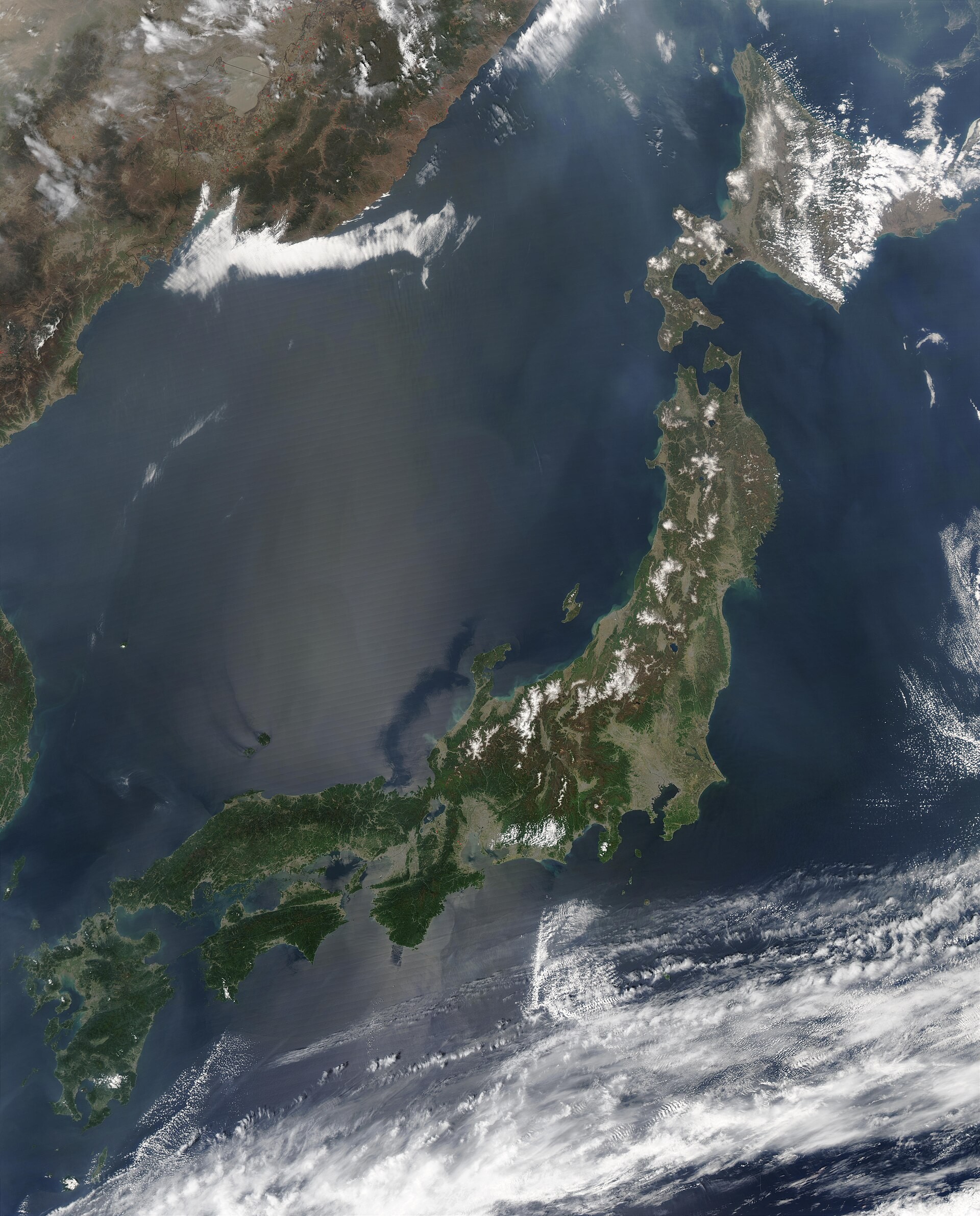
Japan is an island country in East Asia, made up of four main islands, Hokkaido, Honshu, Shikoku and Kyushu, known as the “Home Islands,” with Honshu the largest and most populous, home to the capital, Tokyo. The country has a population of 123,802,000 across an area of 377,974 km², governed as a parliamentary constitutional monarchy with the Diet (Kokkai) as its bicameral legislature and Naruhito as head of state. Its official language is Japanese, its currency the yen, and its founding date is given as 3 May 1947. Japan sits between the North Pacific Ocean and the Sea of Japan, east of the Korean Peninsula, with a coastline stretching 29,751 km and no land boundaries at all, since the country consists entirely of islands.
Key facts
- Capital: Tokyo
- Continent: Asia
- Population: 123,802,000
- Area: 377,974 km²
- Official language: Japanese
- Currency: yen
- Head of state: Naruhito
- ISO code: JP
- Founded: 3 May 1947
Geography and terrain
Japan’s terrain is mostly rugged and mountainous, a feature that shapes settlement patterns across its islands. The country has negligible mineral resources and virtually no natural energy resources, which makes it the world’s largest importer of coal and other fuels. With 29,751 km of coastline and zero kilometers of land boundaries, Japan is entirely surrounded by sea.
History
In 1868, the fifteen-year-old emperor Mutsuhito took the reign name Meiji, meaning “enlightened rule,” after being restored to power, opening a period that reshaped the country’s institutions. Japan attacked US forces in 1941, an act that triggered America’s entry into World War II; Japan went on to occupy much of East and Southeast Asia before its eventual defeat.
Kyoto was spared from strategic bombing during the war, which is why its geiko and maiko districts of Gion and its historic machiya townhouses survive today. The hidden Christians of the Nagasaki region secretly preserved their banned faith for two and a half centuries before receiving their own UNESCO World Heritage inscription in 2018.
Population and society
The share of Japanese aged 65 and older rose to 29.4% in 2025 from 28.5% in 2020, reflecting one of the world’s most rapidly aging societies. Japan’s total fertility rate stood at just 1.14 in 2025, far below the replacement level needed to sustain the population. Foreign residents in Japan reached a record 3,840,039, or 3.1% of the population, in the 2025 census.
Heritage and culture
As of September 2026, Japan has 27 UNESCO World Heritage Sites, comprising 22 cultural properties and five natural properties. The Ancient Capitals of Asuka and Fujiwara, including 19 component sites of palaces, temples and burial mounds, were inscribed as a UNESCO World Cultural Heritage site in 2026. The Jomon Prehistoric Sites in Northern Japan, preserving about 10,000 years of hunter-gatherer settlement, were added to the World Heritage List in 2021.
Since 2024, the kōji-based craft of sake brewing has been inscribed on UNESCO’s Intangible Cultural Heritage list alongside washoku traditional cuisine and washi handmade paper. At Nara Park, sacred deer roam freely among the monuments, protected for centuries as divine messengers.
Foreign policy under Takaichi
Prime Minister Takaichi reaffirmed that Japan stands with Ukraine and will continue to impose sanctions against Russia alongside the international community.
Did you know
- In 1868, the fifteen-year-old emperor Mutsuhito took the reign name Meiji, meaning “enlightened rule,” after being restored to power. (ebsco.com)
- Kyoto was spared from strategic bombing during World War II, which is why its geiko and maiko districts of Gion and historic machiya townhouses survive today. (confinity.com)
- At Nara Park, sacred deer roam freely among the monuments, protected for centuries as divine messengers. (confinity.com)
- The hidden Christians of the Nagasaki region secretly preserved their banned faith for two and a half centuries before receiving their own UNESCO World Heritage inscription in 2018. (confinity.com)
- Japan’s total fertility rate stood at just 1.14 in 2025, far below the replacement level needed to sustain the population. (maseconomics.com)
Data sources
- Wikidata
- en.wikisource.org
- archive.govglance.org
- cia.gov
- fortune.com
- nippon.com
- nippon-essential-info.com
- confinity.com
- japan.kantei.go.jp
Where it appears
- Monkeys Who Lived Through an Outbreak Got Picky About Fake Poop November 8, 2026
Data updated: 2026-11-07