The Egyptian Walk Was Invented on a Ferry
In September 1986, The Bangles released a song that would spend four consecutive weeks at number one on the Billboard Hot 100, by Billboard’s own ranking, the number one song of all of 1987. You almost certainly know the chorus, and the move: arms bent at the elbows, one hand pointing up and one pointing down, head twisted sideways, body shuffling in a rigid Z-shape. Walk like an Egyptian.
Nobody in Ancient Egypt walked like that. There is not a single piece of archaeological evidence that this pose, or anything resembling it, was ever part of Egyptian daily life or ritual. The world’s most recognizable “ancient” movement was invented in the 20th century, and its most famous version was directly inspired by people losing their footing on a boat.
Where the Song Actually Came From
Songwriter Liam Sternberg composed the piece in 1983, watching passengers on an English Channel ferry struggle against rough water, their arms and legs jerking out at odd angles. The awkward, angular scramble reminded him of figures in Egyptian hieroglyphs. He wrote “Walk Like an Egyptian” in a notebook and built a song around the image.
The demo was completed by January 1984 with singer Marti Jones on vocals. Toni Basil turned it down. Lene Lovich recorded a version but stepped away from music before its release. Producer David Kahne eventually brought the song to The Bangles, the most famous musical celebration of ancient Egyptian culture, sparked not by archaeology, but by commuters stumbling on the English Channel.
A Pose That Isn’t in the Art
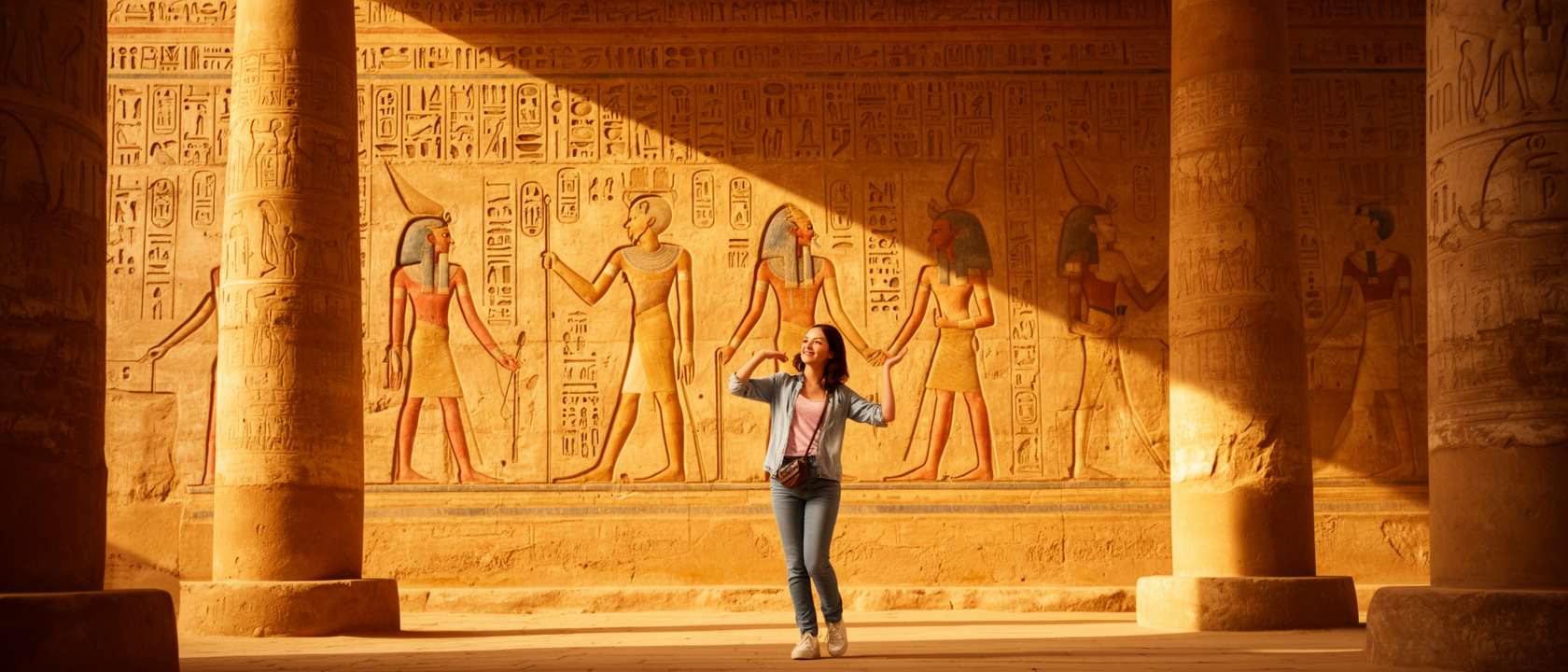
The Z-shaped posture looks like it should come from Egyptian wall paintings. It doesn’t. What Egyptian paintings actually show is what art historians call “composite view”: the torso faces forward while the head, legs, and arms appear in profile, each body part rendered from the angle that makes it most legible, not from a single fixed viewpoint. The goal was clarity, not realism, and Egyptian artists were deliberate about it.
Egyptian art was not made for aesthetic pleasure. Images on tomb and temple walls served religious or political functions: guiding the spirit of the deceased, praising the gods, recording the pharaoh’s deeds. Figures were arranged in horizontal bands called registers, with size indicating importance rather than physical distance, a visual language built for narrative, not the illusion of depth.
When Egypt Sculpted Realistically
Three-dimensional statues tell a different story. Egyptian sculptors worked far more naturalistically, since a statue was meant to serve as a vessel for the deceased’s spiritual essence. Male figures were typically carved in a striding pose with the left foot forward, tied to Egyptian mythology’s association of the left side with the heart.
Around 1346 BCE, Pharaoh Akhenaten shifted artistic conventions dramatically: figures rendered with elongated heads, fuller features, larger hips, and intimate domestic scenes. Importantly, though, the chest-forward composite-view convention persisted even in this new style, it was an evolution, not a clean break. The experiment didn’t last long. Akhenaten died around 1336 BCE and was declared a heretic. By the time Tutankhamun took the throne in approximately 1332 BCE, traditional conventions had been restored and much of the Amarna-style art defaced or destroyed.
The Tune That Built a Caricature
The Z-shaped caricature had a musical companion waiting: the “Arabian Riff”, also called “The Streets of Cairo,” or the snake charmer song. A version appeared as early as 1845, and in Jean-Baptiste Arban’s trumpet method book in 1864. Its origins are murky; some historians suspect it was adapted from an Algerian folk melody called “Kradoudja,” though that remains a hypothesis.
What fixed it in Western culture was the 1893 World’s Columbian Exposition in Chicago, where entertainment director Sol Bloom used it for an attraction called “A Street in Cairo,” complete with camel rides and belly dancers. Bloom later claimed he improvised the melody on the spot when scheduled musicians didn’t show, and never copyrighted it.
Over the following decades the two elements merged into a shorthand that felt ancient and authentic, despite having no real roots in the culture it claimed to represent. The caricature was already fully formed long before Sternberg ever boarded that ferry.