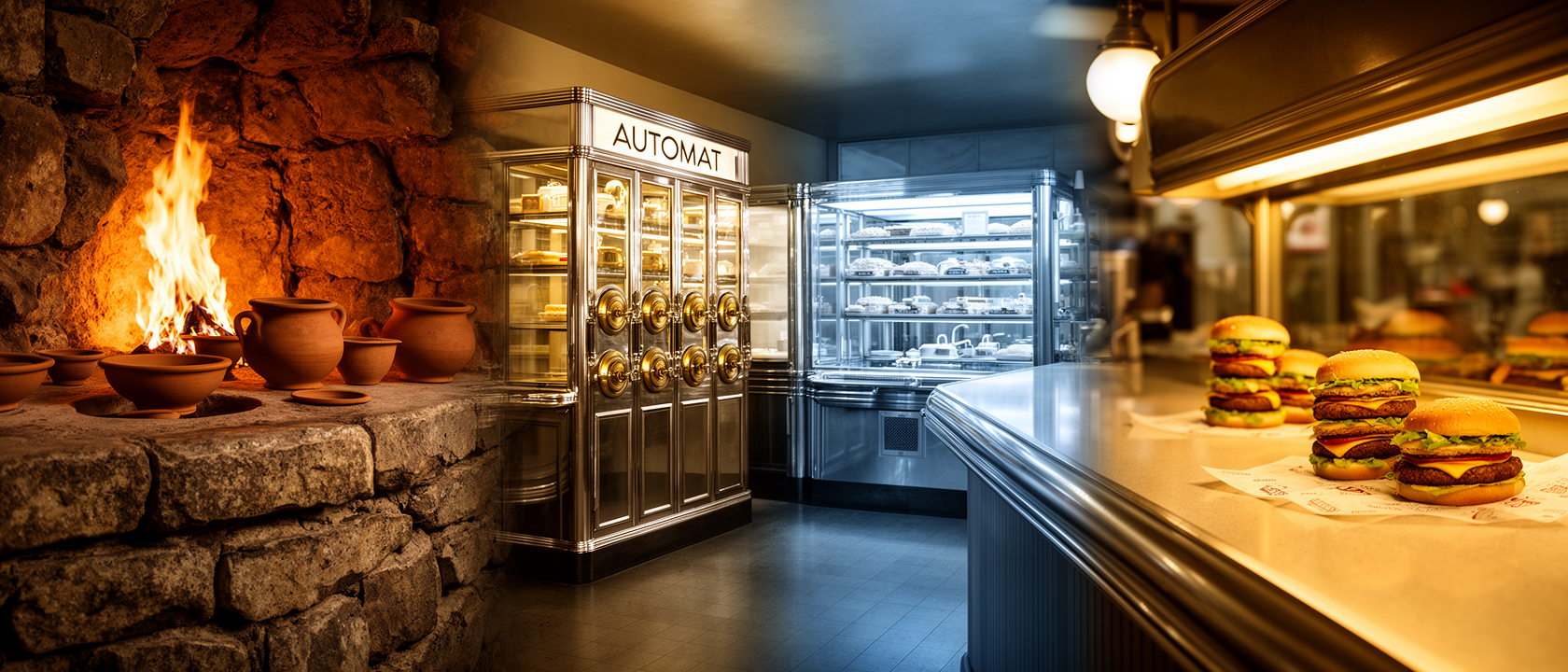
Most people, pressed to name the first fast food restaurant, would say McDonald’s. A smaller group might mention White Castle. Almost no one would think of a mud-brick building in the Kangavar valley of western Iran, built around 3200 BC.
Eating on the Go Is Older Than You Think
At an archaeological site called Godin Tepe, excavated by T. Cuyler Young Jr. and his team from the Royal Ontario Museum between 1965 and 1973, researchers found a structure containing lentils, animal bones from goat and sheep, and evidence of beer and wine. The building sat along a major road connecting Mesopotamian trading centers. Young proposed that its two unusual windows, facing a central courtyard, may have served as take-out counters, though his doctoral student Virginia Badler read the large quantity of clay sling bullets inside as evidence of a military fort instead. The “ancient take-out” interpretation remains an unconfirmed hypothesis.
More solid ground comes from ancient Rome. Roman cities were filled with stone counters called thermopolia, with large terracotta jars sunk into the surface and kept filled with hot food. Archaeologists have identified 89 of them in Pompeii alone. A fully preserved thermopolium excavated in Pompeii’s Regio V in December 2020 still contained remnants of duck, goat, pig, fish, and land snails. Most thermopolia had no seating. You took your food and kept walking.
Jump forward to 16th-century Mexico. Franciscan friar Bernardino de Sahagún, who arrived in New Spain in 1529, spent decades documenting Aztec civilization. His 12-volume Florentine Codex records market vendors selling tamales and tortillas in bulk, cooked quickly for people on the move. Fast? Yes. But something fundamental was missing from all these ancient examples.
Speed Is Not the Whole Story
Angelika Eppe, a professor at the University of Bielefeld in Germany, defines modern fast food not merely by speed but by total standardization: the same ingredients, taste, quantity, and preparation method, regardless of who is cooking or where. A Roman thermopolium got you food quickly. An Aztec market stall got you tamales on demand. But neither guaranteed the same experience twice. The dividing line between a street stall and a franchise is the system behind it, not the speed of the transaction.
The Machine That Changed Everything
The bridge between ancient street food and the modern chain was built in an engineer’s workshop. Coin-operated vending machines appeared from the 1840s onward, first dispensing perfume, then confectionery. In Cologne, chocolate manufacturer Ludwig Stollwerck observed these machines during a business trip to England and recognized a larger opportunity. He partnered with Berlin engineer Max Sielaff, born in 1860, and together they co-founded the Deutsche Automatengesellschaft (DAG) in 1894. At the Berlin Commercial Exhibition of 1896, Sielaff unveiled an “automatic buffet” dispensing full meals through coin-operated compartments, removing the human intermediary entirely. The first permanent Automat restaurant followed in November 1898, on Friedrichstraße in Berlin. Before World War I, roughly 50 Automat restaurants were operating across Germany, with branches in Basel, Brussels, Copenhagen, Stockholm, and Zurich.
Where White Castle and McDonald’s Actually Fit In
When businessman Joseph Horn traveled to Berlin and experienced Sielaff’s Automat firsthand, he brought the concept to the United States. The first American Automat, run by Horn and partner Frank Hardart, opened on June 9, 1902, at 818 Chestnut Street in Philadelphia, using vending equipment manufactured in Sielaff’s Berlin factory. At its peak, Horn & Hardart operated more than 80 locations across New York City and Philadelphia. The Smithsonian, which now holds a 35-foot section of that original installation, has described it as “America’s first major fast food chain.”
White Castle came along in March 1921, when Walter Anderson and Billy Ingram opened their first location in Wichita, Kansas, small square burgers at five cents each, with standardized menus, cooking methods, and employee appearance guidelines. White Castle is generally credited as the world’s first fast food hamburger chain, which is accurate provided you hold onto that “hamburger” qualifier. As for McDonald’s, the first food stand operated by the McDonald family didn’t open until 1937, by which point the Automat had been running for 35 years.
The next time you look at a menu board listing the same items as every other location in the chain, you’re looking at the direct descendant of Max Sielaff’s coin-operated cabinets on Friedrichstraße, a system designed not to make food fast, but to make it identical.