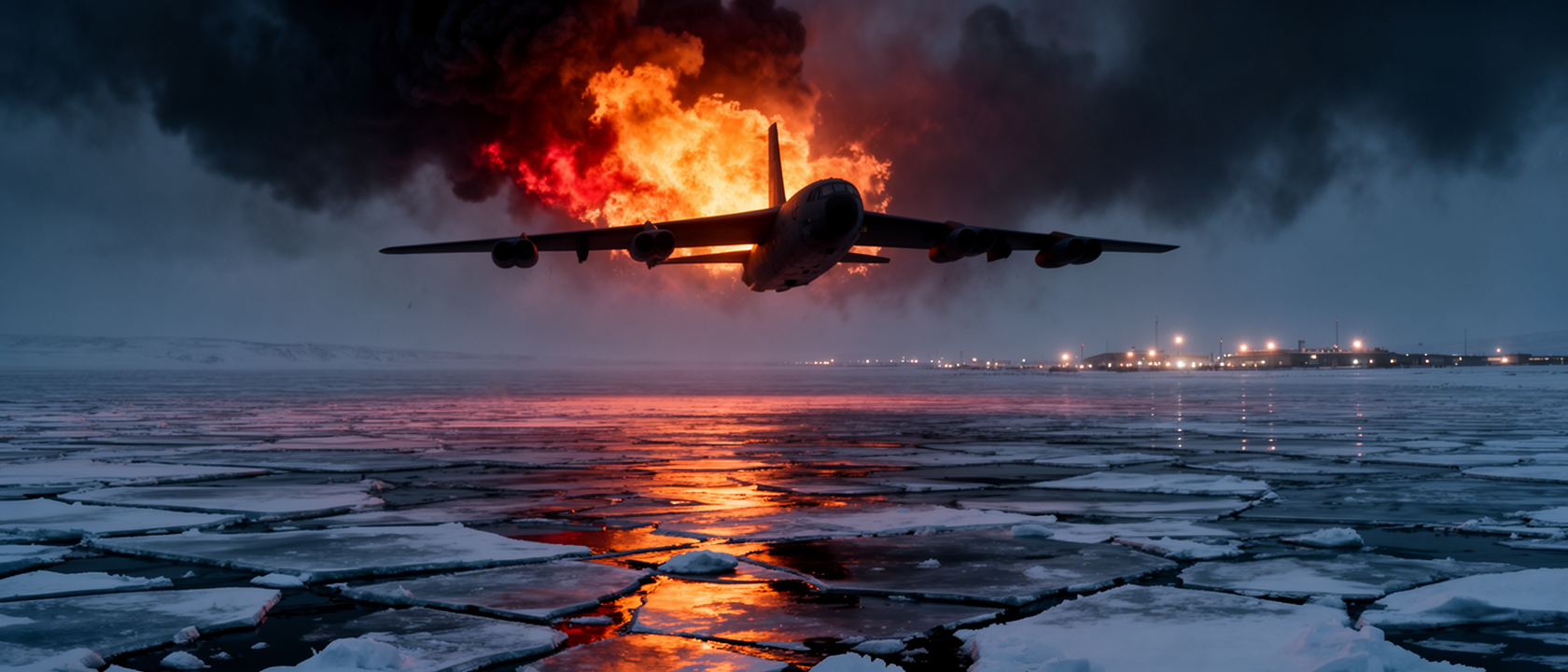
A Cold Cabin and a Warm Arctic Catastrophe
On January 21, 1968, sea ice in North Star Bay, Greenland, became one of the most radioactively contaminated sites in the Arctic. Plutonium and uranium spread across roughly 75 square kilometers of frozen landscape. No missile struck the aircraft. The sequence began with a cold crew member and a few foam-rubber cushions.
The Plane That Had No Business Crashing
The aircraft was a Boeing B-52G Stratofortress, callsign “HOBO 28,” flying out of Plattsburgh Air Force Base, New York, on a mission called “Hard Head.” It carried four B28 thermonuclear gravity bombs, each with a yield of 1.1 megatons.
One Valve, One Seat, One Fire
About six hours into the flight, Captain Richard Marx smelled burned rubber. Major Alfred D’Amario had placed foam-rubber cushions under the instructor navigator’s seat for comfort, directly above a cabin heating vent. Someone had opened an engine bleed valve to warm the freezing cockpit, but the incoming air was far hotter than it should have been and ignited the cushions. Fire extinguishers, stowage bags, and clothing failed to stop it. The fire reached the main electrical cable bundle and burned through it entirely.
With complete electrical failure, aircraft commander Captain John Haug ordered the crew to abandon the plane at 16:37 UTC. Six of the seven ejected. Co-pilot Captain Leonard Svitenko, resting away from his ejection seat, attempted to bail out through the escape hatch and suffered fatal injuries. The unmanned bomber struck the sea ice at approximately 900 km/h.
Why There Was No Nuclear Explosion
The conventional explosives packed around the plutonium cores of all four B28 bombs detonated on impact. But a nuclear detonation requires a precise, synchronized trigger sequence the crash never produced. The explosives simply blew the weapon cores apart, scattering plutonium and uranium across the ice along with roughly 102 tonnes of burning jet fuel. The U.S. military classified the event as a “Broken Arrow”, a major nuclear incident with no risk of triggering war. The contamination was severe, but radiological, not nuclear.
Dogsleds in the Dark
Staff Sergeant Calvin Snapp landed about 9.7 kilometers south of Thule Air Base on an ice floe, in temperatures of -31 degrees Celsius, and wrapped himself in his parachute to survive. Local Inuit, organized by Jens Zinglersen of the Royal Greenland Trade Department, used dogsleds alongside helicopters from the 54th Air Rescue and Recovery Squadron. Snapp was found alive 21 hours later, suffering from hypothermia. The subsequent cleanup, Project Crested Ice, removed approximately 237,000 cubic feet of contaminated ice, snow, water, and debris.
The Logic That Made the Risk Inevitable
Operation Chrome Dome had been running since 1960, keeping up to 12 nuclear-armed B-52s airborne at any moment over Greenland, Alaska, and the Mediterranean. The reasoning: airborne bombers cannot be destroyed on the ground. The problem: more hours aloft means more chances for mechanical failure. A nearly identical accident had already occurred at Palomares, Spain, on January 17, 1966. Chrome Dome ended on January 22, 1968, one day after HOBO 28 went down.
The Policy Nobody Mentioned
Denmark had maintained a nuclear-free policy since 1957, barring nuclear weapons from Danish soil and airspace. The U.S. Air Force had quietly decided its 1951 defense agreement with Denmark covered Chrome Dome overflights, though that agreement made no mention of nuclear weapons. The Thule crash made the contradiction public. In 1995, a report revealed the Danish government had tacitly permitted nuclear overflights throughout, prompting large protests across the country.
Plutonium-239 has a half-life of 24,000 years. Whatever traces remain in the sediment beneath North Star Bay are on a timeline that has nothing to do with ours.