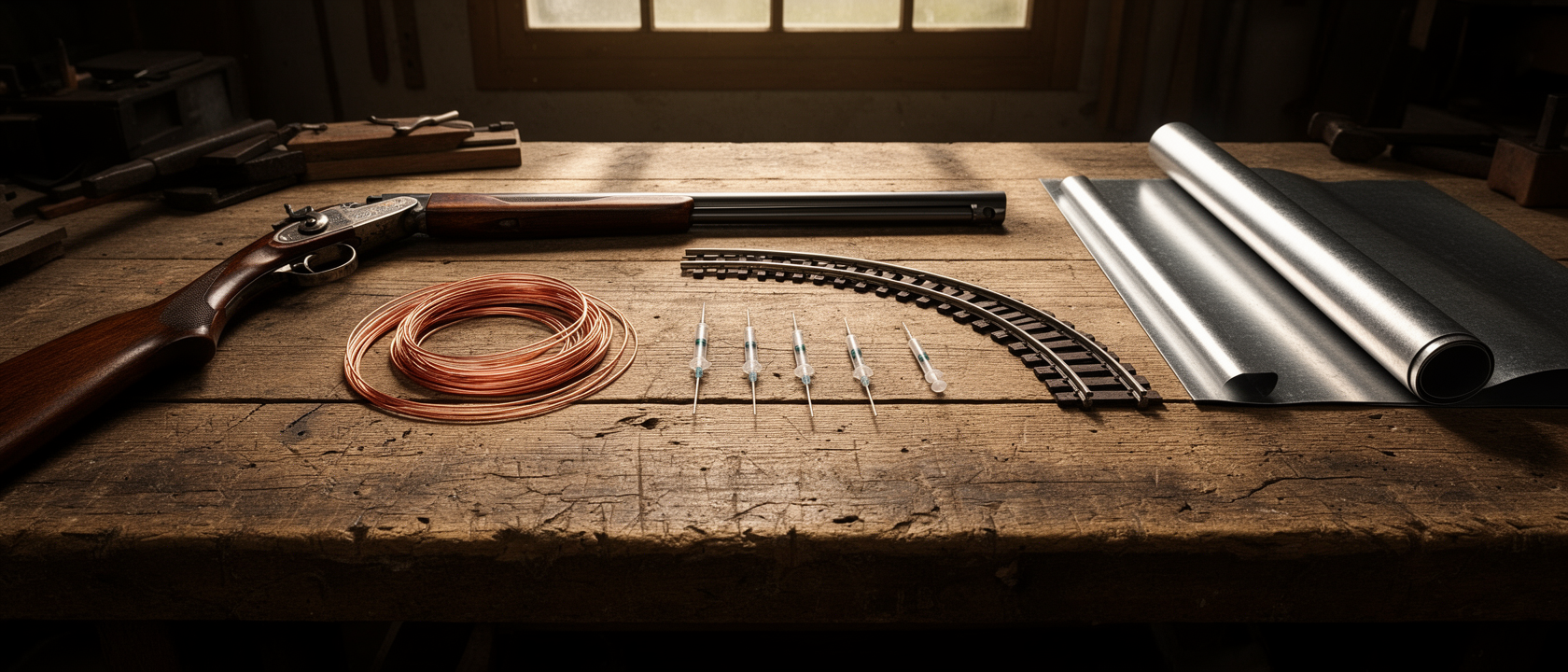
A Word That Measures Nothing Consistently
Pick up a box of hypodermic needles. The higher the gauge number, the thinner the needle. Now open a shotgun catalog. A 12-gauge barrel is wider than a 16-gauge one. Both facts are correct, and both use the word “gauge.” The confusion runs deeper than a quirk of terminology. Gauge is not a universal unit. It is a label borrowed by separate industries, each of which defined it to suit their own purposes, and none of which consulted each other.
A Word With Too Many Jobs
A centimeter is a centimeter everywhere. A gauge is whatever a particular industry decided it meant. The real problem is not just what gauge measures, but which direction the scale runs. In some systems, bigger numbers mean bigger objects. In others, bigger numbers mean smaller objects. Some systems have no formula at all and require a lookup table.
The Secret of the Rollers
For wire and sheet metal, the inverted scale makes complete sense once you know where it came from. To make metal wire, workers drew it through a series of holes in a hardened plate, each hole slightly smaller than the last. The gauge number was a count of those passes. A wire drawn through twelve times is thinner than one drawn through eight times.
This is why 0-gauge is the starting point: zero passes, no reduction. The 0-gauge diameter for wire starts at 0.324 inches, and for sheet metal at 0.2813 inches. Sizes thicker than 0-gauge exist and are written 2/0, 3/0, 4/0, and so on. The British Standard Wire Gauge, fixed by Order of Council on August 23, 1883, formalized this into a legal standard. Each step up reduces diameter by roughly 10.6%, following an exponential curve, and weight per unit length changes by about 20% per step.
The Medical Maze
Medicine uses gauge for both needles and catheters, but the two systems run in opposite directions. Hypodermic needles use the Birmingham Gauge system: higher number, smaller needle. Clinical gauges run from 7 (outer diameter roughly 4.57 mm) down to 34 (about 0.18 mm), with no single formula, only a reference table.
Catheters use the French Gauge system, developed by Swiss-born surgical instrument maker Joseph-Frédéric-Benoît Charrière. His approach is direct: one French unit equals one-third of a millimeter. A 9 French catheter has an outer diameter of 3 mm. Higher number, larger tube, the exact opposite of needle gauge.
Lead, Pounds, and Ballistics
Shotgun gauges have nothing to do with manufacturing passes. Take one pound of lead and divide it into equal spheres, each sized to fit exactly inside the barrel. The number of spheres needed is the gauge. A 12-gauge bore accommodates a sphere weighing 1/12th of a pound, giving a bore diameter of 0.729 inches (18.517 mm). A 16-gauge barrel is narrower because each of its 16 spheres must be smaller. The more spheres required to fill a pound, the smaller each sphere, and the smaller the bore.
Two common misconceptions: the .410 is not a gauge but a direct caliber measurement in inches; calculated as a true gauge it would sit at roughly 67-gauge. And “BB” in BB guns does not stand for ball bearing, it is a pellet-size designation standardized at 0.177 inches (4.5 mm), named from a shot-size classification.
The War of the Gauges
Railway gauge is the simplest concept here: the distance between the inner faces of two rails. The complication was that nobody agreed on what that distance should be. George Stephenson based his track on coal-mining wagon ways in northeast England; when the Liverpool and Manchester Railway opened on September 30, 1830, it ran at 4 feet 8½ inches. When the Great Western Railway board formally adopted Isambard Kingdom Brunel’s design in October 1835, he chose 7 feet ¼ inch, arguing a broader gauge allowed faster, more stable trains.
Where the two networks met, passengers and freight had to transfer between incompatible trains, slowing everything down. The Regulating the Gauge of Railways Act, granted royal assent on August 18, 1846, mandated 4 feet 8½ inches as the British standard. Brunel’s broader gauge was gradually phased out over the following decades. Standard gauge now carries roughly 55 to 60% of the world’s railways, ultimately tracing back to the track dimensions of northeast England coal-mining wagon ways.