A Name That Became a Punchline
Pick up an apple labeled “Delicious” at the grocery store and you probably already know what you’re getting: mealy flesh, watery texture, a flavor somewhere between cardboard and nothing at all. Food writers use the name as shorthand for bland. This isn’t a new joke, people have been making it for decades, which raises an obvious question: how does an apple end up with a name that’s the exact opposite of true?
It Actually Earned the Name
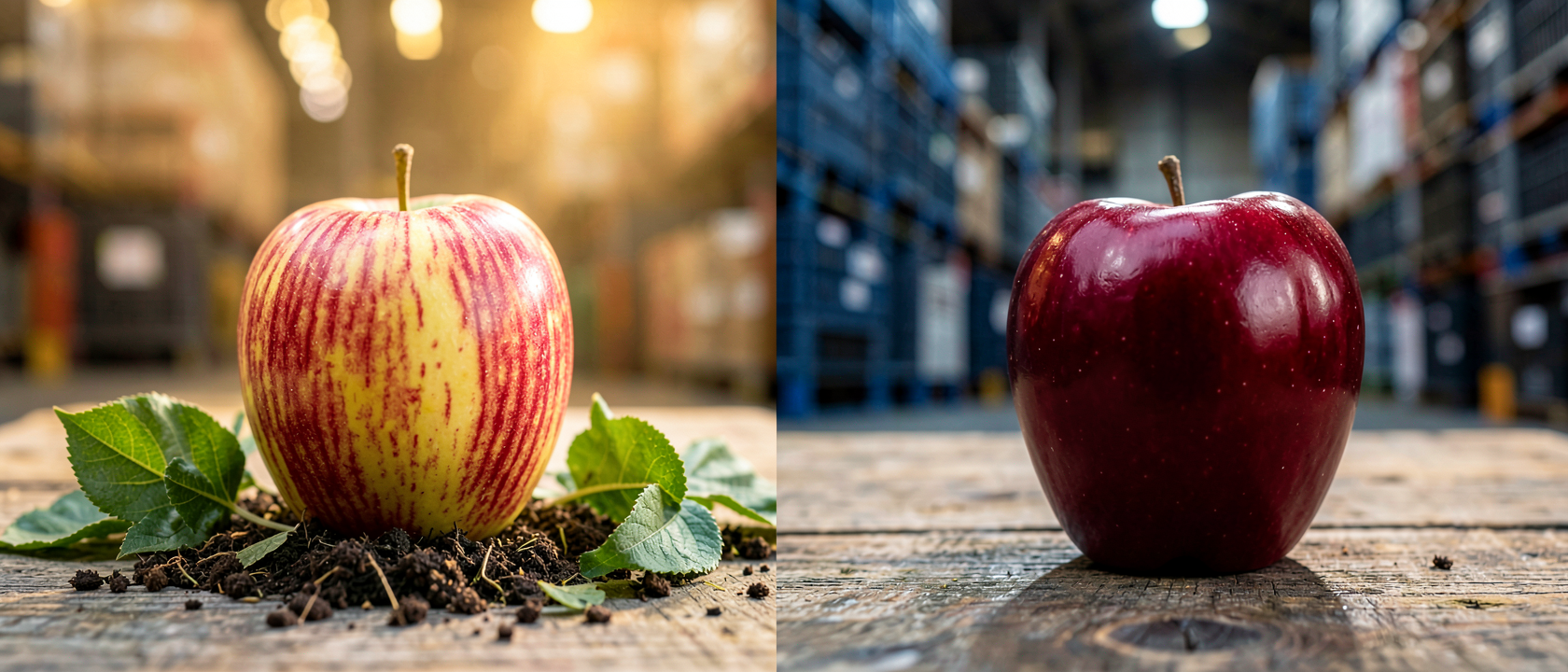
“Delicious” wasn’t always ironic. The apple began as a chance seedling that farmer Jesse Hiatt found growing uninvited between the rows of his orchard near Peru, Iowa, sometime in the 1870s or 1880s. Hiatt named it “Hawkeye,” after his home state. Researchers later concluded it was probably an accidental cross of two older varieties, the Bellflower and the Winesap, though that lineage is more educated guess than confirmed record.
In a contest Stark Brothers Nursery reportedly held around 1892 to find a replacement for the aging Ben Davis apple, other accounts put it a year or two later, Hiatt’s striped red-and-yellow entry won, even though his nametag went missing and he had to resubmit the apple the following year to claim credit. Stark Brothers bought the rights in 1894. According to a popular story, company president C.M. Stark bit into the apple and declared, “My, that’s delicious,” a line that’s more legend than verified quote, but the name stuck. The apple only became the country’s most popular in the 1940s, and it went on to hold that crown for decades afterward, with sources differing on exactly how long that peak era ran, before the streak finally ended in 2018.
Why Did Flavor Fade but Sales Didn’t?
If the apple was good enough to win a contest and build a company around, what changed? And why did shoppers keep buying it for years after it stopped tasting good? This wasn’t a single bad batch or scandal, it was a slow drift, easy to miss while living through it.
Bred for the Shelf, Not the Mouth
The answer sits in how fruit trees get propagated. Apple trees occasionally produce “bud sports,” branches with natural mutations that grow fruit slightly different from the rest of the tree. Growers clip those branches and graft them onto new rootstock, effectively cloning whatever trait showed up. As demand grew, growers kept selecting bud sports with deeper, more solid red color and thicker skin, since customers associated a redder apple with riper fruit, and thicker skin held up better through shipping and cold storage.
The catch: the genes behind the original apple’s yellow stripes sat on the same chromosomes as the genes producing its flavor compounds. Selecting against the stripes, generation after generation, meant selecting against flavor too. Cornell apple breeder Susan Brown has described exactly this pattern: the shift toward solid red color came paired with a loss of taste. Nobody decided to ruin the apple on purpose, it was years of individually reasonable choices made across a supply chain optimizing for color and shelf life, with nobody responsible for protecting flavor.
Victim of Its Own Success
By the 1980s, Red Delicious accounted for 75% of Washington state’s apple exports. With that kind of shelf dominance and so little competition, the apple didn’t need to taste good to keep selling. It sold on habit: it was the one everyone recognized, the one that was always there. The same pattern shows up well beyond the produce aisle, in any product that keeps moving off shelves on name recognition alone, long after the thing that earned that recognition has quietly worn away.
Flavor Finally Fights Back
The reign couldn’t last once genuinely better-tasting apples hit the market. Varieties like Honeycrisp and Gala, bred with eating quality as the actual goal, started winning over shoppers willing to pay more for a better bite. Red Delicious’s share of the US apple market fell 40% from the 1990s onward, and by 2018, industry projections pointed to a 10.7% drop in production, down to about 51.7 million boxes. Depressed prices for Red Delicious, weaker export markets, and competition from imported apple concentrate had already combined to push losses across the US apple industry to $700 million in 2001. Apple historian Lee Calhoun put it plainly in 2005: growers “eventually went too far and ended up with apples the public didn’t want to eat.” Farmer Doyle Fleming said it more bluntly in 2000, describing an industry that had spent nearly fifty years “cramming down the consumer’s throat” an apple bred for color and size instead of taste.
A Quick Correction: Darwin, Mendel, and a Common Mix-Up
One widely shared video on apple history reportedly credits Charles Darwin with explaining how crossbreeding and new plant varieties work. That’s the wrong scientist: Darwin’s theory of evolution describes how species change over time through differential survival, not how breeders deliberately combine traits. The groundwork for selective breeding comes from Gregor Mendel’s experiments with pea plants.
What the Apple Teaches About Everything Else
The real lesson has little to do with apples and everything to do with what happens once a product’s popularity becomes self-sustaining enough that nobody has to keep earning it. Chase the traits that move boxes off a shelf, color, size, shelf life, long enough, and you can quietly erode the quality that built the popularity in the first place. It happens so gradually that almost nobody notices until the product has become the punchline. It’s worth a second look at what else on your own shelves is still selling, still familiar, and quietly not as good as its name suggests.