Skip to 4:54
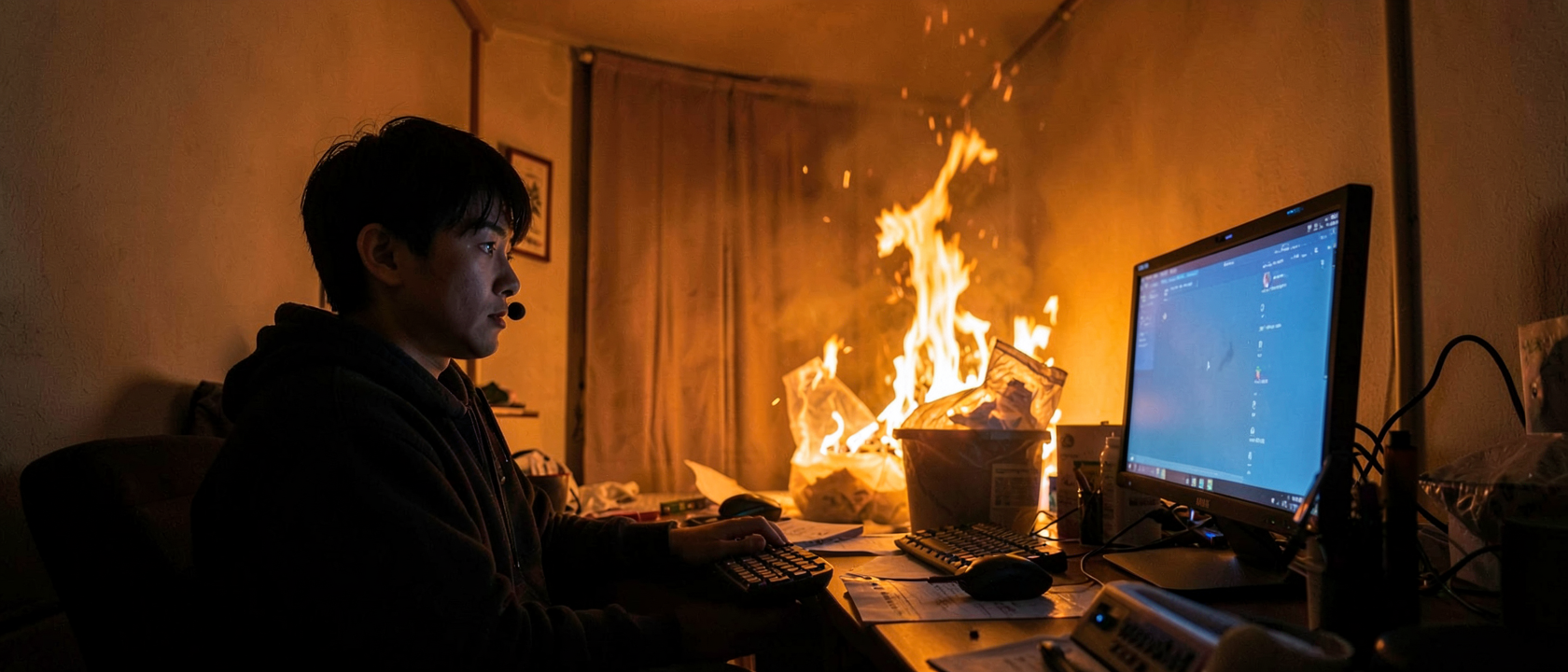
In October 2015, a clip began circulating online with an odd instruction attached: skip to around 4:54. Do that, and you’d see a man’s apartment in Japan catch fire, live, while he streamed for an audience, not a kitchen accident, but a stunt filmed on purpose because someone thought it would make good content. It’s one of the earliest widely shared examples of a format that’s only grown since: someone doing something risky on camera for viewers who want to see what happens next.
Why Play With Fire for an Audience?
Fire makes unusually good content. It moves, it’s unpredictable, and it reads as edgy without feeling as dangerous in the moment as, say, jumping off something. Nobody’s leaving the ground, you’re just holding a flame. That’s the trap. The real question isn’t why someone would film himself playing with fire, since plenty of people have. It’s how a stunt meant to look silly turned into a real emergency within minutes. Fire doesn’t ask permission; it’s easy to start and, once it grows past the size you planned for, surprisingly hard to put back in the box.
How “Silly” Becomes “Out of Control”
Accounts of how it started differ. Some describe a dropped match landing in a bag of tissues. Others point to a reusable “permanent match” lighter and an earlier oil spill he hadn’t cleaned up, so the flame caught bigger than expected and he dropped it. Either way, around the 4:54 mark, a small flame met a bag of trash or paper, and for a few seconds it looked exactly like what it was meant to be: contained and filmable.
It didn’t stay that size. Loose paper and trash burn easily once lit, and a burning bag generates enough heat on its own to ignite whatever is nearby, a flame that looks manageable can double in size within moments, simply because nothing is in place to contain it.
While he fought the flames to his left, a second fire caught in a garbage bag to his right, and he never noticed. His viewers did. A text-to-speech message meant to read out a donation started repeating “Ushiro” (Japanese for “behind”) to warn him, a warning some later write-ups mistook for his actual name, a mix-up that stuck around online for years. Other viewers just asked why he wasn’t calling 119, Japan’s emergency number.
What followed was one failed attempt after another: water from a small bottle, a cardboard box pressed onto the flames, a bowl, then what looks like a mattress. He even carried the burning bag to a corner of the room and went off for more water. Nothing worked. Watching him scramble looks almost cartoonish, not because it’s funny, but because that’s what the gap between a planned stunt and a real emergency looks like once instinct takes over and the plan disappears. He eventually gave up and ran from the apartment, unhurt.
The Aftermath That Wasn’t
After all that, the official follow-up was one sentence: the video’s own description simply said he and his family were alive, with nothing about injuries, apartment damage, or what happened to the stream afterward.
Other outlets ran their own versions later, some describing burns treated among family members, one even claiming a death in the building. None of it was confirmed by an official source, and none of the versions agreed. What spread online was the dramatic middle of a story; the ending never made it into the same conversation.
A Pattern You’ve Seen Before
The clip traces back to an October 6, 2015 write-up on Neatorama by Zeon Santos, who credited the site Dorkly for surfacing it. More than a decade later, it reads less like a story about one careless guy with a lighter and more like an early entry in a pattern that keeps repeating: someone filming a risky stunt, badly misjudging how fast harmless turns into dangerous.
You’ve probably seen a newer version, drones flown too close, dares filmed somewhere they shouldn’t be, stunts staged purely for a reaction that goes wrong in seconds. The prop changes, lighter, drone, rooftop, but the miscalculation stays the same: someone convinced the danger is smaller than it actually is, right up until it isn’t.
Funny and stupid sit closer together than most people filming themselves realize. Most only find out which one they’re in once it’s already happening live, with no way to cut the footage before it does.