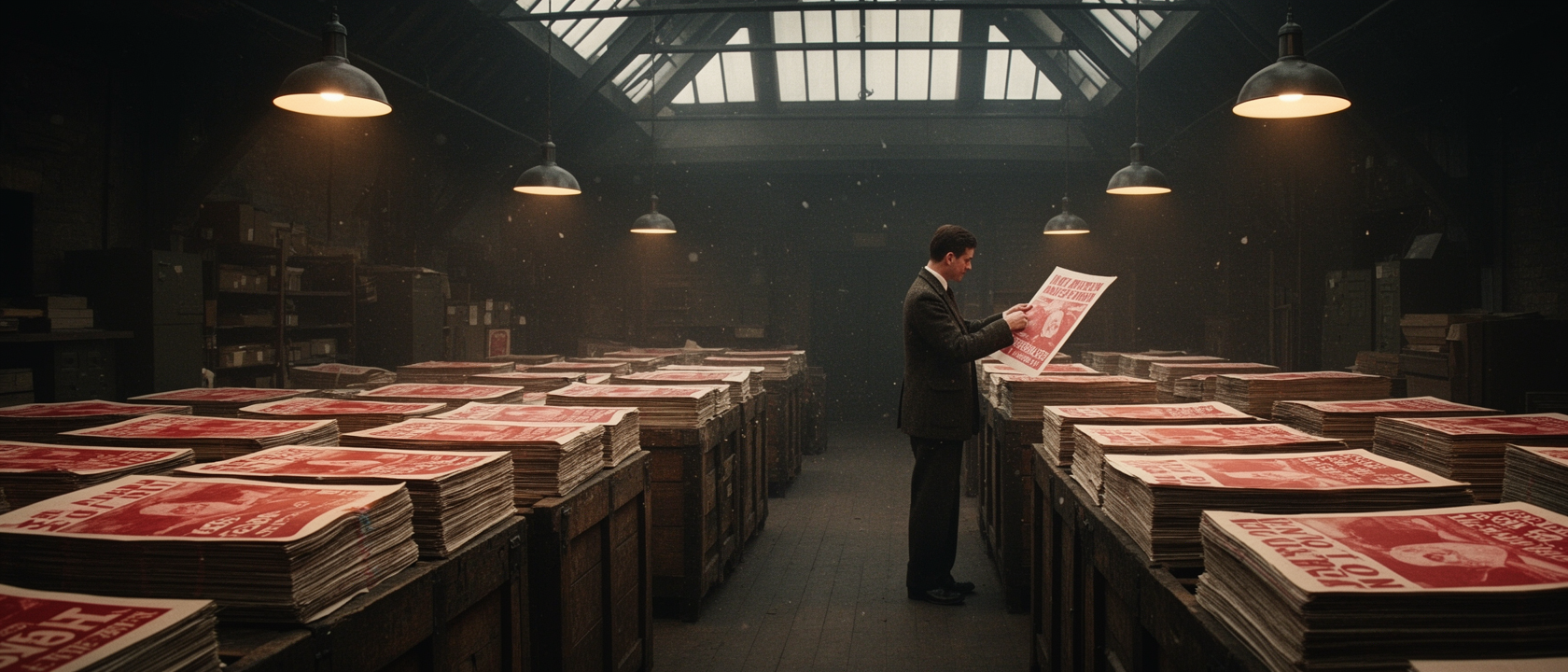
The World’s Most Famous Wartime Poster Was Almost Never Seen
Pick up a mug, a tote bag, or a greeting card in any English-speaking country, and there’s a reasonable chance it reads “Keep Calm and Carry On.” The phrase feels historical, like something Churchill said, or something every Londoner passed on the way to the tube during the Blitz. Neither is true. The poster was a government project that flopped so completely it was sent to be pulped before most people had ever seen it.
A Campaign Designed for a Crisis That Hadn’t Arrived Yet
The British government began planning wartime morale campaigns as early as August 1937. The logic was sensible: if German bombers hit London, panic could be as dangerous as the bombs themselves. After months of deliberation, Home Secretary Samuel Hoare signed off on three poster designs on August 4, 1939. Printing began on August 23, the same day Germany and the Soviet Union signed the Molotov-Ribbentrop Pact, and was still running when Britain declared war on September 3.
By that point, roughly 2.45 million copies of “Keep Calm and Carry On” had come off the press. Two companion posters, “Your Courage, Your Cheerfulness, Your Resolution Will Bring Us Victory” and “Freedom is in Peril; Defend it with all Your Might”, brought the total print run to around 3.75 million. The lettering was probably hand-drawn by graphic artist Ernest Wallcousins; it resembles Gill Sans but doesn’t match any existing typeface exactly.
The Phoney War Problem
“Keep Calm and Carry On” was held in reserve for the most severe scenarios: mass air raids, possible invasion. The companion posters went up first. But the anticipated bombardment never came. The period from September 1, 1939, to May 10, 1940, later called the Phoney War, saw very little fighting on the Western Front. Urgent calls for courage landed with a thud on a population that was more bored than frightened.
Public reaction was not kind. The UK social research group Mass Observation found the response overwhelmingly negative. “Your Courage” in particular came across as condescending, officials asking working people to bear hardship for the benefit of those above them. Design historian Susannah Walker later described the campaign as “a resounding failure.” By October 1939, the whole effort was cancelled.
April 1940: Most of It Goes to the Pulper
With millions of posters sitting unused and paper becoming a precious wartime resource, the government made a practical call. In April 1940, the majority of the stock was destroyed under the wider Paper Salvage campaign. A small number did surface, a 1940 Yorkshire Post report mentions one in a Leeds shop window, and a 1941 Cecil Beaton photograph shows a copy on a pub wall, but these were scattered and unofficial. The sense of ubiquity is entirely a modern invention.
A Bookshop in Northumberland
In 2000, Stuart Manley, co-owner of Barter Books in Alnwick, Northumberland, pulled a copy from the bottom of a box of second-hand books purchased at auction. He framed it and hung it near the cash register. Customers kept asking about it, and he and his wife Mary arranged a small local print run of around 500 reproductions, which began selling in 2001. The image stayed a quiet regional curiosity until late 2005, when Guardian journalist Susie Steiner included it in a Christmas gift feature. Demand jumped sharply, and within a few years the image had spread far beyond Barter Books. Mary Manley’s assessment was candid: “I didn’t want it trivialised; but of course now it’s been trivialised beyond belief.”
Someone Tried to Own It
As the slogan’s commercial value became clear, entrepreneur Mark Coop registered “Keep Calm and Carry On” as an EU community trademark in August 2011, after failing to secure a UK registration. Smaller vendors challenged the filing, and Barter Books argued that Coop was claiming private ownership of shared history. The trademark survived those challenges and remained in force until it expired on October 18, 2020.
The government that printed 2.45 million copies couldn’t get anyone to look at it. Six decades later, people went to court over who got to put it on a coffee cup.