The Man in the Hat and Nothing Else
Robert John Burck has spent decades standing in Midtown Manhattan wearing white briefs, white cowboy boots, and a white cowboy hat, playing guitar and accepting tips. It has worked consistently enough to make him one of the most recognizable figures in New York City.
Burck grew up in Cincinnati, Ohio, and holds a bachelor’s degree in political science from the University of Cincinnati. He started performing as the Naked Cowboy in December 1997 on Venice Beach, California, before moving to Times Square in 1998, where global tourist foot traffic gave the persona real commercial reach. Tips turned into licensing deals and television appearances, including a Chevrolet commercial that aired during Super Bowl XLI. Burck had formalized his identity with trademark registrations and licensing arrangements, making him, in a practical legal sense, a brand.
On February 11, 2008, Burck’s lawyers filed a lawsuit in U.S. District Court in Manhattan against Mars, Incorporated and advertising agency Chute Gerdeman, Inc. Burck was 37 and asking for $6 million.
Wait, You Can Own Underwear?
A trademark does not protect a physical object. It protects a combination of distinctive signals that the public reliably connects to one specific source. Trademark law has no minimum sophistication requirement, it does not care whether your brand is a sleek corporate identity or a man in Times Square in his underwear. What it asks is whether the public recognizes the combination as coming from you. Burck had trademarked his name and his look, and had licensed both to third parties for commercial endorsements.
Why Weird Works Better Than Normal
Trademark protection is partly a function of distinctiveness. A plain red circle is a weak mark because red circles appear in thousands of unrelated contexts. An oddly specific combination, an animated character in white cowboy boots, white briefs, and a white cowboy hat, playing a white guitar in Times Square, is a strong mark precisely because that combination is so unlikely to occur independently. Burck’s stripped-down costume is actually his legal armor: because it is unusual and has been consistently maintained since 1998, there is little room for a defendant to claim the resemblance was accidental.
A Few Seconds of Chocolate, a Six-Million-Dollar Question
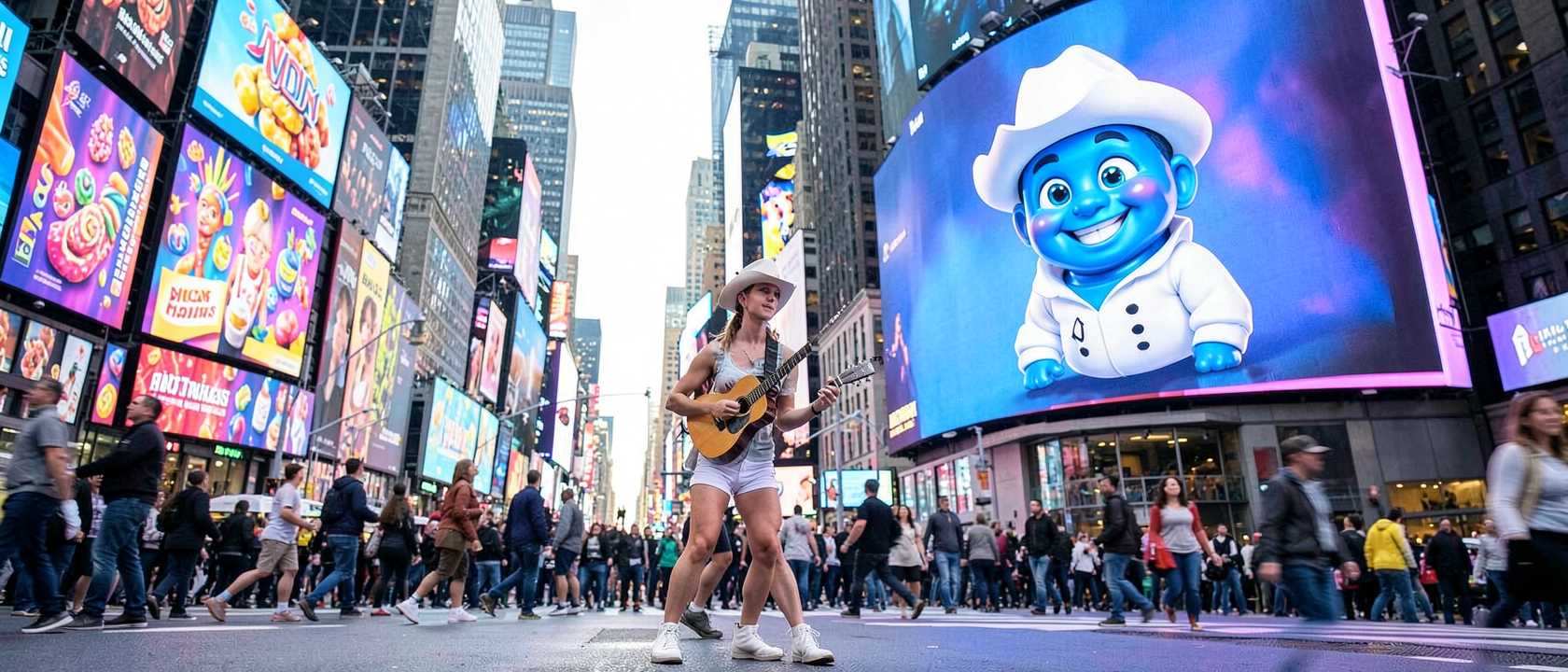
The alleged infringement was specific. A campaign promoting M&M World in Times Square featured an animated blue M&M character dressed in a white cowboy hat, white cowboy boots, and white briefs, playing a white guitar in Times Square. The ad ran on two large electronic billboards and as a mural inside the M&M World store.
Burck’s complaint rested on two legal claims: false endorsement under Section 43(a) of the Lanham Act, and a violation of his right of publicity under New York Civil Rights Law. He sought $2 million for trademark infringement, $2 million for the publicity violation, and $2 million in punitive damages. Mars and Chute Gerdeman countered that the campaign was a parody protected by the First Amendment.
On June 23, 2008, U.S. District Judge Denny Chin dismissed the right of publicity claim, finding the ad depicted a costume and character rather than Burck’s actual likeness. He denied the motion to dismiss the false endorsement claim, however, allowing it to proceed.
Ten Years in Briefs Is Worth Something
Trademarks are built through consistent, public, commercial use over time. Burck had been performing in the same costume since 1998, roughly a decade before the lawsuit. Every appearance in Times Square, every licensing deal, every television spot was another layer of documented association between that costume and that performer, which is precisely what turned a quirky street act into something a federal court was willing to take seriously.
The case settled confidentially on November 7, 2008, with no terms disclosed. What the record shows is that a man who built a commercial identity out of a hat, a pair of boots, and a guitar had built enough of a legal position that Mars chose to settle rather than fight.