Thirteen Miles, on Purpose
A small group sets out walking through Edinburgh on a route that loops for about 13 miles (21 km), roughly half a marathon. They aren’t lost, training, or protesting. Their own records describe the outing as “verifying a species.”
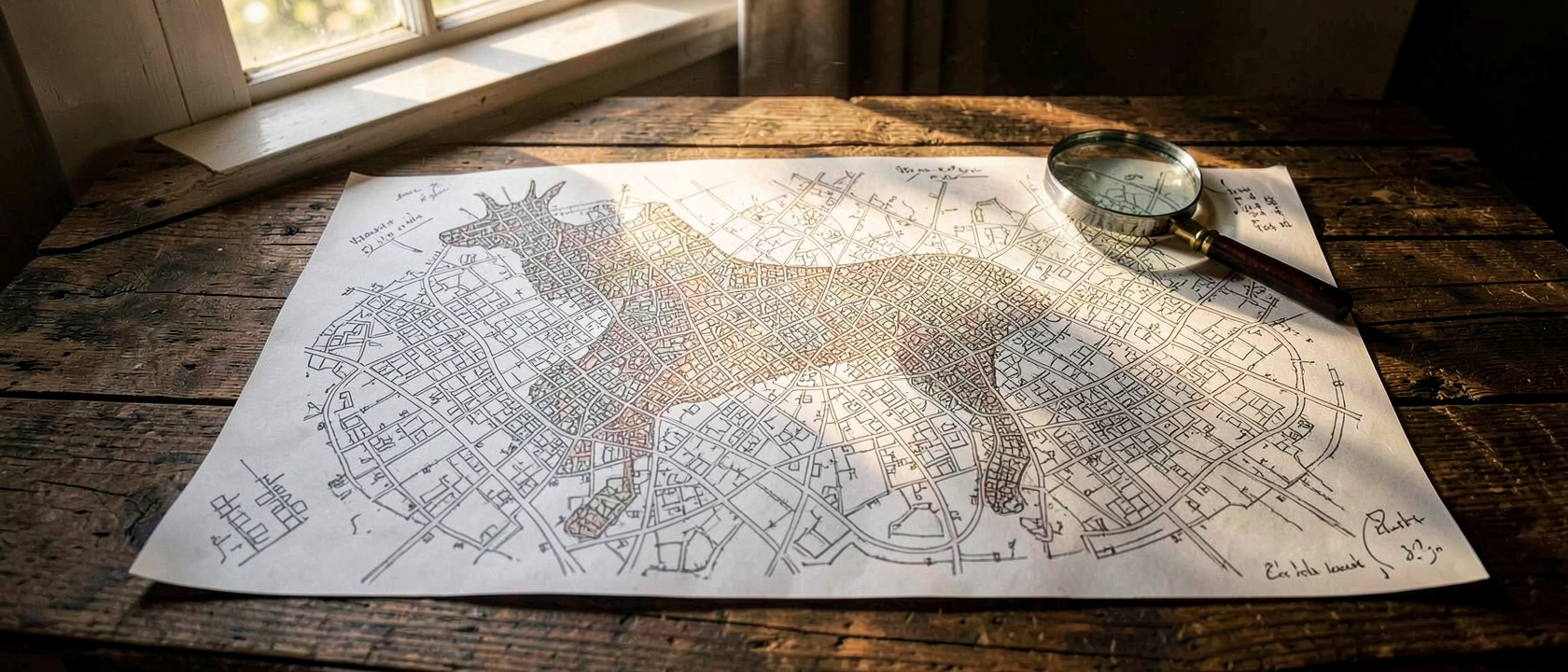
That species is a cow, outlined by the city’s own streets. The walkers belong to the Norwegian Cartozoologic Society, and in their files this route has a name: the Scottish Culture Cow. What kind of group treats a long walk like fieldwork?
Why a Map Starts Looking Like an Animal
You’ve done this before: found a face in a cloud, a man in the moon, an animal in a water stain. Psychologists call it pareidolia, the brain’s habit of snapping random patterns into familiar shapes. Seeing a cow in a tangle of streets is the same reflex, aimed at a map instead of the sky. The odd part is what happens next, when someone takes that reflex and builds rules, terminology, and a whole society around it.
The Method: Spot It, Then Walk It
Cartozoology runs on two steps. First, scan a street map for lines that suggest an animal’s outline: a loop for a body, a dead end for a tail. Second, “con-tour” it, meaning walk the suspected shape in the real city, noting the buildings, parks, and landmarks along the way. The identification isn’t fixed from the start. What reads as antlers on paper can turn into ears once you’re standing on that street, and a leg can resolve into a hoof or a paw depending on what the pavement actually does. That revision process is what makes it feel like research instead of doodling.
From an Essay to a Founding Date
The idea has a paper trail. In 1975, Norwegian writer Tor Åge Bringsværd published an essay called “Den store fisken i Reykjavik” (“The Great Fish in Reykjavik”), floating the notion of hidden animal shapes in city layouts decades before there was a word for it. That word showed up in 2003, in Bringsværd’s book “London,” coined from the French for “map” and the Latin root for the study of animals. On June 19, 2003, three men met at a restaurant in Oslo and formally founded the Norwegian Cartozoologic Society, turning the idea into an organized pursuit.
A Handbook, and Real Safety Tips
Three “secretaries general,” Tor Åge Bringsværd, Roger Pihl, and Eilert Sundt, run the society. Their 2004 “Håndbok i kartozoologi” (Handbook of Cartozoology) sets out identification rules and expedition etiquette, including advice that would suit any hiker: bring an umbrella, tell someone your route beforehand, never go alone. It’s sound travel advice applied, with total sincerity, to the business of walking a cow-shaped street grid.
A Quick Tour of the Menagerie
Oslo alone has two confirmed shapes: the West Side Riesenterrier, traced through its embassy district and a main shopping street, and the Nose-Ringed Dala Horse, running from Parliament to Oslo City Hall. Why a Swedish folk symbol turns up in an Oslo street pattern is something the society itself calls a mystery. Copenhagen has the Ugly Duckling, tied to Hans Christian Andersen; Stamsund, Norway, has the Obese Stamshound, linked to the region’s ties to early space exploration; and the City of London has the Mercantile Mongrel Dog.
Not Every Shape Makes the Cut
The field has standards. One example cited within cartozoology is the constellation Cygnus, traditionally called “the Swan,” which the society flags as a poor resemblance by its own loose criteria. It’s a small detail, but it proves the joke has internal logic: not every suggestive squiggle gets waved through just because someone squinted at it.
An Old Habit, Dressed Up for Laughs
None of this is new behavior, just a new outfit for it. Ancient skywatchers looked at scattered stars and agreed to see hunters and swans; cartozoology does the same thing with asphalt. Paul Auster‘s 1987 novel “City of Glass” offers a literary cousin: a character’s wandering path across New York spells out “THE TOWER OF BABEL” when traced on a map. The instinct connects a constellation namer long ago to anyone who’s ever spotted a face in a wall socket.
The Joke, and Why It Works
Cartozoology isn’t a recognized field. It comes from the Annals of Improbable Research, the magazine behind the Ig Nobel Prizes, and it’s built as satire from the ground up. But the society, the founding date, the handbook, and the 13-mile walks are all real. Nobody involved is trying to convince anyone a cow actually lives in Edinburgh’s street plan. The fun is watching people commit fully to the premise, officers and safety manuals and all, starting from one person looking at a map and saying, “that street looks like a cow.”