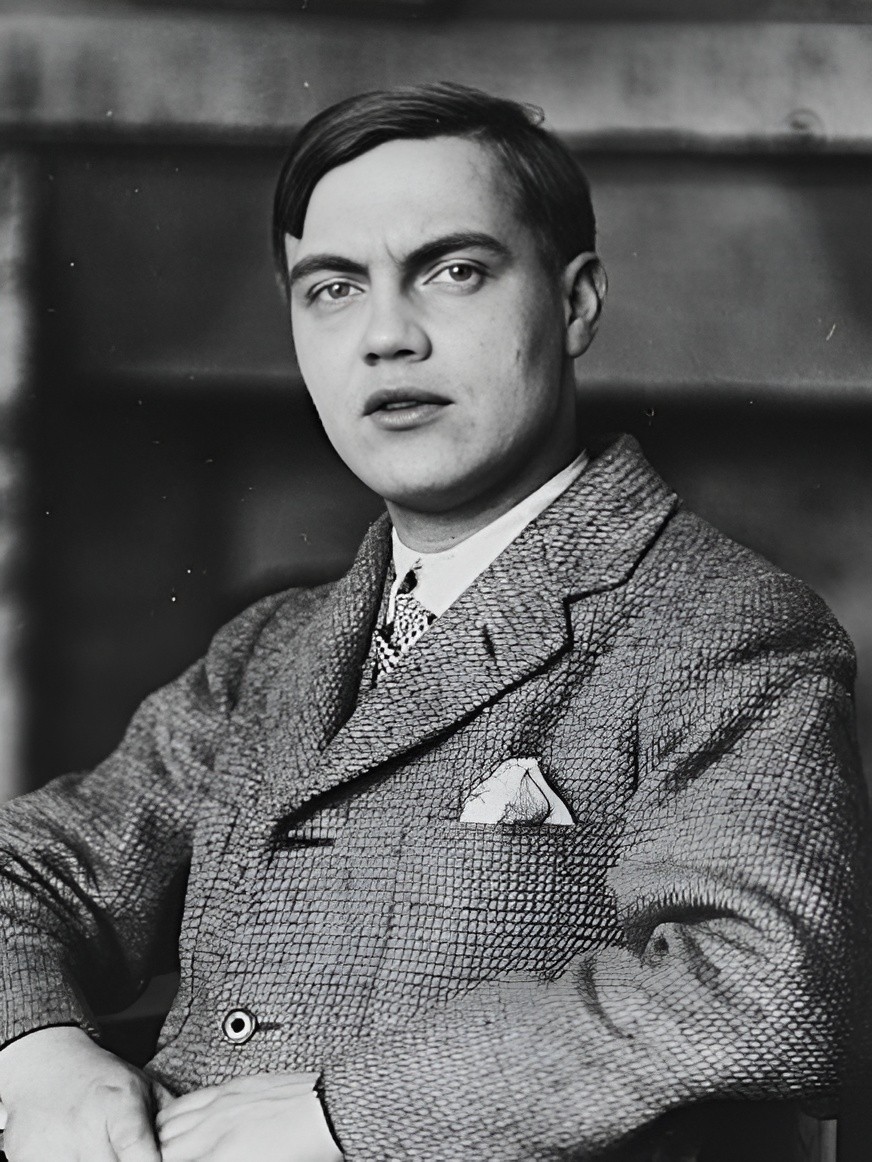
George Antheil (1900–1959) was an American avant-garde composer, pianist, author, and inventor whose career cut across concert halls, silent film studios, and wartime engineering labs. Born in Trenton, New Jersey, to a family of German immigrants, he spent years at the centre of the Parisian modernist scene before returning to the United States to write film scores, books, and advice columns. The invention he co-developed with actress Hedy Lamarr in 1941, a frequency-hopping radio guidance system for torpedoes, was eventually recognized decades after his death when the two were posthumously inducted into the National Inventors Hall of Fame in 2014.
Key facts
- Born: 8 July 1900
- Birthplace: Trenton
- Died: 12 February 1959
- Place of death: New York City
- Country: United States
- Occupation: composer; pianist; film score composer; inventor
- Field: composer; film score
- Education: Trenton Central High School
- Awards: Guggenheim Fellowship; EFF Award; National Inventors Hall of Fame
Early Life and Education
Georg Carl Johann Antheil was born on 8 July 1900 in Trenton, New Jersey, where his father ran a shoe store. He began studying piano at six, and his aptitude was clear enough that by 1916 he was making regular trips to Philadelphia to study with Constantin von Sternberg, a former pupil of Franz Liszt.
In 1917 Antheil enlisted in the American Air Force, serving for two years. He failed to complete his senior year at Trenton Central High School in the winter of 1918. After his military service he returned to academic music, studying in New York City in 1919 with composer Ernest Bloch.
Patronage and the Paris Years
Mary Louise Curtis Bok, who later founded the Curtis Institute of Music in Philadelphia, supported Antheil financially for approximately two decades, giving him the freedom to pursue an unconventional path. That path led him to Paris, where he rented an apartment above Sylvia Beach’s bookshop Shakespeare and Company. Beach later identified him as her first American customer.
James Joyce, Ezra Pound, W. B. Yeats, Erik Satie, and Pablo Picasso all took an interest in his work, treating him as a musical spokesman for their modernist ideas.
Ballet Mécanique and Major Works
Antheil’s most discussed composition from this period is Ballet Mécanique, a percussive, machine-age piece that attracted admiration and controversy in equal measure. Its New York premiere at Carnegie Hall on April 10, 1927 was presented in a scaled-down version. At the same event Antheil organized the simultaneous premiere of his A Jazz Symphony, performed by an African American orchestra.
He received two Guggenheim Fellowships, in 1932 and 1933, which gave him time to compose his second opera, Helen Retires, which premiered in New York City on February 28, 1934.
The Frequency-Hopping Invention
In 1941 Antheil and actress Hedy Lamarr developed a radio guidance system for Allied torpedoes. The system used a code stored on a punched paper tape to synchronize random frequency changes between the transmitter and receiver, making it resistant to jamming. The mechanical principle drew directly on Antheil’s experience with player pianos: the invention switched among 88 frequencies, one for each key on a standard piano keyboard.
The patent, U.S. Patent 2,292,387, was classified top secret for the remainder of World War II and the U.S. Navy did not adopt the technology until the 1960s. Antheil died in New York City on 12 February 1959, before the invention received any public recognition. He and Lamarr were inducted posthumously into the National Inventors Hall of Fame in 2014.
Writing and Other Work
Antheil wrote across an unusually wide range of subjects. His autobiography, Bad Boy of Music, was published in 1945. He also wrote books on glandular criminology and war predictions, contributed columns to Esquire magazine, and ran a romantic advice column. The Esquire column on endocrinology, which examined the relationship between glands and criminal behavior, appeared under the byline of a man who had never finished high school.
He also worked extensively as a film score composer, adding commercial output to a body of work that had begun in the European avant-garde.
Legacy and Archives
Large collections of Antheil’s works and papers are held at the Music Division of the New York Public Library for the Performing Arts, Princeton University, Columbia University, UCLA, and Stanford University. His awards include two Guggenheim Fellowships, the EFF Award, and posthumous induction into the National Inventors Hall of Fame in 2014.
Did you know
- Antheil wrote a column on endocrinology, the study of the glands and their relation to criminal behavior, for Esquire magazine, despite never having finished high school. (stephaniemcpeakpetersen.substack.com)
- The frequency-hopping patent (U.S. Patent 2,292,387) that Antheil co-invented with Hedy Lamarr was classified top secret for the remainder of World War II and was not adopted by the U.S. Navy until the 1960s. (robertgreenbergmusic.com)
- Sylvia Beach, proprietor of the Paris bookshop Shakespeare and Company, identified George Antheil as her first American customer, and Antheil and his wife Boski lived in an apartment above the bookshop. (princetonmagazine.com)
- The New York premiere of Ballet Mécanique at Carnegie Hall on April 10, 1927 was staged in a scaled-down version, and Antheil engaged an African American orchestra to simultaneously premiere his A Jazz Symphony. (walkerhomeschoolblog.wordpress.com)
- Antheil’s frequency-hopping invention used the mechanical logic of a player piano roll to switch among 88 frequencies, one for each key on a standard piano keyboard, to make torpedo guidance signals harder to jam. (ethw.org)
Data sources
- Wikidata
- ressources.ircam.fr
- paristransatlantic.com
- ethw.org
- princetonmagazine.com
- wisemusicclassical.com
- windrep.org
- findagrave.com
- newworldencyclopedia.org
Data updated: 2026-10-31