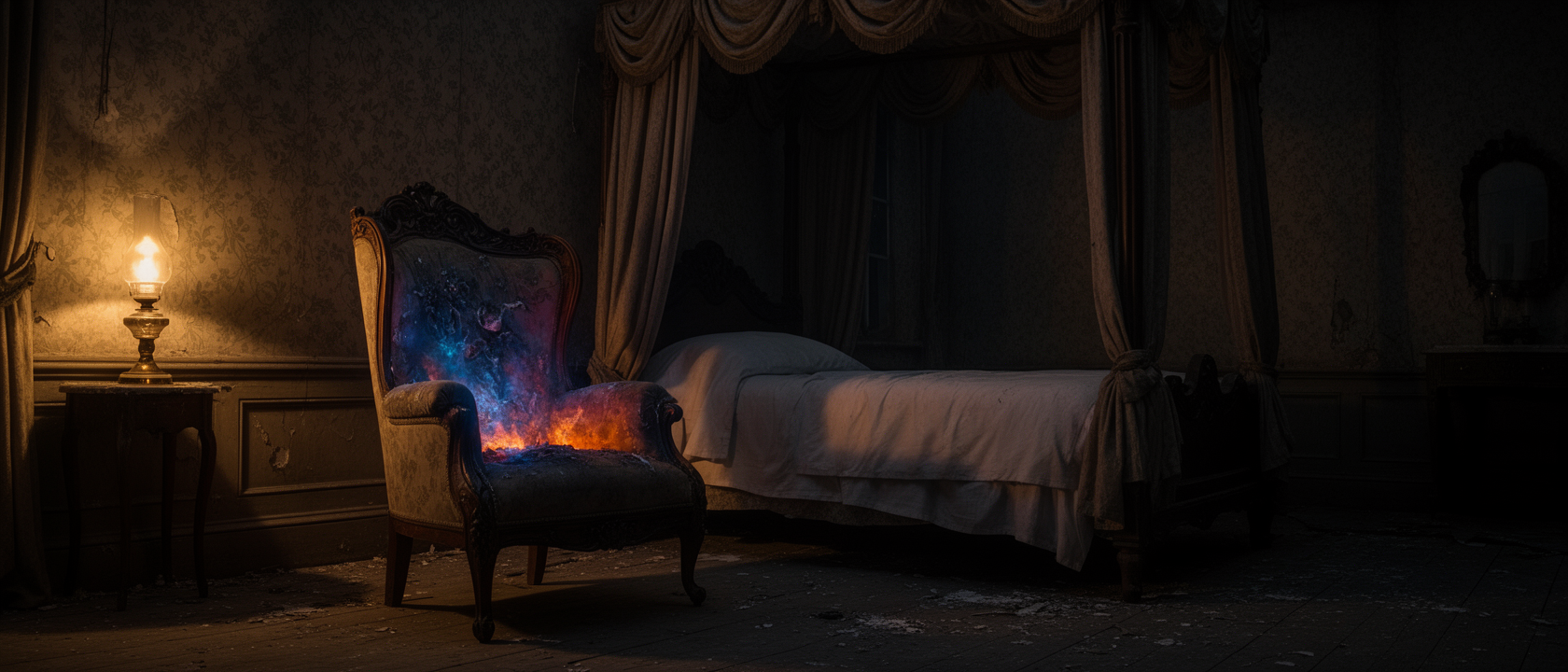
The Impossible Crime Scene
Imagine walking into a room and finding a person’s torso reduced to gray ash while their feet, still in their socks, sit a few inches away and are completely untouched. The furniture around them is intact. The curtains haven’t caught. A fire hot enough to destroy bone requires sustained, intense heat, and when a room fire reaches that point, it generally takes everything with it. So what is happening here?
A Long History of Guesswork
The term “spontaneous human combustion” was coined in 1745 by Paul Rolli, a Fellow of the Royal Society, in a paper for the Philosophical Transactions about the 1731 death of Countess Cornelia Zangari Bandi. She was 66 years old. Her body was found as a pile of ash roughly a meter from her bed, with her lower legs, three fingers, and the front of her skull relatively intact. The furniture was unburned but coated in a greasy, foul-smelling film. An oil lamp on the floor held no oil. Reports at the time noted she habitually rubbed camphorated brandy on her skin to relieve pain.
Over the following centuries, roughly 200 similar cases were reported worldwide. The theories that arose to explain them ranged from creative to absurd: poltergeists; “pyrotrons” causing nuclear-level chain reactions inside the body, in Larry E. Arnold’s 1995 book Ablaze!; and mitochondrial explosions releasing flammable gases, per John Heymer’s The Entrancing Flamepublished in 1996. None of it was testable. The cases attracted imaginative explanations precisely because the scene looked so strange.
Charles Dickens, who found the idea irresistible, used it to kill off a character in Bleak Houseserialized from March 1852 through September 1853. Critic George Lewes pushed back almost immediately, writing in The Leader that a novelist cannot just ignore the laws of physics and accusing Dickens of “giving currency to a vulgar error.”
The Myth of the Flash Fire
The common assumption is that SHC is sudden, something like a match strike. But the cases that investigators have examined most closely argue against that. Carbon monoxide found in muscle tissue from some victims indicates they were still breathing during the fire, whatever burned them did so over time. It was not a flash. A slow, sustained burn fits the physical evidence far better than any sudden ignition, and it also helps explain why the surrounding room so often escapes untouched.
Some cases held up as clear SHC incidents turned out to be simpler still on closer inspection, accidental ignition from a nearby fuel source, ordinary tragedies that got misread as mysteries because the aftermath looked strange to untrained eyes.
The Wick Effect
The explanation forensic scientists point to is called the wick effect. A candle is a reasonable model for it. The wick draws liquid wax up to the flame, which consumes the candle slowly and in one spot. A human body, once ignited by an external source, can behave similarly. Clothing acts as the wick. Subcutaneous fat, the layer just under the skin, acts as the fuel. The fire burns slowly, sustained by fat, and is most intense in the torso, where fat deposits are largest.
The extremities have far less subcutaneous fat and are often covered in thicker material like wool socks or leather shoes. They survive. The fire doesn’t travel across the room because there is no fuel to carry it there. That greasy, foul-smelling film that coated the Countess Bandi’s furniture? It fits this picture precisely: fine particles of rendered fat dispersed through the air during a slow, localized burn over many hours.
Seeing What You Expect
Early investigators described “shrunken skulls” and preserved limbs with an air of the supernatural. Roger Byard, a forensic pathologist and emeritus professor at the University of Adelaide, addressed this directly about a year ago: SHC is “deeply improbable, nigh impossible,” and by his account it has never been witnessed actually occurring.
A human skull without soft tissue is smaller than most people expect. Bone contracts under sustained heat. An untrained observer seeing fire-damaged remains for the first time is likely to find them strange, and the mind interprets strangeness through whatever story is already circulating. The Countess Bandi’s empty oil lamp was sitting in the ashes when her body was discovered. It was right there in the original account. It just wasn’t the detail anyone found compelling.