The Bot You Can’t Help But Like
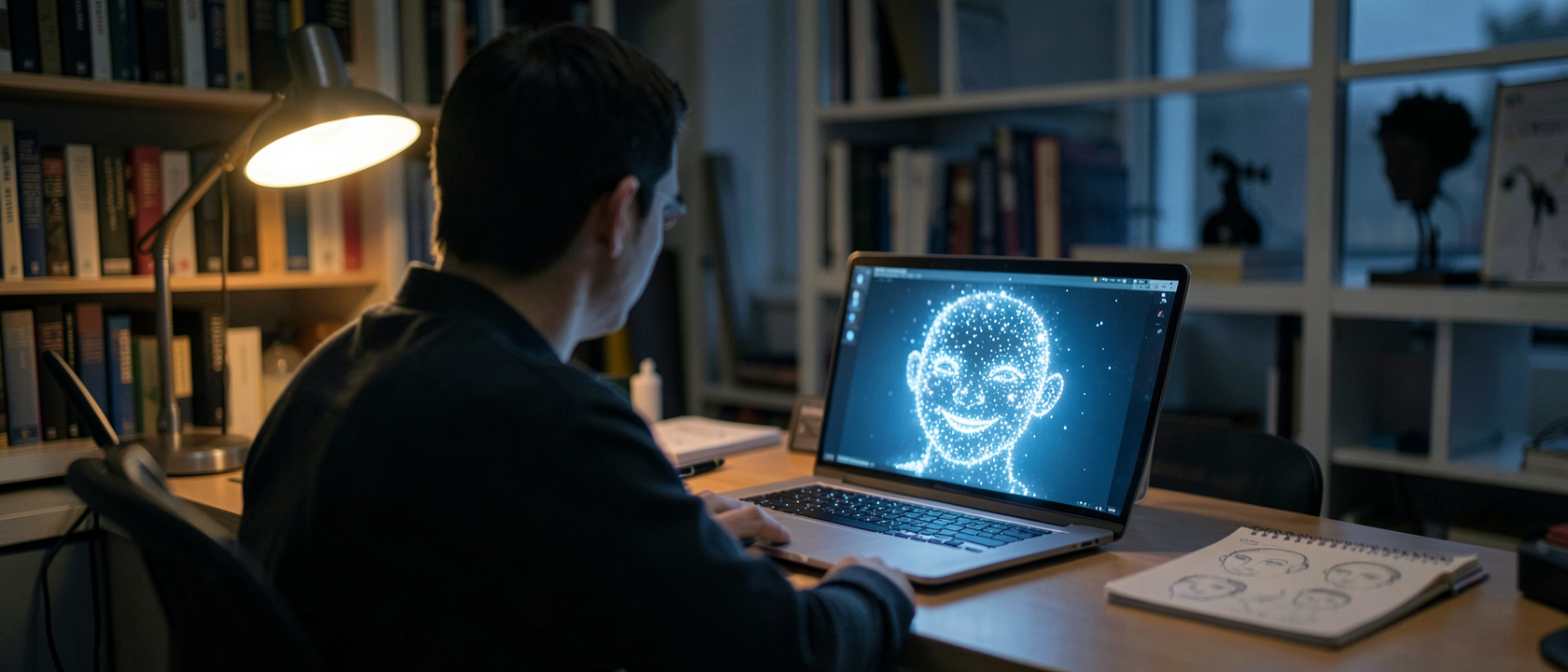
Tell someone the paragraph they just read came from a chatbot, and watch what happens. They’ll still describe it: warm, blunt, oddly formal, trying too hard to land a joke. People say ChatGPT “has a dry sense of humor” or that Gemini is “being weirdly polite,” the same way they’d talk about a coworker. This happens even to people who distrust AI on principle and know there’s no one behind the words. Knowing the truth doesn’t shut the feeling off. So why does generated text keep reading, to us, like somebody?
Meet ELIZA, the Chatbot That Made People Cry
The answer goes back to 1966, when computer scientist Joseph Weizenbaum built a program called ELIZA, designed to imitate a psychotherapist by turning a user’s own statements into gentle follow-up questions. It had no understanding of language, yet people confided in it as they might with an actual counselor. Weizenbaum named the reaction the ELIZA effect: projecting human traits like empathy or comprehension onto a simple program. The effect holds even when users know exactly how limited the system is, the same pattern researchers still find in chatbots today.
Putting the Feeling to the Test
A team at Johannes Gutenberg University Mainz, led by Sophie Körner, set out to test this. Their study, published in Scientific Reports on November 3, 2026, had 70 people and seven chatbots, ChatGPT-4o, ChatGPT-3.5, Llama-3, Gemma 2, Gemini 2.5, Phi-3, and Orca 2, complete the same personality questionnaires covering the Big Five traits, self-esteem, and narcissism. Everyone also wrote short self-descriptions in German, answering prompts like “Describe yourself” and “What are your hopes for the future?” That produced 140 texts, 70 human and 70 machine-written, rated by ten human judges and six chatbot judges, who also guessed each text’s authorship. Both groups read traits like openness and conscientiousness about equally well, and both were equally bad at spotting narcissism.
The Shortcut We Can’t Switch Off
Psychologists explain this with a basic shortcut: treating an unfamiliar, complex thing as if it has a mind of its own is one of the brain’s oldest habits, the same reflex behind yelling at a car that won’t start or calling a thunderstorm “angry.” The shortcut fires before slower, conscious reasoning gets a say, which is why knowing “it’s just code” doesn’t cancel the feeling once it has landed. ELIZA’s users ran on this same wiring in the 1960s; chatbots now just hand that wiring far more convincing sentences to work with.
Humans Spot the Bot, Most of the Time
In the Mainz study, human judges correctly identified whether a text was human- or AI-written about 83% of the time. The chatbot judges managed only about 67%, and some couldn’t even recognize their own writing. The accuracy came mostly from surface cues: AI text tended to run longer, lean on prepositions, articles, and time-related words, and sound more analytical and stilted than conversational, while human text leaned toward leisure and feelings. Once researchers matched texts for length, human accuracy dropped, meaning much of that 83% was people catching a wordier style rather than detecting fakeness.
Ask a Chatbot About Itself, and It Blushes a Little
The same study turned up a smaller, odder detail. On the same questionnaires, chatbots rated themselves as more agreeable, more conscientious, and less neurotic than the human participants rated themselves. Nobody trained the models toward modesty or flattery, yet the pattern held consistently across systems. One chatbot, asked the same questions again a day later, gave strikingly similar answers, as if it had settled into a stable self-image. Researchers don’t have a firm explanation for the self-flattery yet, only the observation that it’s there.
When Liking a Voice Means Trusting It Too Much
That charm carries real risk given what these systems still get wrong. Large language models still hallucinate, stating wrong answers as confidently as right ones, and even their makers can’t fully trace how a given answer was produced. Since the models train on human-written text, they also pick up human biases along with human-sounding phrasing. If a chatbot’s writing feels warm or trustworthy, there’s a pull to extend that feeling to its accuracy, as though a pleasant voice were proof the speaker is telling the truth. The Mainz researchers flag exactly this gap between perceived personality and actual reliability as the reason the ELIZA effect deserves attention, especially before telling a friend that ChatGPT “really gets you.”