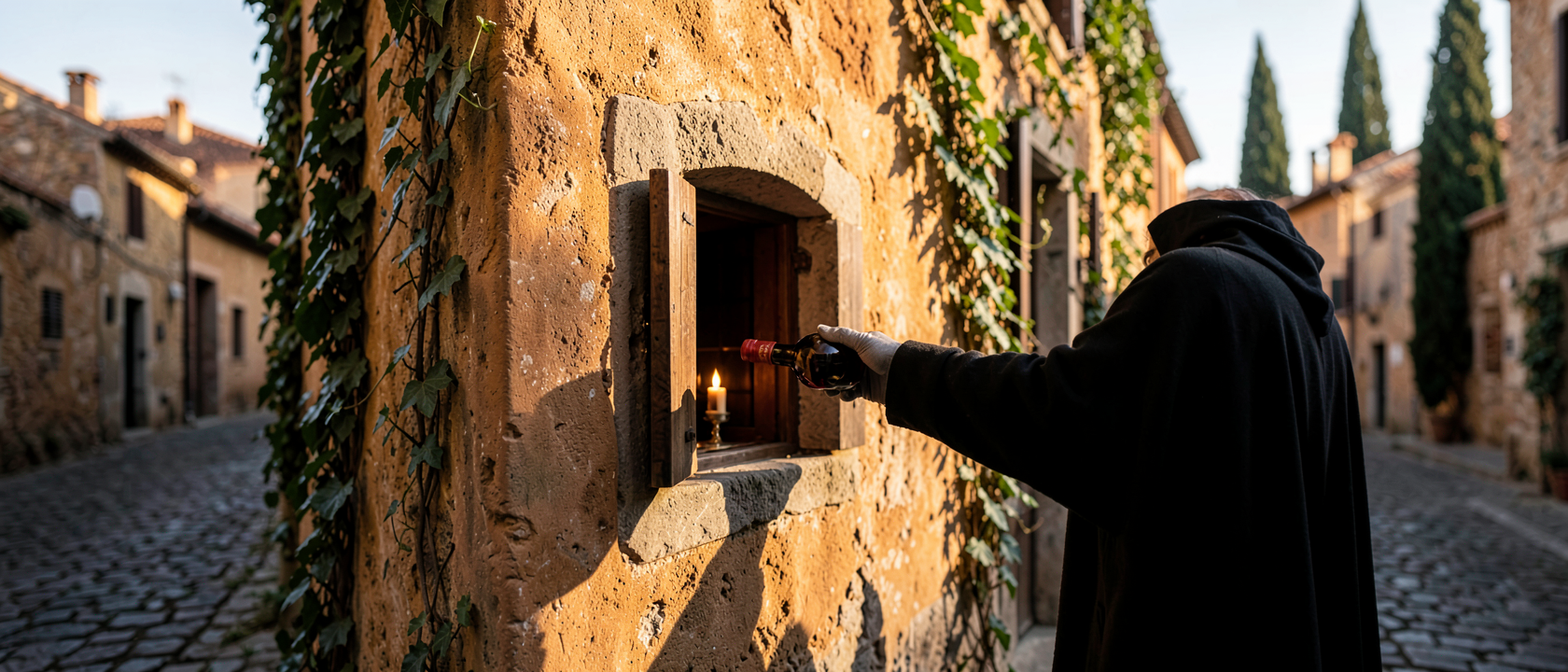
The Windows Too Small for a Head, Just Right for a Bottle
Walk through central Florence slowly enough and you’ll notice them: small stone-framed openings set into old palace walls, usually chest-high, about the size of a large hardcover book. Some still have tiny wooden shutters. Most people walk right past.
That size, cut into solid stone at exactly arm height, suggests function, not ornament. An opening that precise usually means a job once needed doing.
Why Would a Shop Need a Window Instead of a Door?
These buildings already had front doors, counters, and shopkeepers. So why cut a second, smaller opening into the stone?
Ventilation doesn’t explain a hole exactly the size of a wine bottle. Decoration doesn’t explain why dozens of nearly identical openings appear across the city. Even tax evasion, part of the bigger story of why Florentine families sold wine from home, doesn’t explain why a hole was needed instead of just handing a bottle over the counter. The answer only clicks once you know what problem it solved.
Built for a Plague, Not a Pour
In 1559, Grand Duke Cosimo I de’ Medici let noble Florentine families sell wine from their own estates directly out of their city palaces, skipping taverns, innkeepers, and their taxes. That’s why wine was sold from private buildings at all.
The windows came later, for a different reason. Sometime in the 1600s, likely during an outbreak of plague that swept through Florence, sources disagree on whether it ran from 1629 to 1631 or from 1630 to 1633, sellers cut small hatches into their exterior walls. A book published in 1634 already describes them in use. A customer handed in a coin, and a bottle, or a metal tube to refill a flask, came back out, with no doorway to share and no face-to-face contact.
Nobody in the 1600s understood how plague actually spread, but they understood that closeness was dangerous. So they built a low-tech answer: a pass-through hatch doing the job of “social distancing” long before the term existed.
Roughly 150 Still Standing
Estimates vary, from about 146 documented openings to more than 180, but a commonly cited figure puts it at roughly 150 wine windows still surviving in Florence’s historic center, with another 100 to 140 or so across Tuscany.
Each opening measures about 9 by 14 inches (23 by 36 cm), just enough for a fiasco, the round-bottomed Tuscan wine bottle, to pass through. Some still carry old signage or iron shutters.
They’re architectural fossils: features that stopped serving their purpose, sat unused in load-bearing walls for generations, and were never worth removing. Many others were likely lost in Florence’s 1966 flood; the ones that survived simply waited.
Then COVID Arrived, and the Wall Remembered
Italy went into strict lockdown as the coronavirus spread, and after roughly two months of home confinement, businesses were allowed to reopen gradually under strict distancing rules. Restaurants and shops had to figure out how to hand things to customers without standing close to them.
Some Florentine owners looked at the odd little hole already built into their wall and realized the problem wasn’t new. In May 2020, Osteria delle Brache and Babae began pouring wine straight through their buchette again; Babae had actually reopened its window earlier, in summer 2019, without knowing how relevant it would become. The Vivoli gelateria, founded in 1929, reactivated its own window too, using it exactly as it had been used centuries earlier.
Not Just Wine Anymore
Once reopened, the windows didn’t stay limited to wine. Owners passed through coffee, cocktails, sandwiches, and ice cream through the same small stone frame, Vivoli served both gelato and coffee through its. Picture a scoop of gelato passed through a nearly four-century-old hole cut for wine bottles.
The window was never really “for wine” in the deepest sense. It was for handing a small object from one person to another without either stepping into the other’s space, the format didn’t care what was passing through it.
Old Solutions Don’t Expire, They Wait
A hole cut into a wall to solve a 17th-century health crisis sat dormant for roughly three centuries. Then a 21st-century health crisis arrived with almost the exact same shape, and the wall already had the answer built in, unmodified.
Innovation doesn’t always mean inventing something new. Sometimes it means noticing that someone already solved your problem generations ago, they just didn’t have your century’s word for it. History doesn’t repeat itself, but the problems underneath it often do.