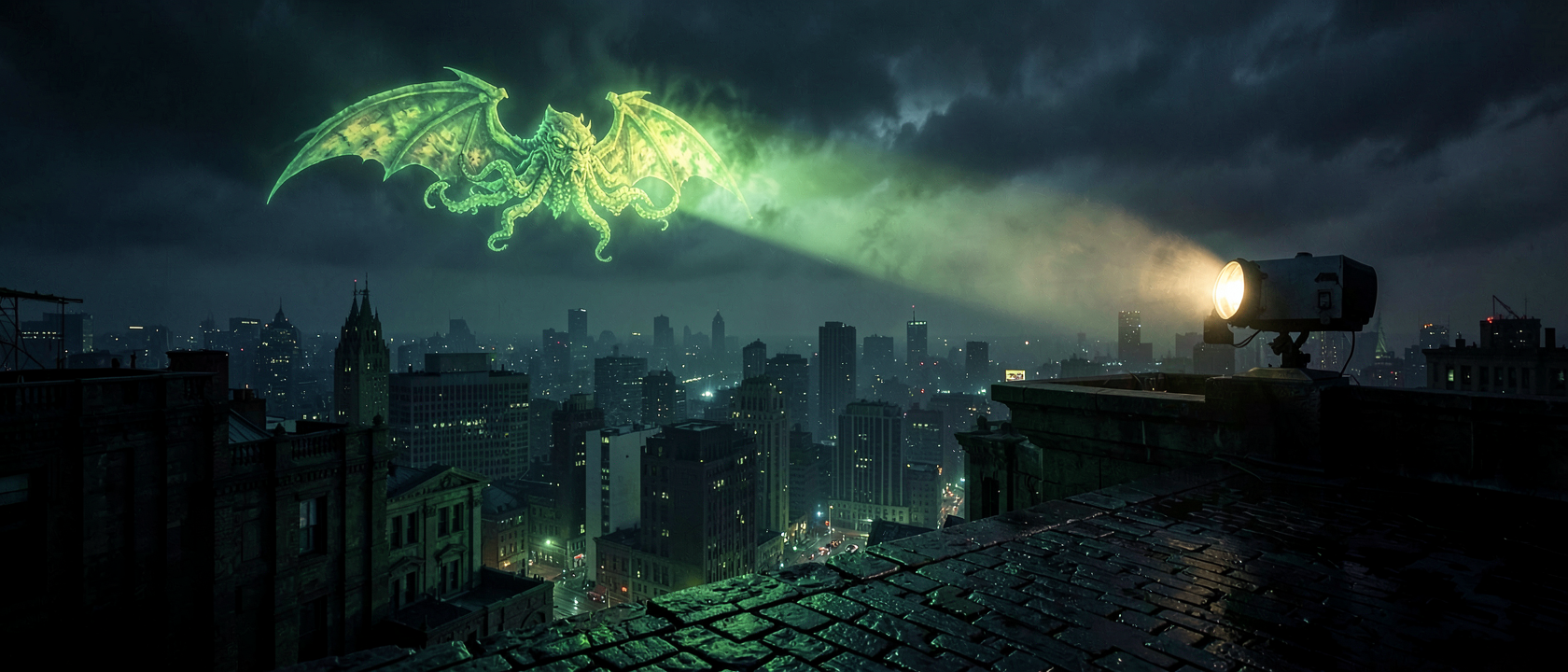
What If Gotham Called the Wrong Number?
The Bat-Signal is one of fiction’s most instantly readable symbols. A city under siege, a searchlight aimed at the clouds, and somewhere in the dark, a protector takes notice. Since its first appearance in Detective Comics #60 in February 1942, that emblem has meant one thing: help is on the way.
Now imagine the wrong symbol goes up instead.
That is the premise of a t-shirt called “The Cthulhu Signal Is On,” designed by an indie artist known as Legendary Phoenix and sold through NeatoShop, Neatorama’s own online store. The design was featured on Neatorama on March 22, 2015, and it landed exactly as its creator must have hoped: with a slow grin and a growing sense of unease. It looks like a joke. It is a joke. But something specific makes it hit harder than a simple swap of one fictional character for another. Batman and Cthulhu are not two different kinds of solution. One of them is not a solution at all.
So Who, Exactly, Is Cthulhu?
H.P. Lovecraft created Cthulhu in “The Call of Cthulhu,” written in the summer of 1926 and first published in Weird Tales in February 1928. That story became the founding text of the Cthulhu Mythos. Lovecraft, born in Providence, Rhode Island in 1890, died there in 1937, but the mythology kept growing long after.
Within that mythology, Cthulhu is a Great Old One: an ancient cosmic entity so vast and alien that human perception cannot process it correctly. Roughly humanoid, green, with features suggesting both an octopus and a dragon, it lies in a death-like slumber in R’lyeh, a sunken city beneath the Pacific Ocean. The critical detail is not the physical description but the effect: perceiving a Great Old One directly does not cause fear that can be survived, it causes the collapse of functioning sanity.
Cthulhu carries no grudge and pursues no agenda. The entity is essentially indifferent, the way deep ocean water is indifferent to anything passing through it. The damage is incidental to its existence. That is the engine of the joke, and what separates this design from a simple character swap.
The Signal Summons No Savior. It Summons the End.
Batman’s value rests on a specific promise: he shows up, reads the situation, and tilts the balance in favor of the innocent. The Bat-Signal works as a comfort symbol because it implies someone paying attention, someone who can act within human moral stakes, who can tell the difference between the person doing harm and the person trying to escape it.
Replace the bat emblem with Cthulhu’s image and none of that holds. An entity that indifferent does not choose sides. The idea of a protector arriving becomes not just useless but structurally impossible. You have not swapped one responder for another. You have replaced the concept of rescue with its opposite.
The Design, the Designer, and the Audience
Legendary Phoenix is an indie designer whose other work includes “J McGills Lawyer Vintage Ad,” “Appetite For Hamburgers,” and “The Legend Of The Golden Cartridge (Vintage Ed.)”, a sensibility running toward nostalgia, parody, and genre references. “The Cthulhu Signal Is On” fits that pattern precisely.
The joke requires two things to be true simultaneously: the reader must recognize what the Bat-Signal means and understand what Cthulhu represents. Without both, the design is just an odd image. With both, it lands in a single glance, a reward for knowing the right things.
The Sulfur and the Rotten Fish Are Not on the Shirt
The Neatorama article introducing the design includes a short fictional narrative: a panicked police commissioner, a bumbling officer who projects the wrong signal, and Cthulhu’s arrival accompanied by sulfur and rotten fish. It is vivid, but it is purely fictional promotional framing, not Lovecraft canon and not a description of what the shirt actually depicts.
A sunken city, a sleeping god, and the knowledge that looking at it ends sanity: that is a punchline all by itself.