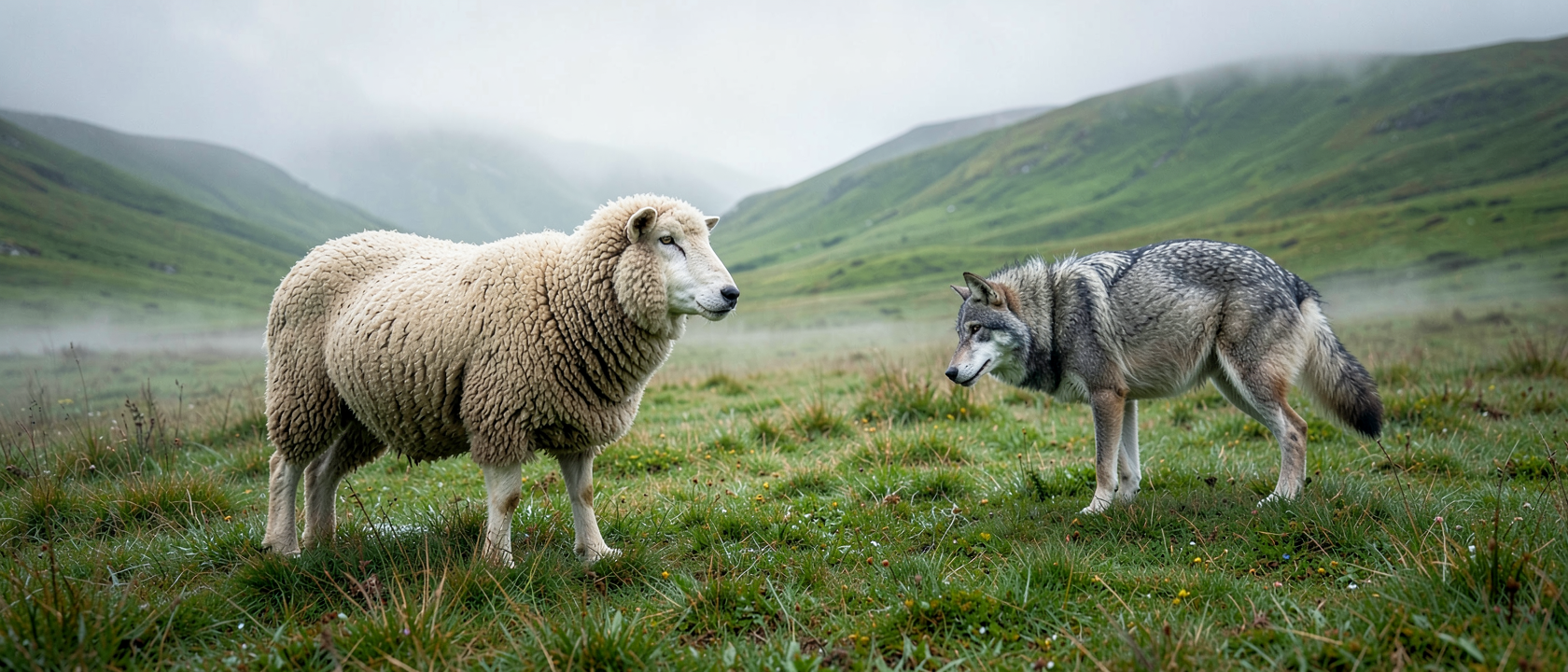
A Video That Refuses to Behave
Somewhere in Norway, someone pointed a camera at a sheep and a wolf and got a clip that’s been passed around online ever since under one blunt title: “Sheep Vs Wolf.” The name alone does the work of a horror movie poster. A wolf and a sheep meet in a field, and only one of them is supposed to walk away.
Except that’s apparently not how it goes. The original post, published on June 17, 2013, described an encounter that doesn’t end the way a lifetime of fairy tales has trained you to expect. What exactly happens, we’re not going to spell out step by step. Some things need to be watched, not summarized.
Why Your Brain Already Knows How This Ends
Notice what just happened in your own head. The moment you read “wolf” next to “sheep,” a small scene probably started playing, uninvited. Teeth, panic, an ending you didn’t need footage to picture. Nobody showed you that scene. You just knew, the way you know a stove might be hot before touching it. That reflex isn’t observation. It’s a script you’ve been rehearsing since childhood without ever auditioning for the part.
Aesop, Red Riding Hood, and the Wolf That Never Gets a Say
That script has a long paper trail. Aesop’s fables used the wolf as a stand-in for greed and danger long before anyone studied how wolves actually behave. Little Red Riding Hood cast the wolf as a predator hiding under a grandmother’s nightgown, built to teach caution, not canine biology. These tales were never really about wolves. They used wolves as convenient villains to make a moral point land harder.
Real wolves tend to be far more cautious than folklore suggests. They avoid unnecessary risk, conserve energy, and pick fights only when hunger, desperation, or a clear opening favors them. A wolf that can eat without a confrontation usually will. Fairy tales needed a reliable villain who shows up on cue, and wolves got handed the role centuries before anyone checked whether it fit.
It Depends: Guardians, Groups, and a Wolf’s Empty Stomach
What actually happens when a wolf meets a sheep hinges on details fairy tales leave out. Is the wolf well-fed or starving? Are guardian dogs or people nearby? Is the sheep alone, or inside a flock?
Strip those variables out, the way every fairy tale does for a clean ending, and you get a fixed script: predator wins, prey loses. Put the variables back in, and that fixed script turns into something much messier and far more interesting. That’s also, incidentally, the difference between a fact you half-remember and one you actually understand, most people stop at the fixed script and never ask what happens once you put the variables back.
Nature Doesn’t Always Read the Script
Sheep have a habit folklore rarely mentions: as a general matter, they can behave defensively, even aggressively, especially when protecting their young, using group behavior to push a threat back rather than simply scattering. That complicates the passive, doomed-prey image most of us grew up with.
Wolves, for their part, aren’t wired for conflict by default. Without hunger or provocation, a wolf may show curiosity, indifference, or simply move on rather than attack. There’s an old phrase, “nature, red in tooth and claw,” used to describe the natural world as one long fight for survival. It’s a broad idea about nature in general, not a description of this particular clip, and it points to a tendency under specific conditions, not a rule nature has to follow every time a camera happens to be rolling.
The Story Behind the Story Also Vanished
Here’s the part that makes this worth telling. The clip traces back to that short post from June 17, 2013, crediting the footage to Tastefully Offensive and describing almost exactly what’s above: an encounter that doesn’t end the way fairy tales taught you to expect. The video itself was uploaded to YouTube on June 16, 2013, under the plain title “Sheep chasing Wolf.” A separate, unconfirmed report places the incident in the village of Rognes, describing a ewe repeatedly driving off a wolf that kept trying to get close to her young. That detail comes from a single secondary site, not from the original post or the video itself, so it’s worth treating as a rumor rather than a fact.
What’s gone missing is the original written explanation. The page has gone quiet, its old address now occupied by unrelated ads, the kind of digital debris left behind when a domain gets repurposed for something else entirely. A story about defying a script became, without anyone planning it, a small example of how the internet’s memory actually works: images and clips keep circulating long after the words explaining them have quietly rotted away. Which leaves one honest option for anyone who wants to know how this one really goes. Watch it yourself.