The Man Who Invented Sound Recording… and Sealed It Away
Alexander Graham Bell is famous for the telephone, but through the 1880s he also ran the Volta Laboratory in Washington, D.C. testing methods for capturing and reproducing voice, partly because his wife was deaf. Bell and his collaborators gave the Smithsonian more than 400 discs and cylinders from those experiments, recordings that sat in storage for over a century, never once played. The man synonymous with transmitting the human voice left behind an archive nobody could actually hear.
Why You Can’t Just Drop a Needle on History
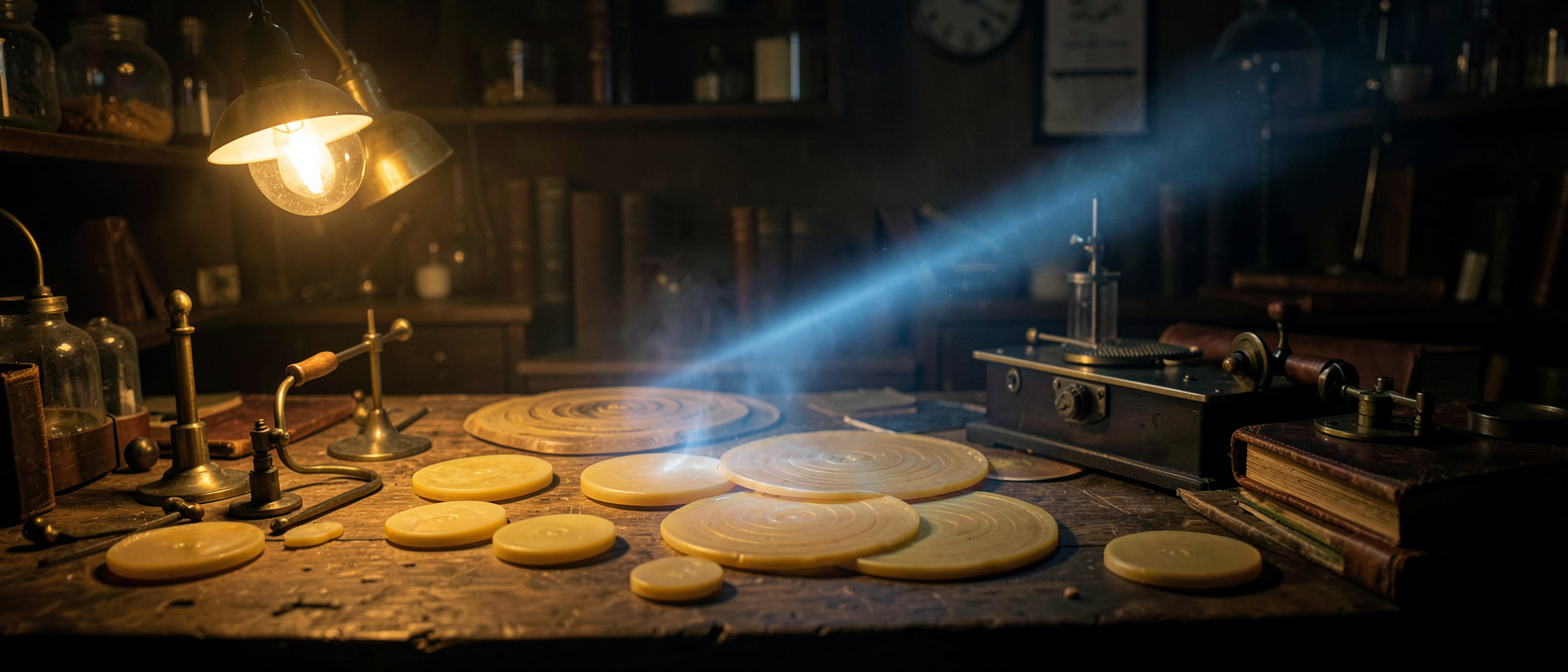
These aren’t durable vinyl records. Bell’s discs ranged from 4 to 14 inches (10 to 36 cm) across, often built from wax layered over cardboard or fiberboard, materials never meant to survive over a century, let alone get played. A standard needle drags through a groove, physically touching every bump that encodes sound; on brittle nineteenth-century wax, that contact would crumble the grooves. Curator Carlene Stephens of the National Museum of American History called them “mute artifacts.” Preserving them meant never playing them, leaving sound recordings that no conventional method could make audible.
A Camera That Listens
The fix came from outside museum work. Physicist Carl Haber at Lawrence Berkeley National Laboratory had already solved a nearly identical puzzle in 2003, recovering audio from 1860 Paris recordings, among the oldest known, without touching them with a stylus. His system, IRENE, treats a groove like terrain instead of something to touch: a camera scans the disc’s surface, taking thousands of high-resolution images mapping every wobble, and software calculates how a stylus would have traveled through those grooves, converting that motion into a digital sound file.
Stephens reached out to Haber, and in 2011 he teamed up with physicist Earl Cornell and Library of Congress specialist Peter Alyea to run Bell’s Volta Lab discs through the process. Muffled voices came back: someone reciting Hamlet’s soliloquy, strings of spoken numbers, a line of “Mary Had a Little Lamb.” One of the first words recovered, fittingly plain, was “barometer.”
Hearing Them Was Only Half the Job
Getting sound out of a disc doesn’t tell you what it means. Many labels scratched into the wax were faint scrawls with no track listing to go by. In autumn 2011, sound-media historian Patrick Feaster of Indiana University, working with Stephens, matched those scraps of handwriting to lab notebooks and known Volta Laboratory activities, building an index for an archive nobody had ever been able to read. Recovering a signal and recovering its meaning turned out to be different jobs, one physics, the other patient work with a magnifying glass and someone else’s handwriting.
April 15, 1885: A Voice Comes Back
Feaster’s label work eventually led to a wax-and-cardboard disc bearing a faint inscription: April 15, 1885. Matched against lab documents, that disc held a recording that closes with a voice stating its own name, the date, and the address of the Volta Laboratory at 1221 Connecticut Avenue, ending with “in witness whereof, hear my voice, Alexander Graham Bell.”
The Smithsonian, the Library of Congress, and Lawrence Berkeley National Laboratory later named the project “Hear My Voice” after this disc, a recording made before the automobile was common, before radio, before either World War, that stayed silent for nearly 130 years before coming back without anyone ever touching the object that held it.
What We Still Don’t Know
The record doesn’t spell out every step of how that voice was confirmed as Bell’s specifically, beyond the disc’s own recorded statement naming him and dated April 15, 1885. Bell isn’t the only voice in the archive: other Volta discs captured his cousin Chichester and his father, Alexander Melville Bell, among others who passed through the lab.
The bigger open question is scale. Of the more than 400 discs and cylinders in the collection, researchers have so far recovered sound from around 20. A later restoration effort aimed to bring roughly 300 more back to life. Most of Bell’s archive, in other words, is still waiting for its turn to speak.