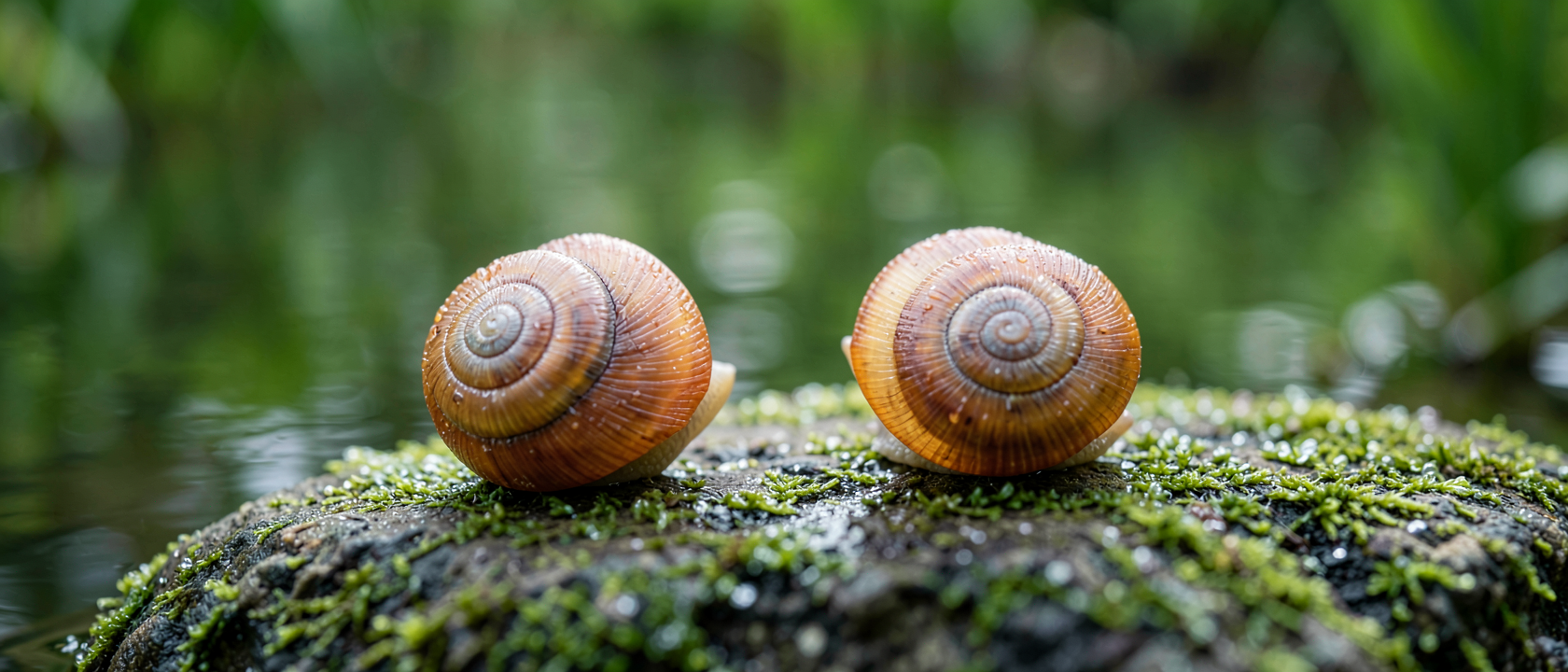
You’re Not as Symmetrical as You Look
Look in a mirror: two eyes, two ears, a face that splits evenly down the middle. Hands look like matching copies of each other.
Open things up, though, and that balance disappears. Most people’s hearts sit toward the left, the liver sits to the right, and most people favor one hand over the other for almost everything. A small number of people are born with every organ mirrored, a condition called situs inversus, usually without any problems. That’s the clue: if a complete flip still works fine, the side an organ ends up on isn’t random. It’s a decision made the same way, every time, across an entire species.
When Does Your Body Decide Which Way Is Left?
Does sidedness build up gradually, as organs jostle into place over weeks, or is it locked in earlier than most people would guess? Nobody can run that experiment on a human embryo, so researchers turned to a simpler stand-in: a pond snail, whose shell spirals one direction for life, almost like a record of a decision made long before anyone could see it.
Ping-Pong Balls on Tennis Balls
In November 2009, Reiko Kuroda, a chemist at the University of Tokyo who studies chirality, published findings in Nature on the great pond snail, Lymnaea stagnalis, whose shell coils either clockwise (dextral) or counterclockwise (sinistral).
The embryo starts as a single cell, splitting into two, then four, all evenly sized. At the next division, the split turns uneven: small cells land on top of larger ones, like ping-pong balls balanced on tennis balls. Those small cells rotate, clockwise or counterclockwise, settling into the grooves beneath them, and that rotation at the eight-cell stage decides which way the entire shell will spiral as the snail grows, long before any shell exists. Some later reporting has suggested the asymmetry may actually be traceable even earlier, back to the single fertilized egg, though Kuroda’s own published results point specifically to this eight-cell step; the exact earliest moment is still debated among sources.
Nudging Fate with a Glass Rod
Kuroda’s team tested this directly. With a thin glass rod, they rotated the small cells of more than 100 eight-cell embryos in the opposite direction from normal. About 78% of those snails grew up with reversed shells, spiraling the “wrong” way, while staying perfectly healthy and fertile. The same nudge did nothing at the two-cell or four-cell stage, only in that one eight-cell window, meaning the tendency toward one direction may be genetic, but the outcome itself comes down to a physical rotation that can briefly be nudged by hand.
Written In Before the First Split
Part of the answer predates the embryo itself. In Lymnaea stagnalis, twist direction is set by a single gene inherited from the mother, with the right-coiling version dominant, meaning the tendency is already fixed before the fertilized egg has even split once, even if the physical rotation that carries it out happens a few divisions later.
In 2016, Angus Davison of the University of Nottingham and Mark Blaxter traced that gene to a formin, a protein that helps build a cell’s internal scaffolding. A single disabling change in one copy of that gene, just one letter out of roughly a billion in the snail’s genome, was enough to flip a snail from right-coiling to left-coiling. Kuroda’s team later confirmed the gene, named Lsdia1, using CRISPR editing: snails lacking a working copy grow shells that spiral left.
The Same Trick in a Frog’s Heart
If a formin really sets left from right, it should matter outside of snails too. Davison and Blaxter tested that in frogs, blocking formin with a drug or injecting extra amounts. Frog hearts, which normally settle on one particular side, ended up on the opposite side instead.
Snails and frogs sit far apart on the evolutionary tree, so the same protein doing the same job in both hints at a shared, ancient trick for setting sidedness, not a snail-only quirk. That doesn’t prove human development works exactly the same way, but it’s a real clue the underlying machinery runs deep.
Why Does One Side Usually Win?
None of this explains why one direction tends to dominate across a species instead of splitting evenly. Most people are right-handed. Most pond snails coil right. The mechanism explains how one embryo ends up one way, not why evolution keeps favoring that side.
Whether this exact formin-based mechanism plays out the same way in human development is still unresolved. The frog experiment is the clearest cross-species clue researchers have, not a finished map.
What’s no longer in question is the timing. The asymmetry you carry around, heart left, liver right, a favorite hand, never drifted into place as you grew. By every account, it was settled astonishingly early, among the very first decisions your body ever made.