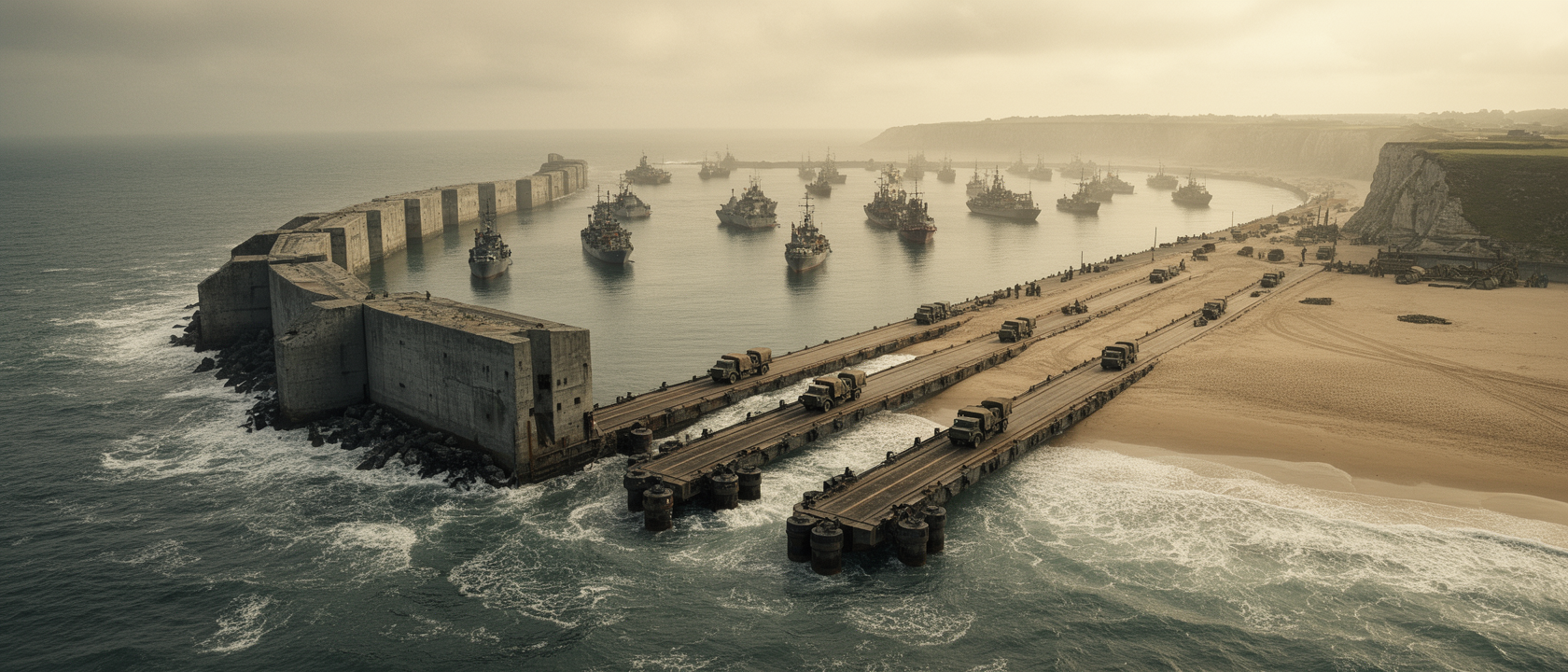
The Harbor They Built in England and Towed to France
By June 1944, the Allies had a plan to invade Nazi-occupied France. What they didn’t have was a way to keep more than 156,000 soldiers fed, fueled, and armed once they got there. A modern army needs a port. The Germans knew that too, which is why they had fortified every major port on the French coast into a fortress.
The solution was, on its face, absurd: build a harbor in England, cut it into pieces, tow it across the English Channel, and assemble it on an open beach in under three weeks. It worked.
What Dieppe Made Clear
On August 19, 1942, a combined Allied force of roughly 6,000 troops, predominantly Canadian, raided the port of Dieppe. The port’s geography gave the defenders a perfect kill zone. Of the 6,086 soldiers who went ashore, roughly 68% became casualties, and about 907 Canadians were killed. The operation lasted less than ten hours before the retreat order came.
Royal Navy Captain John Hughes-Hallett, returning from Dieppe, reportedly framed it plainly: if a port couldn’t be captured, one would have to be brought along. That became the organizing logic of everything that followed.
The Wall They Couldn’t Punch Through
On March 23, 1942, Hitler issued Directive No. 40, ordering a defensive line along the entire western coast of occupied Europe. The Atlantic Wall eventually ran thousands of kilometers from Norway to the Spanish border, built from 17 million cubic meters of concrete and 1.2 million tonnes of steel across roughly 15,000 fortified sites. Major ports including Cherbourg, Brest, and Antwerp were designated “Festungen” (fortresses), with orders to hold until destroyed. Capturing one fast enough to be useful during an invasion wasn’t a plan; it was a wish.
The Design Competition Nobody Knew About
Between June 28 and July 2, 1943, a conference codenamed “Rattle” convened in Largs, Scotland. Engineers pitched competing designs for a portable harbor. The core problem was consistent: how do you build a stable platform on an open beach where tides rise and fall by 7 meters?
Ronald Hamilton’s “Swiss Roll”, a flexible roadway of canvas and hinged wooden planks, collapsed under a 3-ton truck in under two hours and couldn’t support loads over 7 tons. Welsh civil engineer Hugh Iorys Hughes proposed the “Hippo”: floating concrete caissons topped with an articulated metal roadway. More robust, but it couldn’t rise and fall with the tide, leaving a fixed-height platform either submerged or stranded in mud for half the day.
The System That Held
The winning design came from Colonel William Everall, Major Allan Beckett, and Cambridge biology professor John D. Bernal. Their system had three interlocking parts.
“Spuds” were large floating pierheads mounted on vertical legs resting on the seafloor. As the tide moved, the platform slid up or down those legs, staying level with the water’s surface regardless. “Beetles” were the steel or concrete pontoons supporting the roadway between shore and pierhead. “Whales” were flexible steel spans laid across those pontoons: rigid enough to carry tanks, articulated enough to move with the swell without cracking. Prototypes were tested at Garlieston and in wave-making tanks at the National Physical Laboratory in Teddington. The design held through both.
What It Actually Moved
Two Mulberry harbors were deployed. Mulberry A went in off Omaha Beach near Saint-Laurent-sur-Mer for the American forces. Mulberry B was assembled off Gold Beach at Arromanches for the British, later nicknamed “Port Winston.” Each was specified to move 12,000 tons of cargo and 2,500 vehicles per day.
A storm on June 18–19, 1944, described as the worst June gale in the Channel in forty years, wrecked Mulberry A beyond repair. Salvaged components reinforced Mulberry B, which kept running. Over roughly ten months of operation, Mulberry B processed more than 2.5 million troops, 500,000 vehicles, and 4 million tonnes of supplies, what “turning a landing into a campaign” actually looks like, measured in cargo.