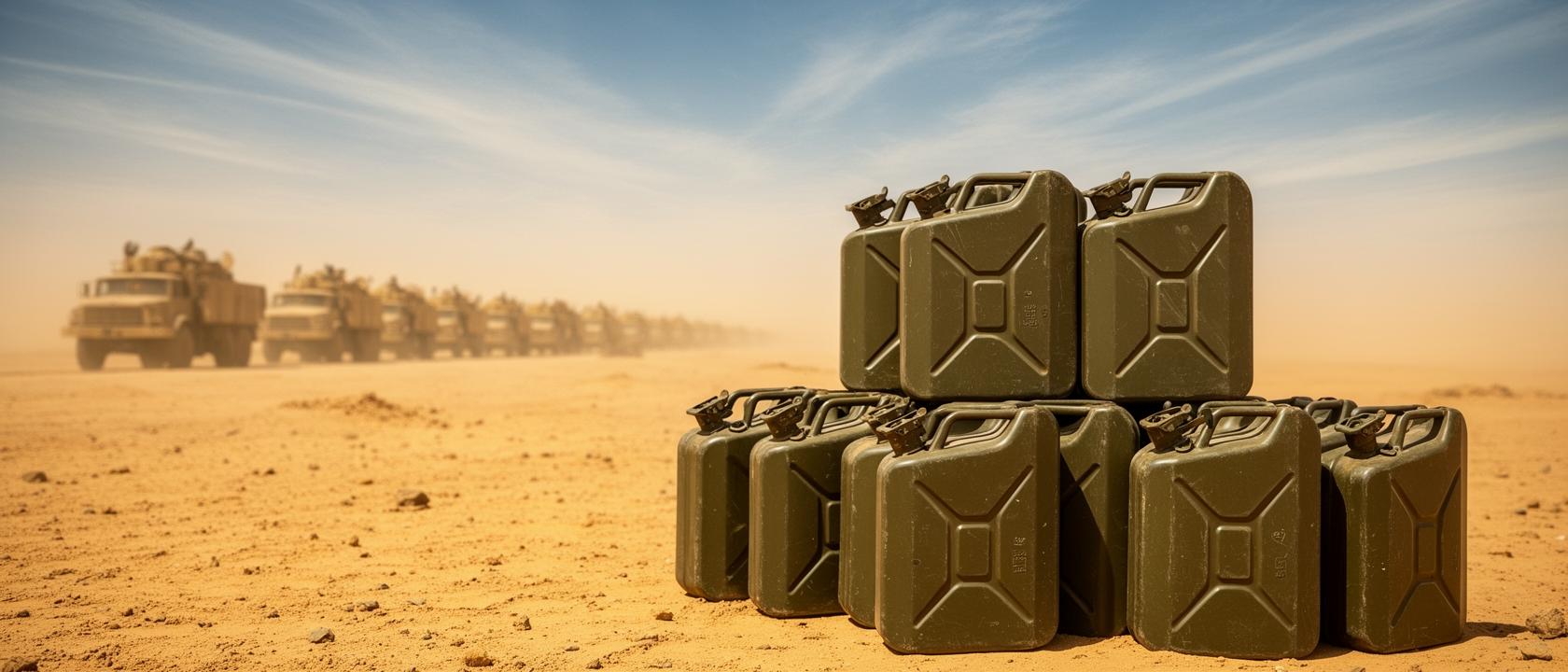
Mechanized warfare runs on fuel. By 1942, the British Eighth Army in North Africa understood this better than anyone: before a single drop of gasoline reached a vehicle, roughly 30% of it was already gone.
The High Cost of a Leak
The container responsible was called the Petrol, Oil and Water can, universally known as the “Flimsy.” Made of thin sheet tinplate with crimped, soldered seams, it split and leaked under desert transport conditions. General Auchinleck estimated losses of over 30%, with some shipments losing around 20% and others well over 50%. The First Battle of El Alamein, in July 1942, stalled partly because armored units lacked the fuel to maneuver freely. A motorized army that cannot move is not much of an army.
What made it worse was how fixable the problem was. The Germans had already fixed it.
The Engineering of the Jerry Can
In 1937, engineer Vinzenz Grünvogel at the Müller firm of Schwelm completed the Wehrmacht-Einheitskanister, “Armed Forces Standard Canister.” A similar design had been quietly field-tested during the Spanish Civil War in 1936. Hitler had specifically identified fuel logistics as the weakest link for fast-moving Panzer divisions, and the can’s development was kept secret.
The can held 20 liters. Two halves of thick stamped steel were welded together, with seams recessed into the body to absorb impacts. X-shaped indentations in the side walls let the metal expand and contract with temperature changes. A plastic lining, adapted from steel beer barrels, prevented corrosion and allowed the same can to carry either gasoline or drinking water.
Three handles let one soldier carry two full cans or four empty ones, and the hollow handles trapped enough air that a full can would float. The spout had a built-in air tube for smooth pouring and a snap-close lid requiring no wrench and no funnel. The rectangular shape stacked cleanly in a truck bed. The design left nothing to accident.
The Pragmatism of Adoption
Allied forces encountered German cans during the invasion of Norway in 1940 and again in North Africa. The quality difference was apparent to anyone who handled both. The design reached the United States through Paul Pleiss, an American engineer who in the summer of 1939 left Berlin on an overland drive toward India with a German colleague carrying three Jerry cans obtained from a Luftwaffe stockpile at Tempelhof Airport. The cans performed without incident across eleven national borders. When Göring ordered the German engineer recalled mid-journey, the engineer gave Pleiss the full manufacturing specifications before leaving.
Pleiss had the car shipped back to the United States, arriving in the summer of 1940. One can went to Camp Holabird, Maryland, for Army evaluation, and the result was a version with rolled seams instead of welded ones, no plastic lining, and a spout still requiring a wrench. They had built a slightly different Flimsy.
The real correction came in September 1942, when Richard M. Daniel, a quality control officer posted to the Middle East, passed through Cairo and submitted a report to Washington pushing for a direct, unmodified copy of the German design. This time, production followed.
The Logistics of Victory
Close to 2 million Allied-produced Jerry cans reached North Africa in 1943. By October 1944, the Allied advance through France was moving more than a million gallons of gasoline per day, most of it in these cans. By May 1945, over 19 million cans had been produced for US forces in the European theater. The scale of demand was staggering: 3.5 million cans went missing in October 1944 alone, and the Army offered prizes to French schoolchildren to recover empties, eventually collecting over a million cans that way.
In 1944, Franklin Roosevelt put the matter plainly: “Without these cans it would have been impossible for our armies to cut their way across France at a lightning pace which exceeded the German Blitz of 1940.” The can he was describing had been designed in Schwelm in 1937, tested in Spain, carried across eleven borders in 1939, and copied into mass production in 1943. The welded seams, the triple handles, the snap-close spout: the design has not meaningfully changed since.