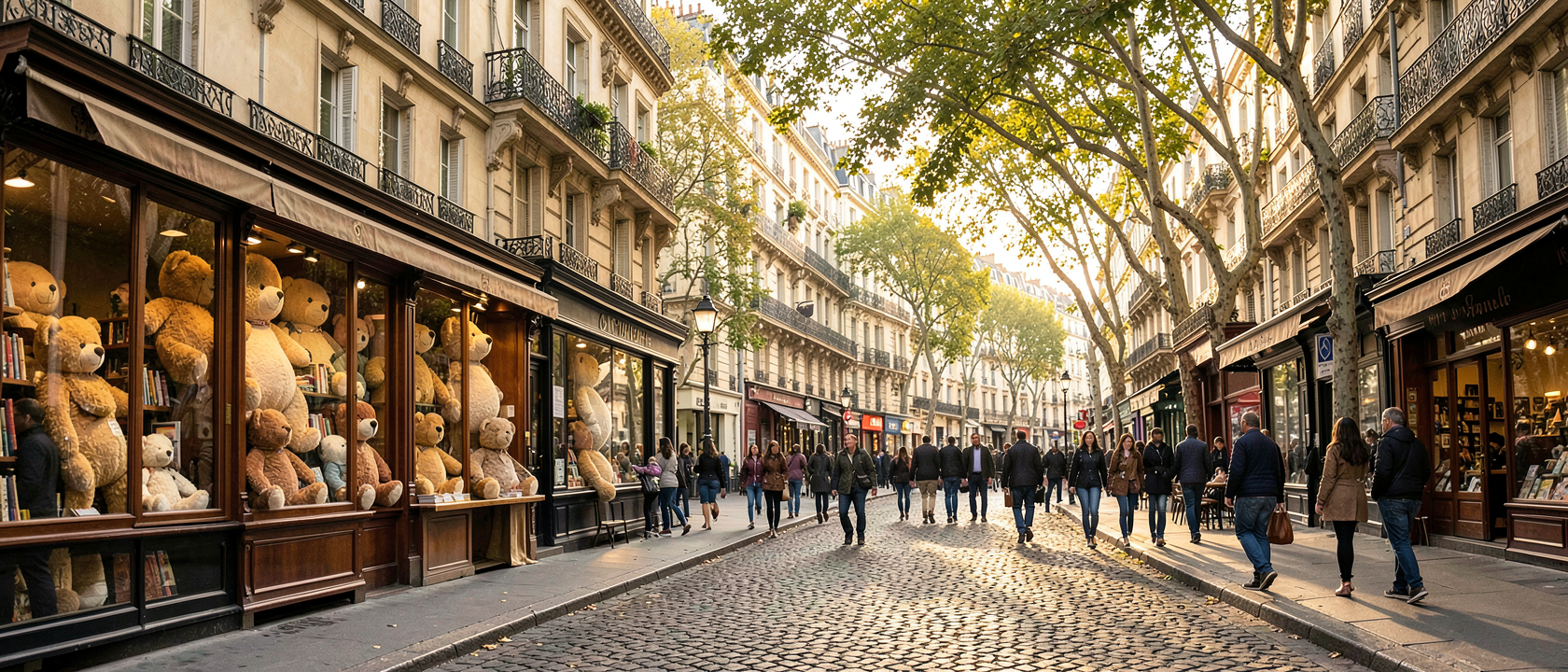
Something Odd on Avenue des Gobelins
Paris’s 13th arrondissement isn’t short on charm, but one short stretch of Avenue des Gobelins, about 984 feet (300 meters) long, started drawing a different kind of attention in 2018. A giant teddy bear turned up in a bookshop window, tall enough to reach a grown adult’s shoulder. Another sat on a café chair outside, settled in like a regular customer. No price tag, no explanation, just a bear sitting there as if it had always belonged.
Locals started calling them “les nounours des Gobelins,” the teddy bears of the Gobelins, a nickname casual enough to show how fast people stopped questioning the scene and simply folded it into daily life.
Who’s Doing This, and Why?
Here’s where it stopped being cute and got genuinely strange. Nobody on the street could say who was behind it. Shopkeepers and neighbors all had guesses, and none matched. The bears weren’t a one-time stunt either: they kept reappearing, week after week, in new windows and on new terraces, as if the block had adopted a rotating population of stuffed residents.
That pattern turned a funny photo into a running local story. Was it art? A marketing trick? A private joke the whole neighborhood had stumbled into? For a while, every answer was just a guess.
Meet Philippe, Father of the Teddies
The person behind it turned out to be a bookseller who owns a small newsstand-bookshop called Le Canon de la Presse, at 25 Avenue des Gobelins. He goes only by a self-given nickname, “Philippe, le papa des nounours”, “Philippe, the Teddy Bear Father.”
His own account of how it started is almost deflating: no manifesto. By his telling, it began with his own oversized teddy bear, Gorille, who seemed to need a companion, a doudou, the plush object a toddler drags everywhere. After he found one, he came across three more bears that looked like triplets and couldn’t bear to split them up, so all three came home too. When the trio never returned from a trip to Copenhagen, he found more bears, decided they were cousins, and started naming them.
That’s the whole origin story: no symbolism, no campaign. What people assumed was a carefully designed art project was, in his telling, just a bookseller who kept adopting bears until he had more than he knew what to do with, so he started lending them out. The spread wasn’t engineered by him; it happened because other people noticed, photographed, and shared it on their own.
From One Street to Sri Lanka
The first bear appeared in June 2018. By mid-October of that year, Philippe had turned the habit into something semi-official: lend a bear for 48 hours, always free, then post the photos. Six nearby businesses joined at first. Before long the Grand Hôtel des Gobelins displayed 37 bears in its windows at once, and the local police station borrowed two, naming them Starsky and Hutch.
Most bears stand 4 feet 7 inches (1.4 meters) tall and weigh around 11 pounds (4.9 kilograms). One giant, at 7 feet 10 inches (2.4 meters), still sits in the window of the first bookshop that took one in, surrounded by books.
A little over a year after that first window appearance, sightings had spread to Montmartre, to other parts of France, to New York City, where one bear turned up on the Friends couch, and to Sri Lanka. A growing Instagram gallery tracking it all passed 50,000 followers across platforms. Not even Philippe can say for certain which far-flung sightings are bears he placed himself and which are copycats who saw the photos and ran with the idea.
Why This Is the Part Worth Remembering
Ask Philippe why it kept growing and he doesn’t have a tidy answer, not because he’s being modest, but because there genuinely isn’t one. There’s no ad campaign, no funding plan, no strategy document. It was just a bookseller with a soft spot for oversized stuffed animals, and thousands of strangers who each decided, on their own, that a bear in a window was worth a photo.
This is roughly how most things like this spread: not through a mastermind pulling strings, but through one small, odd gesture that other people pick up and carry further than its creator ever expected. The next small, strange thing you spot on a walk might already be further along than you think.