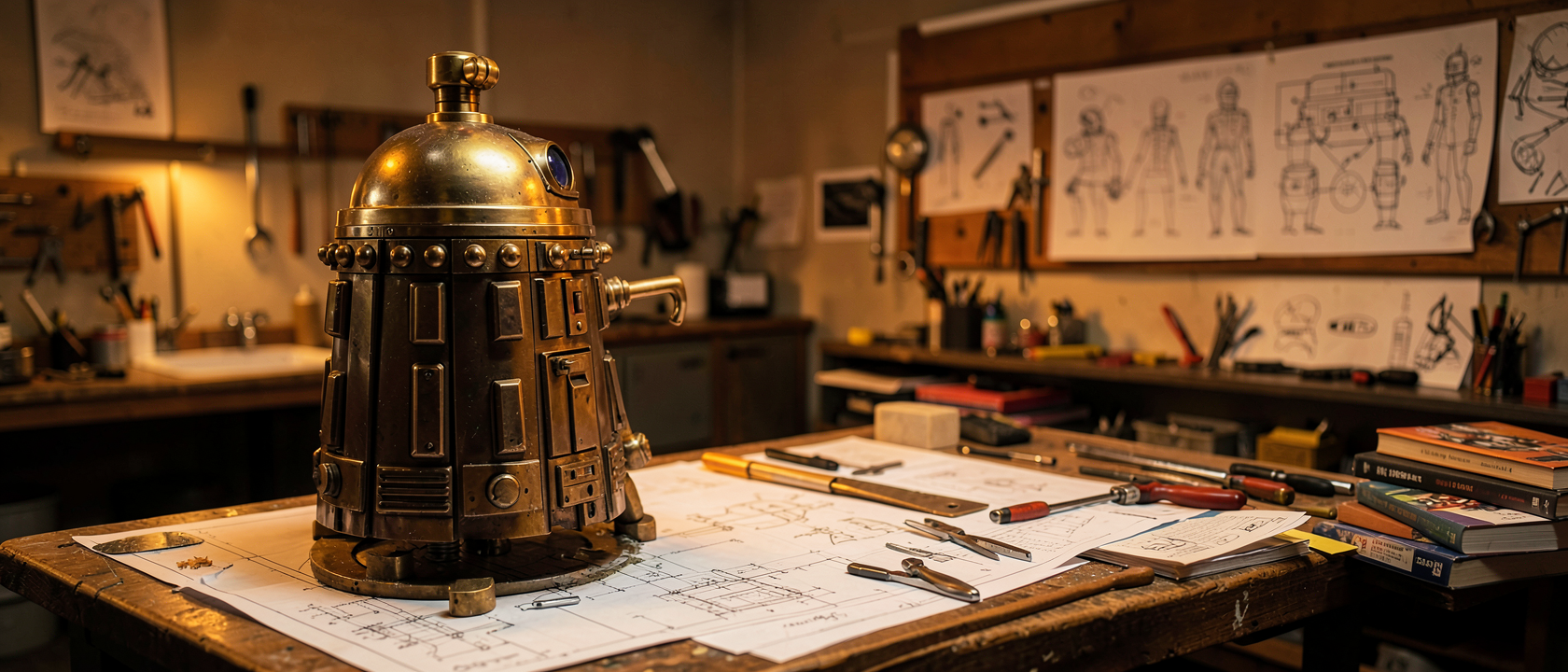
Somewhere, Someone Is Building a Dalek in Their Garage
Picture a Dalek: the pepper-pot-shaped alien that glides across a floor, eyestalk twitching, gun arm humming, a flat metallic voice ordering someone to “EXTERMINATE.” Now picture it not on a BBC soundstage but in a garage in some ordinary town, built from scratch by a fan with no studio budget and no official help. That scene is real, and an organized online community exists entirely to make it possible, with its own name, manual, and shared body of knowledge passed between strangers who’ve never met. Finishing a full-size, moving, speaking replica of a sci-fi robot sounds like something almost nobody could pull off alone. People keep finishing it anyway.
What Does It Actually Take to Build One?
Building a Dalek is closer to building a small vehicle than sewing a costume. The shell must curve correctly across dozens of panels, usually molded in fiberglass, while the midsection rotates smoothly so the head assembly can turn independently from the base. Inside, a hidden drive system moves the whole thing across a floor without a wobble, while working lights pulse in sync with a voice modulator and the gun and eyestalk mechanisms operate. None of this ever came with a public instruction manual. The Daleks first rolled onto British television in “The Daleks,” broadcast in parts from December 21, 1963, to February 1, 1964. The character was created by writer Terry Nation and physically designed by Raymond Cusick for broadcast, not for home workshops, so no official guide ever existed for a fan who wanted to build one. So where would an ordinary person even start?
The Reveal: Project Dalek and the Builder’s Bible
That gap is exactly what the fan-run site Project Dalek was built to close. Made by Doctor Who enthusiasts for other enthusiasts, its centerpiece is a document the community calls the Dalek Builder’s Workshop Manual, described on the site as the “builder’s bible”: everything needed to construct a full-size Dalek, gathered in one place. The site also hosts downloadable plans covering nearly every design era the Daleks have worn on screen, from the original 1960s look through the 1970s version, the 1980s Imperial and Renegade models, the 2005 “New Series” redesign, and the newer “New Dalek Paradigm” shape, plus custom designs exclusive to the project and plans for Davros’s chair from both classic and newer eras. There’s even a section on fiberglass work, the material most full-size shells are built from. Access requires joining: a paid “Active” membership grants instant entry, while a free sign-up sits in a validation queue the site admits can take a while. Either way, what once existed only inside a BBC workshop is now a download away.
A Community Built on Participation, Not Perfection
What gets posted and celebrated on the site covers a wide range. Some members build tabletop-scale models that fit on a shelf; others spend years on full-size, motorized replicas that move under their own power; others skip the workshop entirely and build digital Daleks rendered in 3D software. The forum’s “Members’ Build Diaries,” called the heart of the community, treats all three equally: a finished render gets the same enthusiasm as a half-built fiberglass shell in someone’s garage. One builder, documenting his project on GitHub, downloaded the plans free from the Project Dalek forum and found them detailed enough to scale down, building his own Dalek at roughly two-fifths scale by treating every inch on the life-size plan as one centimeter. Nobody’s Dalek gets dismissed for being small, digital, or unfinished, devotion counts for more here than polish.
The Catch: What the Manual Doesn’t Tell You
Worth noting: the manual’s reputation as the definitive guide comes entirely from the community that uses it, not from any independent review or official endorsement. It’s treated as gospel because enough builders say so, making it something closer to a crowd-sourced legend than an audited technical standard. The site doesn’t publish who administers the project, how many people have actually finished a build, or what baseline skills, welding, wiring, fiberglass work, a newcomer genuinely needs before starting. There’s an irony underneath it all: a fictional villain famous for demanding total obedience is being recreated by a completely voluntary, loosely organized network of strangers who owe each other nothing but shared enthusiasm. And because nobody keeps a public count, there’s no real way to know how many finished Daleks are sitting in garages and basements, quietly waiting for someone to flip the switch.