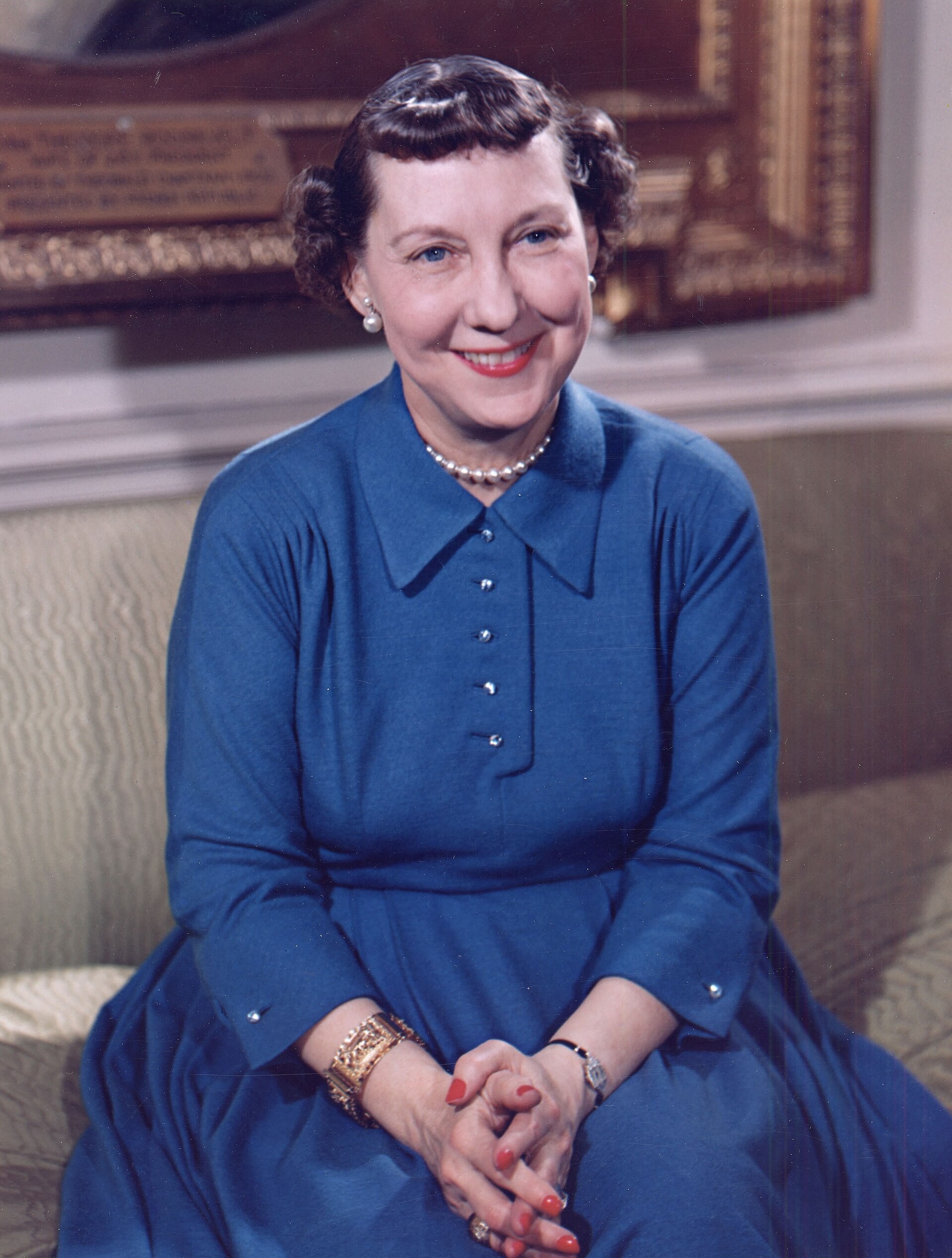
Mamie Geneva Doud Eisenhower was born on November 14, 1896, in Boone, Iowa, and served as First Lady of the United States from 1953 to 1961 alongside President Dwight D. Eisenhower. Over 37 years as an Army wife she relocated at least 27 times, following her husband to posts across the United States, Panama, the Philippines, and France, before arriving at the White House. Her eight years there left a visible mark on American domestic culture, from the china displayed in the White House China Room to the color pink, which she made a national fashion. She died on November 1, 1979, in Washington, D.C., at age 82.
Key facts
- Born: 14 November 1896
- Birthplace: Boone
- Died: 1 November 1979
- Place of death: Washington, D.C.
- Country: United States
- Occupation: dancer; writer; politician
- Education: East High School
- Awards: Colorado Women’s Hall of Fame; Iowa Women’s Hall of Fame; Hasty Pudding Woman of the Year
Early Life and Family
Mamie Geneva Doud was born at 718 Carroll Street in Boone, Iowa, the second of four daughters of Elivera Mathilde Carlson and John Sheldon Doud. Her father owned and managed a meat packing plant in Boone; the business proved profitable enough that he retired at thirty-six and moved the family to Denver, Colorado.
Her name carried an unusual origin. According to the Mamie Doud Eisenhower Birthplace Foundation, she was named in part after the popular song ‘Lovely Lake Geneva.’
In Denver, Mamie attended local public schools and then graduated from the Wolcott School, a private finishing school for girls, in 1915. When her father offered to send her to college afterward, she declined.
Meeting Dwight and the Army Years
In October 1915, Mamie visited Fort Sam Houston in San Antonio, Texas, where she met Second Lieutenant Dwight D. Eisenhower. The couple announced their engagement on February 14, 1916.
The decades that followed were defined by constant movement. Mamie estimated that across her 37 years as an Army wife she had unpacked her household at least 27 times, moving between postings in the United States, Panama, the Philippines, and France.
World War II tested the marriage severely. While Dwight served in Europe, Mamie lived at the Wardman Park Hotel in Washington, D.C., and volunteered with other Army wives at a Red Cross canteen. She wrote to her husband almost daily; he wrote back 319 letters over the course of the war, yet the couple saw each other only twice during those years. At one stretch she went three full years without seeing him. Dwight was the only one of the World War II five-star generals to spend those years apart from his wife.
First Lady, 1953–1961
When Dwight Eisenhower won the presidency, Mamie brought to the White House both the organizational habits of a career military spouse and a strong sense of style. The Eisenhowers hosted approximately 70 official foreign visitors during their two terms, more heads of state than any presidential couple before them.
During President Eisenhower’s second term, Mamie turned attention to the White House china collection, studying its history and rearranging its exhibition in the China Room in collaboration with Smithsonian curator Margaret Brown Klapthor.
She also took symbolic steps against segregation: she invited African-American children to the White House Easter Egg Roll and accepted an honorary membership in the National Council of Negro Women.
After Dwight suffered a heart attack in September 1955, Mamie assumed both local and national chairmanship of the American Heart Association’s fundraising drive in 1956. That campaign produced a 70 percent increase in income and pushed the volunteer force to 750,000.
Health and the Alcoholism Rumor
Mamie suffered from Meniere’s disease, an inner-ear disorder that caused severe bouts of dizziness and sometimes made her stumble in public. The visible unsteadiness gave rise to persistent rumors that she drank heavily. Those rumors reached print in the June 7, 1959, issue of the National Enquirer; the claims were unfounded.
Later Years and Death
In 1968, Mamie’s grandson David Eisenhower married Julie Nixon, daughter of Richard Nixon, linking the two political families. Mamie later appeared in a campaign commercial for Nixon in 1972.
On September 25, 1979, Mamie suffered a stroke at the farm in Gettysburg, Pennsylvania, and was admitted to Walter Reed Army Medical Center. She died in her sleep on November 1, 1979, at age 82.
Recognition and Legacy
Mamie Eisenhower holds a geographic distinction: she was only the second First Lady born west of the Mississippi River. The first was Lou Henry Hoover, born in 1874 in Waterloo, Iowa.
On June 22, 1980, her birthplace in Boone, Iowa, was dedicated as a historic site. Abigail Adams is the only other First Lady to have been honored with a designated birthplace historic site in that way.
Her recognitions include induction into the Colorado Women’s Hall of Fame, the Iowa Women’s Hall of Fame, and the Hasty Pudding Woman of the Year award.
Did you know
- Mamie’s love of pink ran deep enough to reshape American consumer taste. Her favorite shade became known as “Mamie pink,” setting off a national trend for pink clothing, housewares, and bathrooms throughout the 1950s. Reporters began calling the White House “the Pink Palace.” (historyfacts.com)
- Mamie estimated that across her 37 years as an Army wife she had unpacked her household at least 27 times, moving between postings in the United States, Panama, the Philippines, and France. (obamawhitehouse.archives.gov)
- The Eisenhowers hosted approximately 70 official foreign visitors during their two White House terms, more heads of state than any presidential couple who had occupied the mansion before them. (kids.kiddle.co)
- Mamie was named “Mamie Geneva Doud” in part after the popular song “Lovely Lake Geneva,” according to the Mamie Doud Eisenhower Birthplace Foundation. (mamiebirthplaceboone.org)
- During World War II, Mamie lived at the Wardman Park Hotel in Washington, D.C., and worked alongside other Army wives at a Red Cross canteen. At one point she went three years without seeing Dwight, making him the only World War II five-star general to spend the war years separated from his wife. (home.nps.gov)
Data sources
- Wikidata
- mamiebirthplaceboone.org
- nps.gov
- whitehousehistory.org
- home.nps.gov
- potus-geeks.livejournal.com
- history.com
- washingtonpost.com
Data updated: 2026-10-28