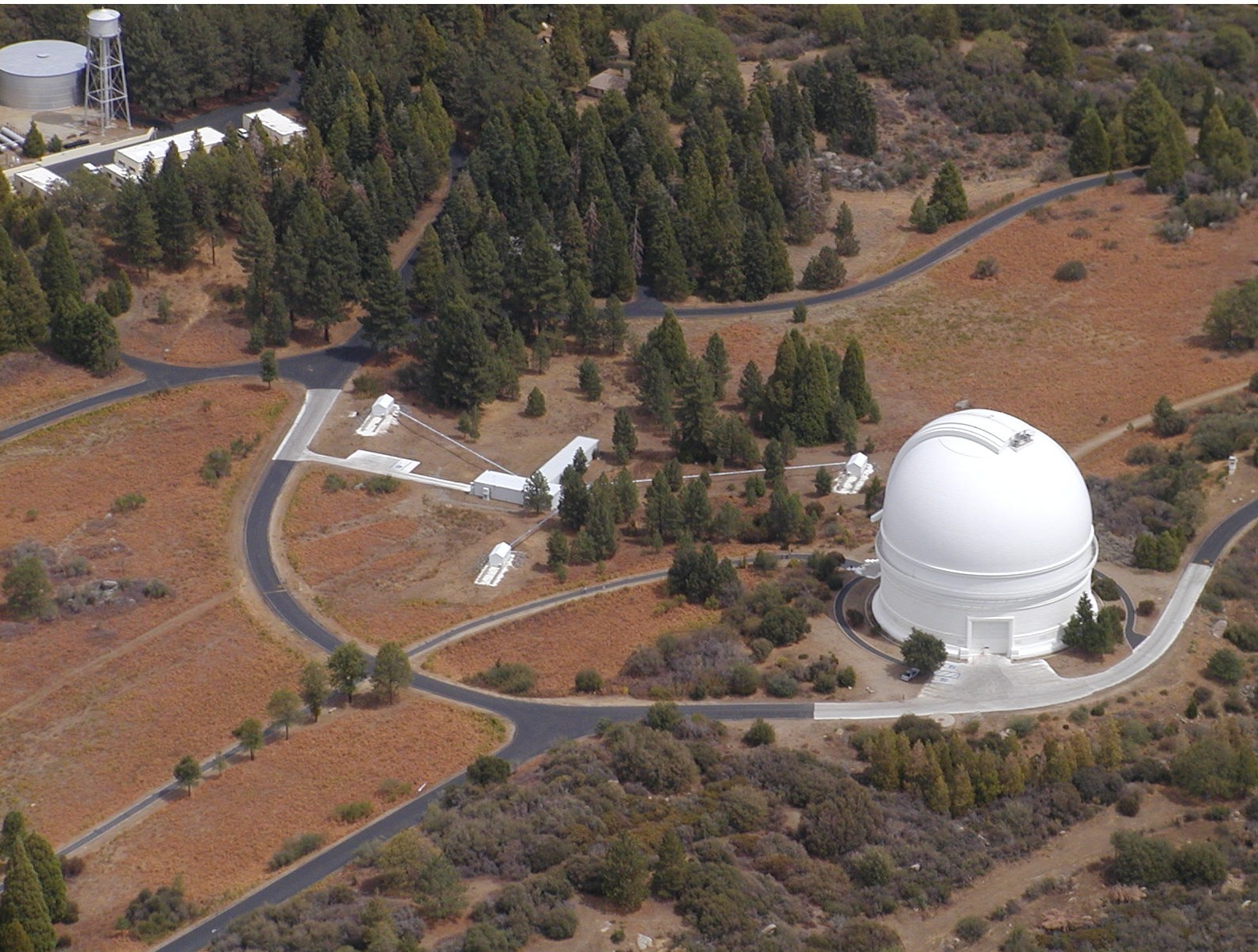
Palomar Observatory sits at 1.7 kilometres elevation on Palomar Mountain in San Diego County, California, and has been operated by the California Institute of Technology since its founding in 1928. The facility is home to several telescopes, the most celebrated of which is the 200-inch Hale Telescope, whose 5.1-metre primary mirror was for decades the largest in the world. From this single site, astronomers have identified the first known quasar, confirmed the existence of brown dwarfs, catalogued the northern sky in its entirety, and added several dwarf planets to the solar census.
Key facts
- Country: United States
- Type: astronomical observatory
- Located in: San Diego County
- Coordinates: 33.3564, -116.8650
- Elevation: 1.7 km
- Founded: 1928
Origins and funding
The observatory’s story begins with astronomer George Ellery Hale, who in 1928 secured a grant of $6 million from the Rockefeller Foundation’s International Education Board to build an observatory centred on a 200-inch reflecting telescope, to be administered by Caltech. Hale already had an extraordinary record: he had previously built the world’s largest telescope four successive times, culminating in the 100-inch Hooker reflector at Mount Wilson in 1917. The 200-inch project was his most ambitious attempt yet.
Choosing the right mountain took years of systematic work. Between 1929 and 1934, surveyors tested several candidate sites using 4-inch refracting telescopes to measure atmospheric seeing conditions. Palomar Mountain was selected in 1934 as the best location available in Southern California.
Building the Hale Telescope
The telescope’s primary mirror presented the greatest engineering challenge. The 200-inch disk is a Pyrex blank that weighs 14.5 tons (13 tonnes) and is coated with a thin reflective layer of aluminium. Casting it was not straightforward: the first attempt at Corning Glass Works failed on March 25, 1934, when steel bolts melted in the furnace heat and dislodged bricks from the mould, ruining that blank. A second casting succeeded, and that mirror eventually made its way to Palomar.
The finished telescope, not including its dome, weighs about 530 tons. Despite that mass, it floats on a thin film of oil supplied at 750 pounds per square inch of pressure, lifting the instrument 8/1,000 of an inch off its bearings so that it moves with almost no friction during observing. The piers supporting the telescope are anchored to bedrock 22 feet (6.7 metres) below the floor, and the dome supports extend about 7 feet (2.1 metres) into the underlying granite, keeping the structure isolated from ground vibrations.
The dome itself is 135 feet (41 metres) tall and 137 feet (42 metres) in diameter, proportions similar to those of the Pantheon in Rome. The rotating section of the dome alone weighs approximately 1,000 tons. The Hale Telescope was dedicated on June 3, 1948, in a ceremony attended by nearly 1,000 invited guests seated under the instrument on the observing floor, with speakers from Caltech and the Carnegie Institution.
The Samuel Oschin Telescope and sky surveys
A second major instrument, the Samuel Oschin Telescope, is a 48-inch (1.2-metre) Schmidt-type telescope whose first official photograph, taken on September 29, 1948, captured the Andromeda Galaxy, M31. The Oschin Telescope became the workhorse for large-area sky surveys.
Between November 1949 and December 1958, the National Geographic Society–Palomar Observatory Sky Survey (POSS I) used the Oschin to photograph the entire northern sky. The resulting atlas became the standard reference library for every major observatory worldwide.
Fritz Zwicky used the 48-inch Samuel Oschin telescope, alongside an 18-inch prototype, to discover more than 120 supernovae at Palomar, a total that held the record for the most supernova discoveries by a single astronomer until 2009. Decades later, Caltech astronomer Mike Brown and colleagues used the same instrument to discover the dwarf planets Quaoar in 2002, Sedna in 2003, and Eris in 2005.
Major discoveries
In 1963, Caltech astronomer Maarten Schmidt used the Hale Telescope to identify 3C 273 as the first known quasar, placing it approximately 3 billion light-years away. The result redefined the scale of energetic phenomena in the universe.
In October 1994, Palomar’s 60-inch telescope, equipped with the Adaptive Optics Coronagraph built at Johns Hopkins, was used to confirm the first known brown dwarf, Gliese 229B. Brown dwarfs occupy the gap between the heaviest planets and the lightest stars, and Gliese 229B was the first object firmly established in that category.
Current instruments and technology
The Hale Telescope continues active research, aided by the PALM-3000 adaptive optics system. PALM-3000 uses a deformable mirror with 3,388 actuators that reshape the mirror’s surface up to 2,000 times per second, compensating for the blurring effect of Earth’s atmosphere in real time.
The Samuel Oschin Telescope hosts the Zwicky Transient Facility camera, known as ZTF. The ZTF camera covers an area of sky equivalent to 240 times the size of the full moon in a single exposure, making it capable of detecting short-lived events, such as supernovae and other transients, that pass too quickly to be caught by instruments with narrower fields of view.
The site and public access
Palomar Mountain lies within the Palomar Ranger District of the Cleveland National Forest. The higher elevations around the observatory support bigcone Douglas-fir, black oak, incense cedar, and Coulter pine.
The observatory is open to the public on almost all days of the year. Classic guided tours of the 200-inch Hale Telescope are available on weekends from April through October; in 2026, the weekend tour season ran from April 11 through November 1.
Did you know
- The first attempt to cast the 200-inch mirror blank at Corning Glass Works failed on March 25, 1934, when steel bolts melted in the heat and dislodged bricks from the mould. That ruined disk is on display at the Corning Museum of Glass in New York. (sites.astro.caltech.edu)
- The Hale Telescope’s 530-ton mount is so precisely balanced that it can be pointed using a 3-horsepower motor for right ascension and only a 1-horsepower motor for declination. (sites.astro.caltech.edu)
- The dome of the Hale Telescope completes one full rotation in about 4 minutes. Four 7.5-horsepower motors drive it, and it rides on 32 carriages, each fitted with four wheels. (sites.astro.caltech.edu)
- George Ellery Hale, who secured the funding for Palomar, built the world’s largest telescope four times in succession: the 40-inch refractor at Yerkes in 1897, the 60-inch reflector at Mount Wilson in 1908, the 100-inch Hooker reflector at Mount Wilson in 1917, and finally the 200-inch Hale at Palomar. (sites.astro.caltech.edu)
- The ZTF camera on the Samuel Oschin Telescope covers an area of sky equivalent to 240 times the size of the full moon in a single image, allowing it to catch short-lived cosmic events that narrower instruments would miss entirely. (ipac.caltech.edu)
Data sources
Data updated: 2026-10-28