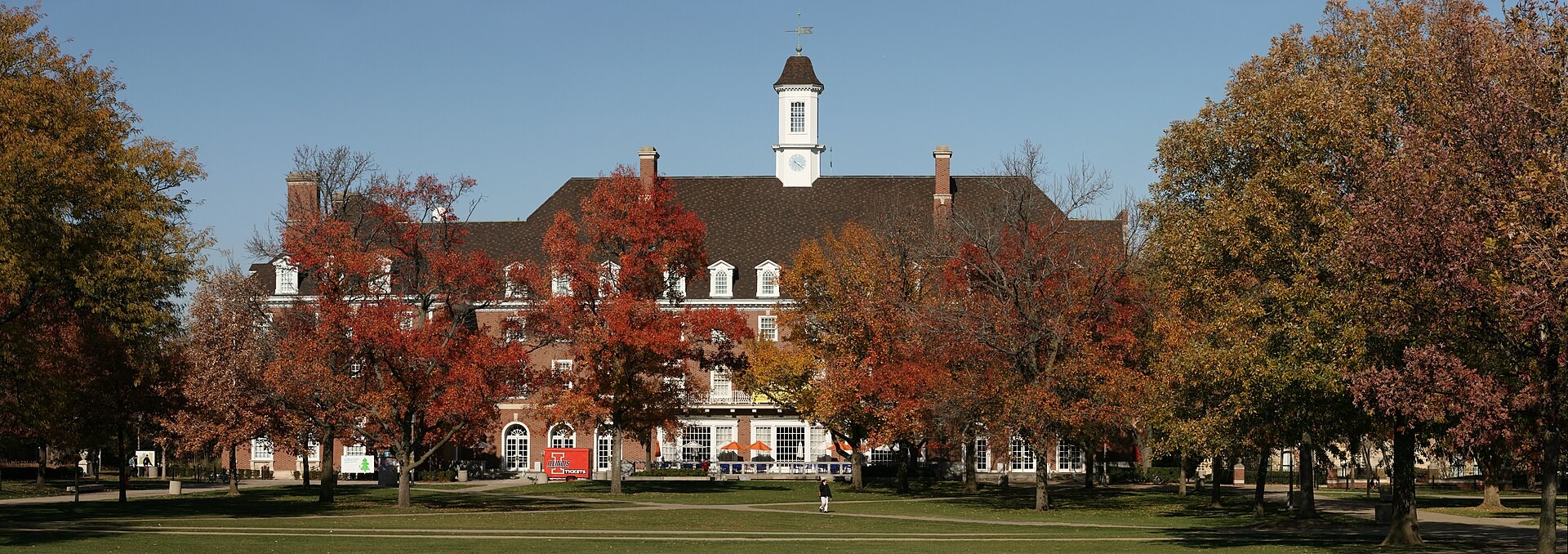
Founded in 1867 as a land-grant institution in the twin cities of Urbana and Champaign, Illinois, the University of Illinois Urbana-Champaign is one of the country’s foremost public research universities. It is classified by the Carnegie Classification as “R1: Doctoral Universities – Very high research activity,
Key facts
- Country: United States
- Founded: 1867
- Type: public research university; land-grant university; public educational institution of the United States
- Parent organisation: University of Illinois System
- Employees: 8,085
- Website: https://illinois.edu
Identity and Name
The institution has operated under several names across its history. From 1885 to 1982 it was known as the University of Illinois, after which it became the University of Illinois at Urbana-Champaign. In 2021, the word ‘at’ was dropped, giving the university its current form: University of Illinois Urbana-Champaign.
Its motto, ‘Learning and Labor,’ encapsulates a dual character that has shaped the campus since the beginning: a classical academic institution that is simultaneously a practical land-grant university, oriented toward applied work and public service.
Research and Facilities
The university regularly leads the nation in National Science Foundation funding and operates more than 150 centers, laboratories, and research institutes. Together, those facilities account for over 3 million square feet devoted to research activity.
Among those facilities is the National Center for Supercomputing Applications, established in 1986 with National Science Foundation funding. NCSA supplies high-performance computing resources to researchers across the United States and has been a hub of computing innovation since its founding.
The Grainger College of Engineering is the campus unit that draws the largest share of federal funding. In fiscal year 2024 it received over $154 million in direct federal costs, including $55 million from the Department of Defense and $42 million from the National Science Foundation.
The Mosaic Browser and the Public Internet
One of the most consequential pieces of software in computing history originated at the university’s NCSA. Marc Andreessen and Eric Bina began developing the Mosaic web browser there in late 1992, and version 1.0 was released in January 1993. Mosaic was widely credited with making the internet accessible to ordinary users for the first time.
The browser’s influence extended well beyond its own lifespan. It led directly to Netscape Navigator, and Microsoft licensed Mosaic code to build its original Internet Explorer.
Libraries
The university’s library system comprises about 30 departmental and subject libraries and holds over 14 million volumes, with 24 million total items in its collections. By those measures it ranks as the second largest academic library in the United States.
Rankings
In the U.S. News and World Report 2027 edition of Best Colleges, the university is ranked 34th among National Universities (tied) and 8th among Top Public Schools (tied).
Leadership and Staff
The university employs 8,085 people. On August 1, 2025, Charles Lee Isbell Jr. became the university’s 11th chancellor. A computer scientist who holds a PhD from MIT, Isbell focuses his research on machine learning and human-centered AI.
Did you know
- The Mosaic web browser, widely credited with igniting the World Wide Web revolution for the general public, was created at the university’s NCSA by Marc Andreessen and Eric Bina. It led directly to Netscape Navigator and, through licensed code, to Microsoft’s original Internet Explorer. (siebelschool.illinois.edu)
- Jack Kilby earned a Bachelor of Science from the University of Illinois in 1947. He later won the Nobel Prize in Physics in 2000 for his role in inventing the integrated circuit, the microchip found in virtually every modern electronic device. (guides.library.illinois.edu)
Data sources
- Wikidata
- illinois.edu
- chancellor.illinois.edu
- fightingillini.com
- research.illinois.edu
- ncsa.illinois.edu
- get.illinois.edu
- news.illinois.edu
- cu-citizenaccess.org
- usnews.com
Data updated: 2026-10-28