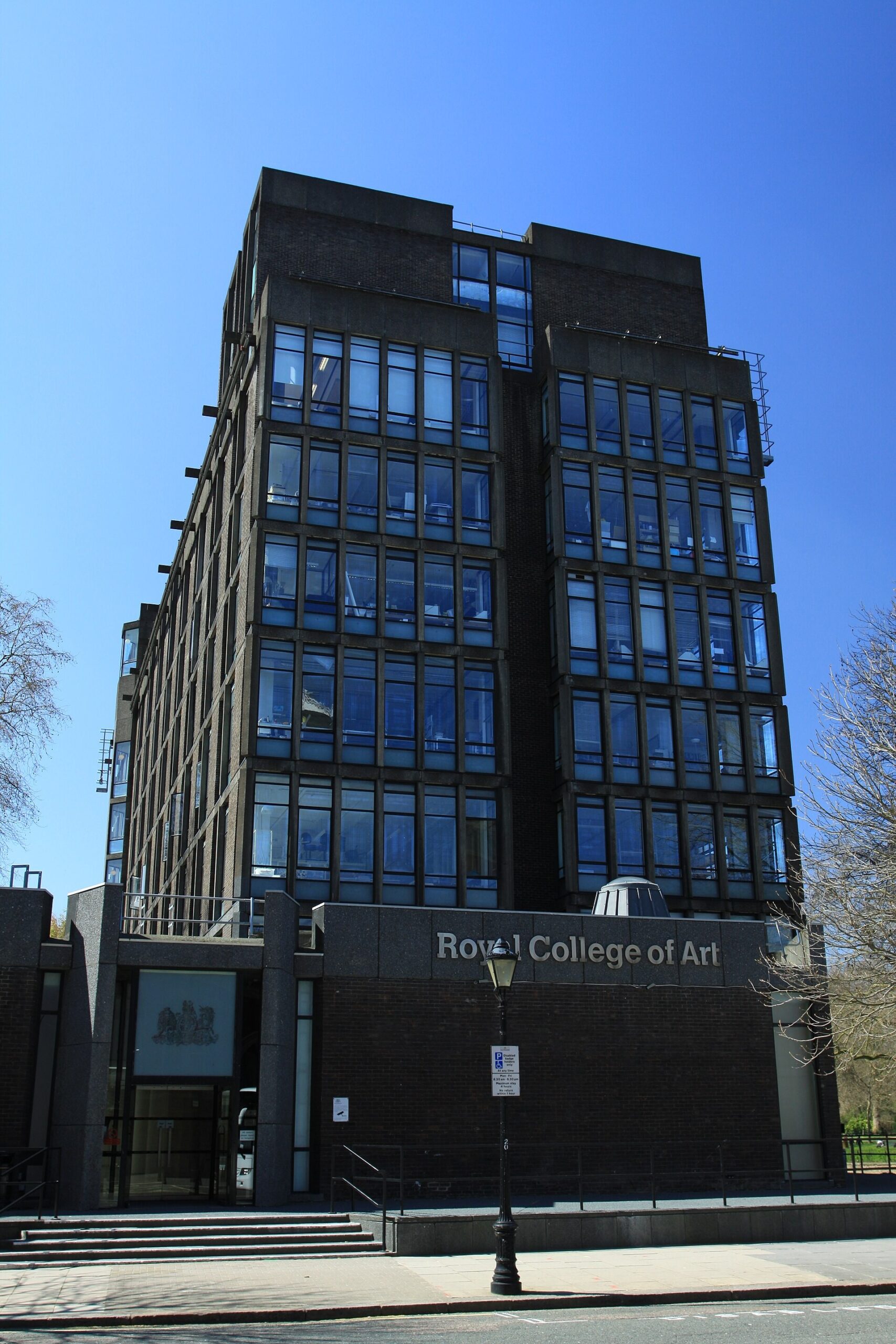
The Royal College of Art is a postgraduate art and design university based in London, England. Founded in 1837 and granted its Royal Charter in 1967, it has spent nearly two centuries training practitioners across art, design, architecture, film and the applied sciences. According to the QS World University Rankings by Subject 2025 edition, the RCA ranked first in the world for art and design for the eleventh consecutive year, achieving an overall score of 97.4.
Key facts
- Country: United Kingdom
- Founded: 1837
- Type: art academy; public research university; higher education institution; collection
- Website: http://www.rca.ac.uk/
Origins and Early History
The institution began in 1837 at Somerset House in the Strand, London, under the name the Government School of Design. Its founding purpose was deliberately practical: to advance art, design and industrial technology at a moment when Britain was manufacturing at a scale the world had not seen before. For more than a century it evolved under various names and arrangements before receiving its Royal Charter in 1967, which conferred university status and independent degree-awarding powers.
In the early 1960s, the college became one of the crucibles of British Pop Art. Students including David Hockney and Ron Kitaj were central to that movement, working alongside Professor of Painting Carel Weight, who held the chair from 1957 to 1973 and maintained a more traditionalist approach to teaching even as his students pushed in a very different direction.
Academic Structure
The RCA organises its teaching across four schools: the School of Architecture, the School of Arts and Humanities, the School of Communication and Design, and a cluster of research and innovation units that includes InnovationRCA. All programmes are postgraduate, giving the institution an unusually focused academic profile.
The Helen Hamlyn Centre for Design, founded in 1991 and endowed by the Helen Hamlyn Trust, is the RCA’s largest and longest-running design research centre. Its work concentrates on inclusive design for ageing populations, disability and health — applied research that connects the college’s creative output to measurable social outcomes.
Entrepreneurship and Commercialisation
InnovationRCA, the college’s centre for entrepreneurship and commercialisation, had launched 81 start-ups as of March 2023. Those companies generated a combined turnover of over £37 million in the twelve months preceding that date, placing the RCA in the top ten UK universities for spin-out creation. The centre runs a pre-incubator that takes design-led ideas from concept through to commercially viable businesses.
Campuses
The RCA operates across three London campuses: Kensington, Battersea and White City. From August 2027, the college plans to vacate White City and consolidate its activities across the two remaining sites in Kensington and Battersea.
The Battersea campus, designed by Swiss architects Herzog and de Meuron and described as the most significant campus development in the RCA’s history, was unveiled on 23 May 2022 at a total cost of £135 million. Funding came from several sources, including an unprecedented £54 million grant from HM Treasury announced in the Chancellor’s Spring budget in 2016, and a £15 million gift from the Sigrid Rausing Trust — the largest single philanthropic donation in the college’s history.
In October 2026, Westminster City Council granted full planning permission for a £90 million renewal of the Kensington campus. The project is led by Witherford Watson Mann Architects alongside Clementine Blakemore Architects, with construction due to complete in 2032.
Leadership and Governance
The RCA’s governing body is the Council, chaired by Sir Peter Bazalgette as Pro-Chancellor. His term runs from 1 January 2022 to 31 December 2029. Day-to-day executive leadership sits with the President and Vice-Chancellor, Professor Christoph Lindner, who took up the role in April 2024.
Sir Jonathan Ive, the former Chief Design Officer of Apple Inc., has served as Chancellor of the Royal College of Art since 1 July 2017, when he succeeded Sir James Dyson in the position.
Alumni
The college counts more than 33,000 alumni working across art, design, architecture, film and other creative disciplines worldwide. Among the most recognised are sculptor Henry Moore, painter David Hockney, textile designer Dame Zandra Rhodes, filmmaker Sir Ridley Scott, designer Sir James Dyson and artist Dame Tracey Emin.
Collectively, RCA alumni had won fifteen BAFTAs, five Turner Prizes, three Oscars, a Booker Prize and the Earthshot Prize at the time of the college’s alumni media factsheet. Alumni also designed the torch, cauldron and medallists’ podia for the London 2012 Olympic Games. As of the same factsheet, 43 RCA alumni held the title of Royal Designer for Industry, the highest accolade for designers in the United Kingdom, out of a maximum of 200 holders worldwide.
Did you know
- Sir Ridley Scott, director of Blade Runner and Gladiator, graduated from the RCA in 1961 with a Diploma in Graphic Design, making the college arguably the origin of one of cinema’s most visually distinctive careers. (rca.ac.uk)
- The Battersea campus exterior used approximately 450,000 bricks in its construction, giving the Herzog and de Meuron-designed building a distinctive industrial character suited to its south London location. (whynow.co.uk)
- Dame Zandra Rhodes, one of Britain’s most celebrated textile and fashion designers, completed her MA in Textiles at the RCA in 1964 and went on to become one of the institution’s most prominent alumni ambassadors. (rca.ac.uk)
Data sources
- Wikidata
- rca.ac.uk
- artbiogs.co.uk
- dezeen.com
- ianvisits.co.uk
- timeshighereducation.com
- norwichuni.ac.uk
Data updated: 2026-10-28