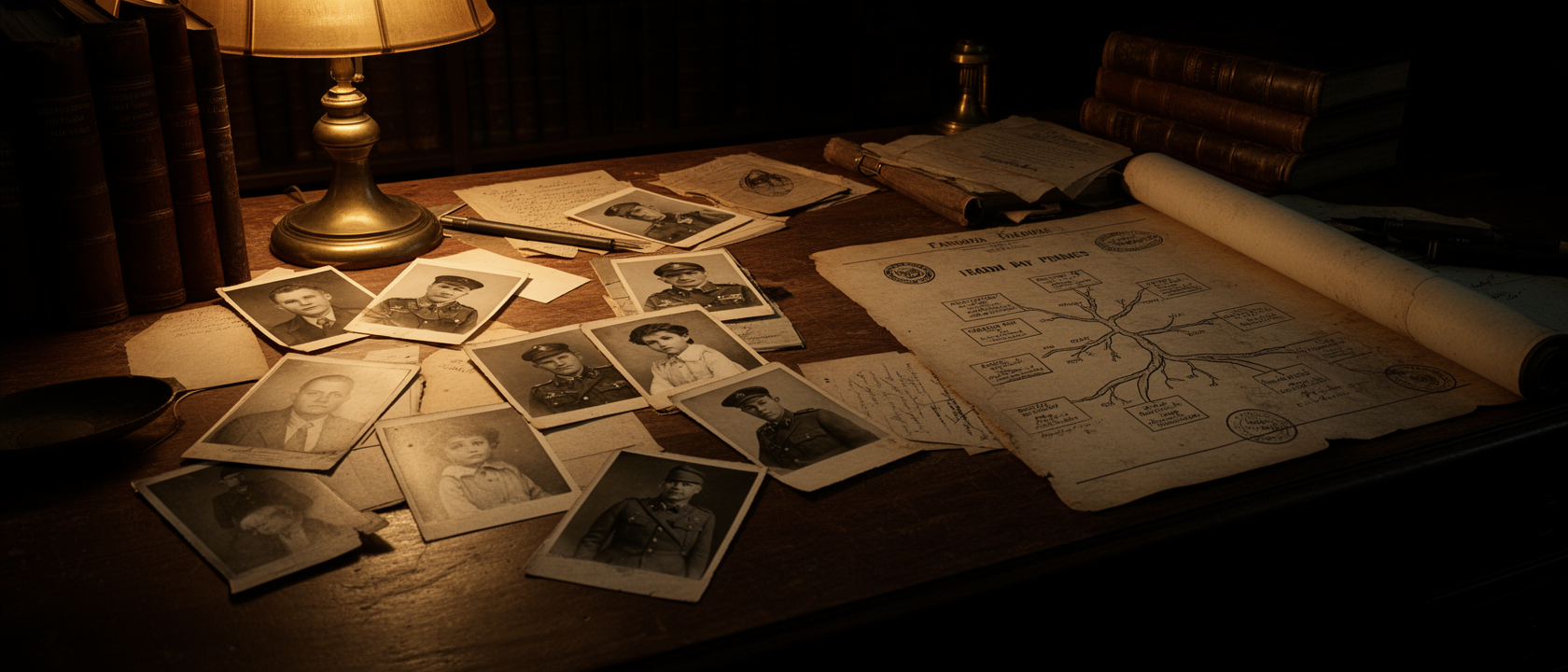
The Führer’s Family Was Fighting on Both Sides
At the height of the Second World War, Adolf Hitler held absolute authority over the Third Reich. He decided who lived and who died across an entire continent. And yet, one of his nephews had already died in Soviet captivity, another was still a prisoner of the Soviets, and a third had enlisted in the United States Navy to fight against him. That is not a metaphor. It is the actual shape of his family tree by 1944.
A Family Kept at Arm’s Length
Most dictators pack their relatives into comfortable positions. Hitler did the opposite, keeping his kin at a deliberate distance to avoid accusations of favoritism and because relatives who traded on the family name embarrassed him. He occasionally bent the rule, helping his half-nephew William Patrick find work at a Berlin bank in 1933 and later at Opel Automotive, but when William used the Hitler name to boost car sales, the work permit was revoked. When Hitler asked William to surrender his British citizenship in 1938 in exchange for a senior position, William refused and fled Germany instead.
Two Nephews in Soviet Hands
Heinz Hitler, born March 14, 1920, volunteered for the German Army and served as a signals NCO in Operation Barbarossa. Soviet forces captured him near Vyazma on January 10, 1942. He was transferred to Butyrka prison in Moscow and died there on February 21, 1942, at 21 years old. Germany listed him as missing in action.
Leo Raubal Jr. born October 2, 1906, was the son of Hitler’s half-sister Angela. A Luftwaffe lieutenant and trained engineer, he was serving with the 6th Army at Stalingrad when Soviet forces captured him in late January 1943. In custody, Leo revealed his identity and cooperated with interrogators, providing information about Hitler’s habits and inner circle.
When Hitler learned Leo was a prisoner, he offered to exchange him for Yakov Dzhugashvili, Stalin’s eldest son, captured on July 16, 1941. Stalin declined. Yakov died at Sachsenhausen on April 14, 1943. Leo was convicted of war crimes in 1949 and sentenced to 25 years in a Gulag, but was released on September 28, 1955, after West German Chancellor Konrad Adenauer petitioned Soviet Premier Nikita Khrushchev. He returned to Austria, resumed teaching chemistry in Linz, and died of tuberculosis on August 18, 1977. The failed swap proposal reveals something Hitler rarely showed: that family ties he publicly dismissed still mattered to him privately.
The Nephew Who Joined the Other Side
William Patrick Hitler, born March 12, 1911, in Liverpool, had already failed to leverage the family name in the early 1930s. After arriving in the United States in January 1939, he found himself stranded when war began, the British Army had turned him down because of his surname. On March 3, 1942, he wrote directly to President Franklin D. Roosevelt requesting permission to enlist. Roosevelt passed the letter to J. Edgar Hoover at the FBI, who cleared William after an investigation. William was sworn into the U.S. Navy on March 6, 1944, served as a Pharmacist’s Mate, was wounded in action, and received the Purple Heart. After his discharge in 1947, he changed his surname to Stuart-Houston, settled in Patchogue, New York, and built a quiet life running Brookhaven Laboratories, a blood sample analysis business. Adolf Hitler reportedly called him “my loathsome nephew.”
The Broader Pattern
The family’s misfortunes predated the war itself. Geli Raubal, Hitler’s half-niece and Angela’s daughter, was found dead on September 19, 1931, in Hitler’s Munich apartment, shot with his own pistol, officially a suicide, though the circumstances remain disputed. The ideology Hitler built celebrated blood and lineage above everything else. His own family ended up scattered across enemy prison camps, enemy navies, and early graves.