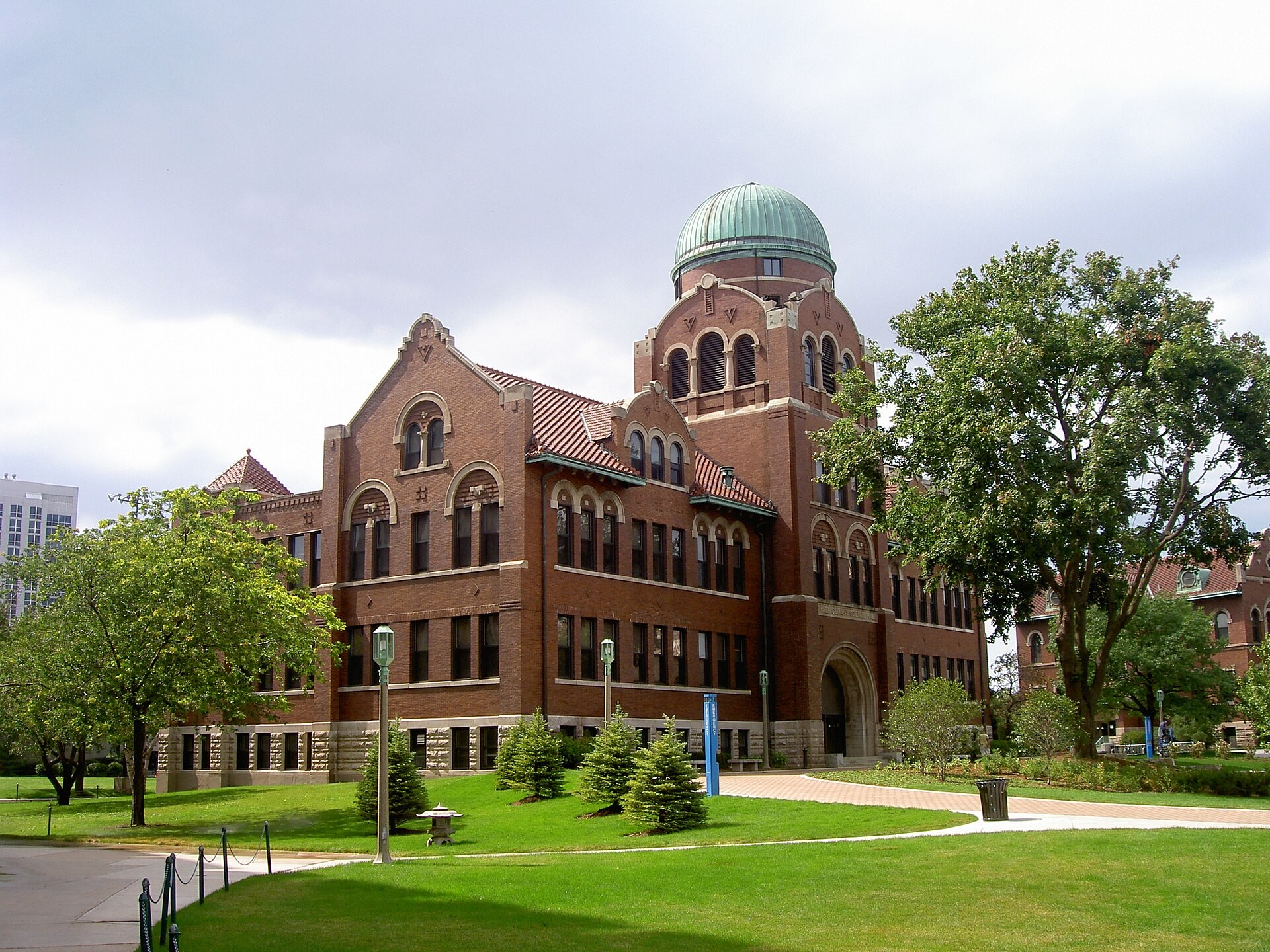
Loyola University Chicago is a private, Catholic research university founded in 1870 by the Society of Jesus on Chicago’s near South Side. The university operates multiple campuses in the Chicago area, a permanent center in Rome, and an alumni network of more than 130,000 graduates spread across all 50 states and 120 countries. A May 2026 independent economic study estimated Loyola’s annual impact on Illinois at $3 billion, supporting more than 13,500 jobs and generating $111 million in tax revenue each year.
Key facts
- Country: United States
- Founded: 1870
- Headquarters: Chicago
- Type: university; private not-for-profit educational institution
- Employees: 3,473
- Website: https://www.luc.edu/
History and Origins
The Jesuits established St. Ignatius College in 1870, one year before the Great Chicago Fire devastated much of the city. The original campus occupied Chicago’s near South Side, where the college operated for nearly four decades before being relocated in 1908 to what is now the Lake Shore Campus on the city’s North Side.
On November 21, 1909, St. Ignatius College was reorganized under a new charter and renamed Loyola University. At the same moment, the Lincoln College of Law became the Loyola University Law Department, which eventually grew into the Loyola University Chicago School of Law. The 1909 charter was explicit on one point: no religious test or particular religious profession would ever be held as a condition of admission. That commitment proved more than formal — as early as 1921, the university placed an advertisement in a Yiddish newspaper to attract Jewish students, an unusually early gesture of interfaith outreach for a Catholic institution.
In 1991, Mundelein College merged with Loyola, a decision that prompted student sit-ins at the college’s Learning Resource Center. The building that witnessed those protests was later converted to administrative use and now operates as the Sullivan Center for Student Services.
Campuses and International Presence
Loyola’s main academic life is anchored at the Lake Shore Campus on Chicago’s North Side. The university also maintains a Health Sciences Campus, which as of fiscal year 2025 hosts more than 400 active clinical trials.
The John Felice Rome Center opened in the spring of 1962 as the Loyola University Chicago Rome Center for Liberal Arts. It holds the distinction of being the oldest continually operating U.S. university program in Italy, giving Loyola a permanent academic foothold in Europe since 1962.
Research and Academic Standing
Loyola’s 2025 Carnegie R1 designation reflects a sustained growth in research activity. As of fiscal year 2025, the university’s research enterprise includes 202 research faculty members and 45 research institutes and centers, alongside the extensive clinical trial program at the Health Sciences Campus.
In the U.S. News and World Report 2027 Best Colleges rankings, Loyola placed 121st nationally, marking the ninth consecutive year the university finished in the top third of schools nationwide.
In September 2025, Loyola officially launched its strategic plan, titled For the Greater Good, organized around four pillars to guide development in education, research, service, and leadership over the five to ten years following its September 2025 launch. A University-Wide Student Success Strategy followed in September 2026, developed across the 2025–26 academic year to strengthen student retention, graduation rates, career outcomes, and equity.
Sustainability
In December 2024, Loyola announced it had achieved carbon neutrality across its Chicago-area campuses, becoming the first university in the Chicago area to reach that milestone.
Loyola became the first institution in the Midwest to receive this rating.
The campuses feature 17 green roofs spanning more than 55,000 square feet. Together, those roofs divert an estimated 19 million gallons of water from city sewers each year.
Finances and Community Engagement
Fiscal year 2026, ending June 30, marked Loyola’s 23rd consecutive year of positive financial results. Fundraising for that year totaled $115 million, and the university’s comprehensive campaign raised $450 million in its quiet phase. The 2026–2027 full-time undergraduate tuition was set at $56,930, a 4.4 percent increase approved by the Board of Trustees, with just under $358 million budgeted for financial assistance.
As of May 2026, the Board of Trustees elected Rocco J. Martino (MBA ’78) as Board Chair for a two-year term at the Board’s annual meeting on April 30, 2026. Mark C. Reed, the university’s 25th president, has concentrated his tenure on expanding academic programs, strengthening research, and advancing Loyola’s Jesuit, Catholic mission.
Each year, Loyola students log more than 240,000 hours of community service, working with more than 850 community partners on issues including food insecurity, education, housing access, and environmental sustainability throughout Chicago. The May 2026 economic study by Econsult Solutions Inc. placed the university’s total annual contribution to Illinois at an estimated $3 billion.
Did you know
- The 1963 Loyola championship basketball team was the first in NCAA history to start four African-American players. Their game against Mississippi State that year, remembered as the “Game of Change,” took place after Mississippi State defied a state ban on playing integrated teams. (specialcollections.luc.edu)
- Loyola’s campuses feature 17 green roofs spanning more than 55,000 square feet, which together divert an estimated 19 million gallons of water from city sewers annually. (news.luc.edu)
- As early as 1921, Loyola placed an advertisement in a Yiddish newspaper, presumably to attract Jewish students, making it one of the earliest Catholic universities to actively recruit students of other faiths. (news.luc.edu)
- When Mundelein College merged with Loyola in 1991, students staged sit-ins at the college’s Learning Resource Center to protest the decision. The building was later converted to administrative use and is now the Sullivan Center for Student Services. (luc.edu)
Data sources
Data updated: 2026-10-29