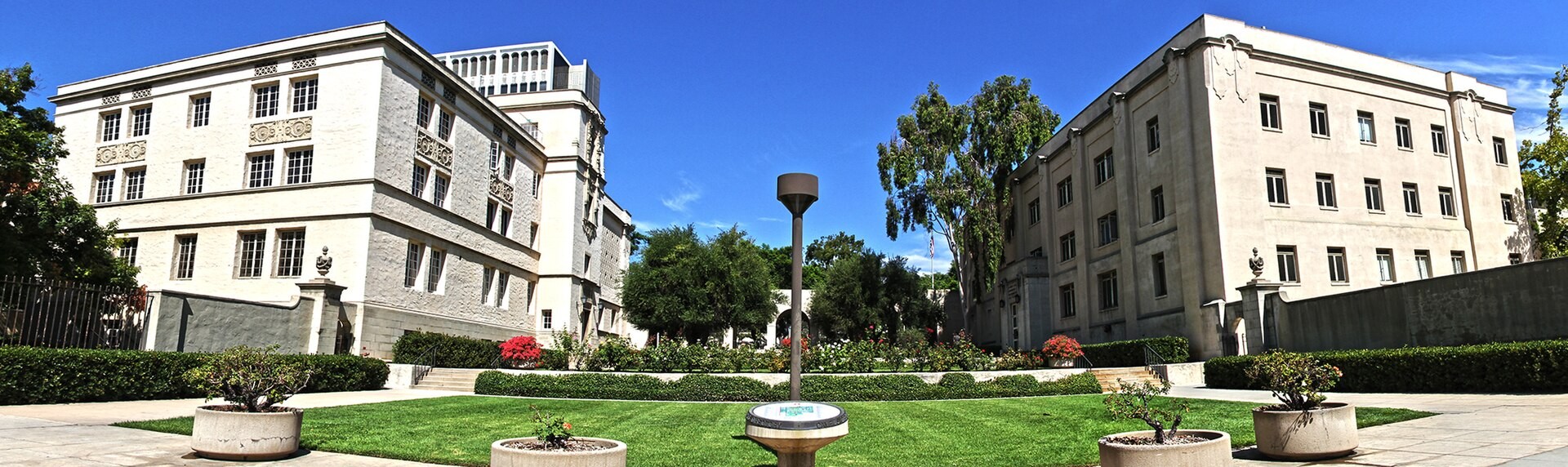
California Institute of Technology, universally known as Caltech, is a private research university in Pasadena, California, approximately 11 miles northeast of downtown Los Angeles. Founded in 1891, it occupies 124 acres and concentrates its academic work across six divisions, from physics and astronomy to biology and the humanities. With an acceptance rate of 2.6 percent for the 2024–2025 academic year and 91 percent of undergraduates participating in research, the institution operates at a scale that keeps research and teaching tightly bound. Caltech also created and continues to manage NASA’s Jet Propulsion Laboratory, making it the only university that runs a federally funded research and development center for the space agency.
Key facts
- Country: United States
- Founded: 1891
- Headquarters: California
- Type: university; private not-for-profit educational institution
- Employees: 979
- Website: https://caltech.edu
Origins and Name
Caltech began on September 23, 1891, when local businessman and politician Amos G. Throop founded a preparatory and vocational school called Throop University in Pasadena, California. The institution changed direction more than once in its early decades. It became Throop Polytechnic Institute in 1893 and then Throop College of Technology in 1913. On February 10, 1920, it formally adopted the name California Institute of Technology.
That arc from a small vocational school to a research university took less than three decades, and the name change in 1920 marked the moment the institution committed fully to scientific and technical education at the highest level.
Academic Structure
Caltech organizes its faculty and research into six divisions: Biology and Biological Engineering; Chemistry and Chemical Engineering; Engineering and Applied Science; Geological and Planetary Sciences; Humanities and Social Sciences; and Physics, Mathematics and Astronomy. Undergraduates choose from 26 majors, which the Institute calls ‘options.’ Computer science, chemical engineering, electrical engineering, mechanical engineering, and physics are the most popular.
The Carnegie Classification places Caltech in the R1 category, designating it a doctoral university with very high research activity. That classification is reflected in undergraduate life: as of the Institute’s own reporting, 91 percent of undergraduates participate in research alongside faculty.
Caltech’s Honor Code reads: ‘No member of the Caltech community shall take unfair advantage of any other member of the Caltech community.’ The code’s practical consequence is that take-home examinations are unproctored, a level of academic trust unusual among selective universities.
Admissions
For the 2024–2025 academic year, Caltech received 13,856 first-year applications. It admitted 356 students, an acceptance rate of 2.6 percent, and 218 enrolled. Those figures reflect a student body whose size, combined with endowment assets of approximately $4.4 billion and roughly 2,200 students in total, produces an endowment-per-student ratio that exceeds $2 million per student.
Jet Propulsion Laboratory
Caltech created the Jet Propulsion Laboratory in 1936, tracing directly to rocket experiments conducted at the Guggenheim Aeronautical Laboratory’s Arroyo Seco site. When NASA was established in 1958, Caltech took on formal management of JPL on the agency’s behalf. JPL remains NASA’s only federally funded research and development center.
The missions that JPL has managed under this arrangement include Voyager, Galileo, Cassini, the Mars Exploration Rover program, the Perseverance Mars rover, the Ingenuity Mars Helicopter, and Europa Clipper.
The most recent major mission to emerge from the partnership is SPHEREx, a space telescope developed by Caltech and JPL with a principal investigator based at Caltech. SPHEREx launched on March 11, 2025, aboard a SpaceX Falcon 9 rocket from Vandenberg Space Force Base, and regular science operations began on May 1, 2025.
Observatories
Caltech owns and operates Palomar Observatory, which houses four instruments: the Hale 200-inch Telescope, a 60-inch telescope, the 48-inch Samuel Oschin Telescope, and an 18-inch Schmidt camera. The observatory gives Caltech researchers direct access to optical and survey astronomy beyond what can be conducted from the main campus.
Campus and Administration
The main campus covers 124 acres in Pasadena and hosts more than 50 research centers, institutes, and facilities. As of the 2025–2026 course catalog, provost David A. Tirrell and Board of Trustees chair David W. Thompson lead the institution’s administration. Caltech employs 979 people and maintains its website at caltech.edu.
Did you know
- Among Caltech’s most celebrated pranks is the 1961 Great Rose Bowl Hoax. Students infiltrated the University of Washington’s card-stunt section and altered the pre-arranged card display so that it read ‘Caltech’ rather than the name of a competing team. (caltech.edu)
- Based on approximately $4.4 billion in endowment assets and roughly 2,200 students, Caltech’s endowment-per-student ratio exceeds $2 million per student, placing it among the highest such ratios of any university in the world. (pipelineroad.com)
- The JPL-Caltech relationship traces to rocket experiments at the Guggenheim Aeronautical Laboratory’s Arroyo Seco site in 1936. JPL went on to launch Explorer 1, America’s first satellite, in January 1958, just months before NASA itself was formally established. (catalog.caltech.edu)
- Caltech’s campus is home to approximately 130 olive trees. The annual Olive Harvest Festival and the annual Millikan Pumpkin Drop on Halloween are among the Institute’s long-running campus traditions. (admissionsight.com)
Data sources
- Wikidata
- library.caltech.edu
- catalog.caltech.edu
- ipac.caltech.edu
- caltech.edu
- collegedata.fyi
- admissions.caltech.edu
- astro.caltech.edu
Data updated: 2026-10-31