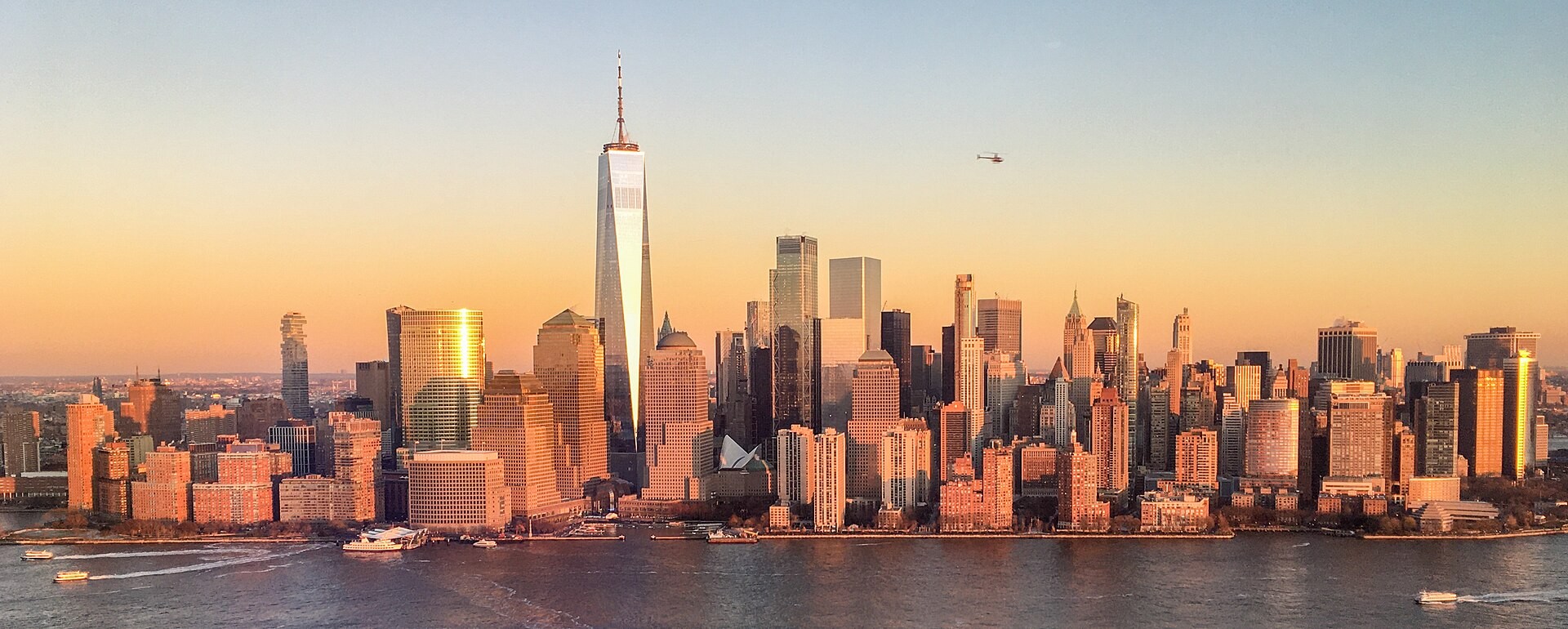
New York City is the most populous city in the United States, home to 8,804,190 people spread across 1,213 km² at the mouth of the Hudson River. Founded in 1624, it grew from a Dutch trading outpost of a few hundred residents into a global city whose port, financial markets, and transit infrastructure shape economic life far beyond its boundaries. Its deepwater harbor anchors a shoreline that runs more than 900 km, the longest of any American city. The New York Stock Exchange and the Western Hemisphere’s largest subway system both operate here, making the city a hub for commerce and movement at a scale matched nowhere else in the country.
Key facts
- Country: United States
- Type: global city; port city; city in the United States; city
- Located in: New York
- Coordinates: 40.7128, -74.0061
- Population: 8,804,190
- Area: 1,213 km²
- Elevation: 25 m
- Founded: 1624
Geography and layout
New York City sits at coordinates 40.7128° N, 74.0061° W, occupying 1,213 km² of land at a mean elevation of 25 m above sea level. The city is divided into five boroughs: Manhattan, Brooklyn, Queens, the Bronx, and Staten Island. Of these, the Bronx is the only one directly connected to the New York State mainland; the remaining four occupy islands or peninsulas, a geographic fact that shapes everything from daily commuting to infrastructure planning.
The city’s shoreline exceeds 900 km, defined by bays, inlets, rivers, and the deep natural harbor where the Hudson River meets the Atlantic. That harbor was the original reason European traders settled here in 1624, and it has underpinned the city’s commercial importance ever since.
History
New York City was founded in 1624 as New Amsterdam, a Dutch colonial settlement on the southern tip of Manhattan. Even in those earliest years the settlement was strikingly multilingual: by 1643, when the population had barely reached 500 residents, 18 languages were reportedly spoken within its boundaries.
The city’s financial infrastructure also has deep roots. On May 17, 1792, 24 stockbrokers gathered and signed the Buttonwood Agreement, establishing rules for trading securities. That meeting on Wall Street in Lower Manhattan eventually gave rise to the New York Stock Exchange, now the world’s largest stock exchange.
By the early 1930s the New York metropolitan area had surpassed 10 million residents, becoming the first megacity in human history. Immigration through Ellis Island contributed heavily to that growth. Ellis Island itself began as a modest 3.3-acre site and was later expanded to 27.5 acres using landfill material that included soil excavated during the construction of New York City’s subway tunnels.
Transit
The New York City subway first opened on October 27, 1904, and has grown into the largest rapid transit system in the Western Hemisphere by number of stations. Unlike most metro systems worldwide, it operates 24 hours a day, seven days a week. On December 12, 2024, the subway recorded a post-pandemic single-day ridership of 4,497,599 passengers, a milestone that Governor Kathy Hochul publicly celebrated.
Population and language
With a population of 8,804,190, New York City is the most populous city in the United States. According to the 2020–2024 American Community Survey, approximately 47.7 percent of residents — around 3.82 million people — speak a language other than English at home. Spanish is the most widely spoken non-English language among them. The linguistic diversity visible in the data echoes a pattern that goes back centuries: when the settlement had fewer than 500 residents in 1643, 18 languages were already in use.
Finance
The New York Stock Exchange, located on Wall Street in Lower Manhattan, traces its formal origins to the Buttonwood Agreement of May 17, 1792. It is the world’s largest stock exchange, and its address on Wall Street has become synonymous with American financial markets broadly. The Exchange’s presence in the city reinforces New York’s status as a global financial center, a role bound to the same deepwater harbor that first attracted traders four centuries ago.
Did you know
- In 1643, when New Amsterdam had barely 500 residents, 18 languages were reportedly spoken there, a degree of linguistic variety that foreshadowed what the city would become centuries later. (factsaboutnewyorkcity.com)
- At its dedication in 1886, the Statue of Liberty, standing 305 feet 1 inch (93 m) tall, was the tallest structure in all of New York City. Its copper surface took about 30 years to oxidize and turn green. (nps.gov)
- On December 12, 2024, New York City’s subway set a post-pandemic single-day ridership record of 4,497,599 passengers, a milestone celebrated publicly by Governor Kathy Hochul. (governor.ny.gov)
- The New York metropolitan area surpassed 10 million residents in the early 1930s, making it the first megacity in human history. (huggingface.co)
- Ellis Island originally covered just 3.3 acres. It was later expanded to 27.5 acres using landfill material that included soil excavated during the construction of New York City’s subway tunnels. (nps.gov)
Data sources
- Wikidata
- geographyworlds.com
- newyorkknow.com
- nycexplored.com
- corporatefinanceinstitute.com
- yahoo.com
Data updated: 2026-11-01