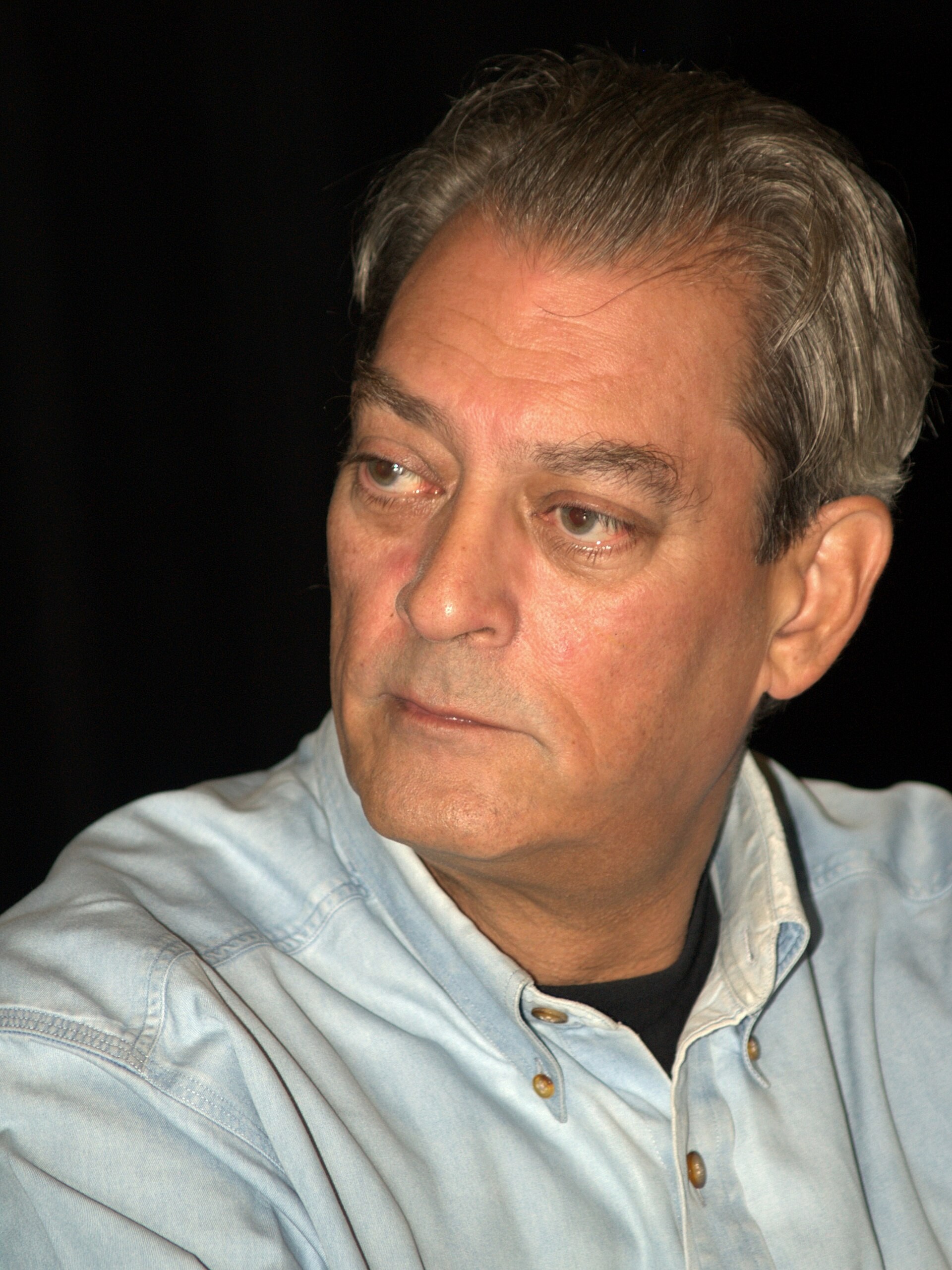
Paul Auster (1947–2024) was an American novelist, poet, essayist, screenwriter, and translator whose 34 books, including 18 novels, made him one of the most recognisable figures in postmodern American fiction. Born in Newark on February 3, 1947, he spent the formative decades of his career moving between Paris and Brooklyn, accumulating a readership in Europe far larger than the one he held at home. Critics labelled him the “dean of American post-modernists” and “the most meta of American meta-fictional writers,” and The New York Times called him the “Patron Saint of Literary Brooklyn.” He died in Park Slope, Brooklyn, on April 30, 2024, at the age of 77, after complications from lung cancer.
Key facts
- Born: 3 February 1947
- Birthplace: Newark
- Died: 30 April 2024
- Place of death: New York City
- Country: United States
- Occupation: screenwriter; film director; linguist; translator
- Field: literature; English studies; comparative literature; film
- Employer: Columbia University
- Education: Columbia University; Columbia High School
- Awards: Princess of Asturias Literary Prize; Prix Médicis étranger; Fellow of the American Academy of Arts and Sciences; Commandeur des Arts et des Lettres
Education and early career
Auster attended Columbia High School and went on to Columbia University, where he earned a Bachelor of Arts in 1969. He stayed on for a further year and received his Master of Arts in comparative literature in 1970.
Rather than beginning a conventional academic or publishing career in the United States, Auster left for Paris, where he lived and worked from 1970 to 1974. During those four years he supported himself as an expatriate poet and translator, carrying French literature into English. The writers he translated included Jean-Paul Sartre, Stéphane Mallarmé, Joseph Joubert, and Maurice Blanchot. The immersion in French language and thought shaped his aesthetic in ways that became visible throughout his later fiction.
After returning to the United States, he married the writer Lydia Davis in 1974. The couple had one son, Daniel Auster, born on June 12, 1977, and divorced in 1979. In 1981 Auster met the writer Siri Hustvedt at a poetry reading; they married in 1982 and had one daughter, Sophie Auster, born in 1987.
Literary breakthrough: The New York Trilogy
Auster gained widespread recognition in the mid-1980s with The New York Trilogy, a series of three loosely connected novellas: City of Glass (1985), Ghosts (1986), and The Locked Room (1986). The books used a postmodern detective framework to probe questions of identity, language, and the act of writing itself. Critics identified in them a self-conscious relationship to literary form that would remain a hallmark of Auster’s work across his entire career.
His work has since been translated into more than forty languages. While he became a bestselling author in Europe, he never achieved equivalent commercial success in the United States — a contrast that New York magazine captured memorably in 2007, noting that the first thing you hear approaching an Auster reading anywhere in the world is French.
Screenwriting and film
Alongside his novels and essays, Auster worked as a screenwriter and film director. The film Smoke grew from a short story he wrote on commission for the Op-Ed page of The New York Times in November 1990. The screenplay earned him the Independent Spirit Award for Best First Screenplay in 1995.
His fields of work formally encompass literature, English studies, comparative literature, and film, reflecting the breadth of a career that did not settle into a single genre.
Civic and institutional roles
Auster served on the board of trustees of the PEN American Center from 2004 to 2009, including a term as vice president from 2005 through 2007. At various points in his career he was also affiliated with Columbia University as an employer, connecting his professional life back to the institution where he had been educated.
Awards and recognition
The French government named Auster a Chevalier de l’Ordre des Arts et des Lettres in 1991, and he subsequently received the higher rank of Commandeur, a distinction that reflected France’s particular embrace of his writing. In 1992 he received the Prix Médicis étranger for best foreign novel published in France, awarded for The Music of Chance. He was elected a Fellow of the American Academy of Arts and Sciences.
Final years and legacy
Auster was diagnosed with cancer in 2022. He died on April 30, 2024, of complications from lung cancer at his home in Park Slope, Brooklyn, aged 77. His widow, Siri Hustvedt, wrote a memoir titled Ghost Stories (2026) about their marriage and his illness; the book also contained letters Auster had written to their grandson Miles.
By the end of his career Auster had produced 34 books in total, among them 18 novels, in a writing life that began in the 1970s and continued until his death. The body of work spans fiction, memoir, poetry, criticism, translation, and screenwriting, and sits at the intersection of formal experiment and personal reckoning with chance.
Did you know
- At age 14, during a summer camp visit, Auster witnessed a fellow camper being struck by lightning and killed. He described the event as the “seminal experience” of his life, one that fixed his lifelong preoccupation with chance and mortality. (haaretz.com)
- The film Smoke began as a very short story Auster wrote on commission for the Op-Ed page of The New York Times in November 1990. He later said the idea came to him while opening a tin of his favourite Dutch cigars, the Schimmelpennicks, and thinking about the Brooklyn tobacconist who sold them. (ndla.no)
- New York magazine wrote in 2007 that the first thing you hear approaching an Auster reading anywhere in the world is French. The magazine noted that he was “merely a best-selling author” in the United States but “a rock star in Paris.” (college.columbia.edu)
- Auster met Samuel Beckett in Paris in 1971 through the poet Jacques Dupin, whose work he had been translating since his undergraduate days. Beckett later contributed translations to Auster’s anthology The Random House Book of Twentieth-Century French Poetry (1982). (lithub.com)
Data sources
- Wikidata
- ebsco.com
- prospectmagazine.co.uk
- bookseriesinorder.com
- pbs.org
- npr.org
- jta.org
- weissman.baruch.cuny.edu
- arabbitsfoot.substack.com
- college.columbia.edu
Where it appears
Data updated: 2026-11-02