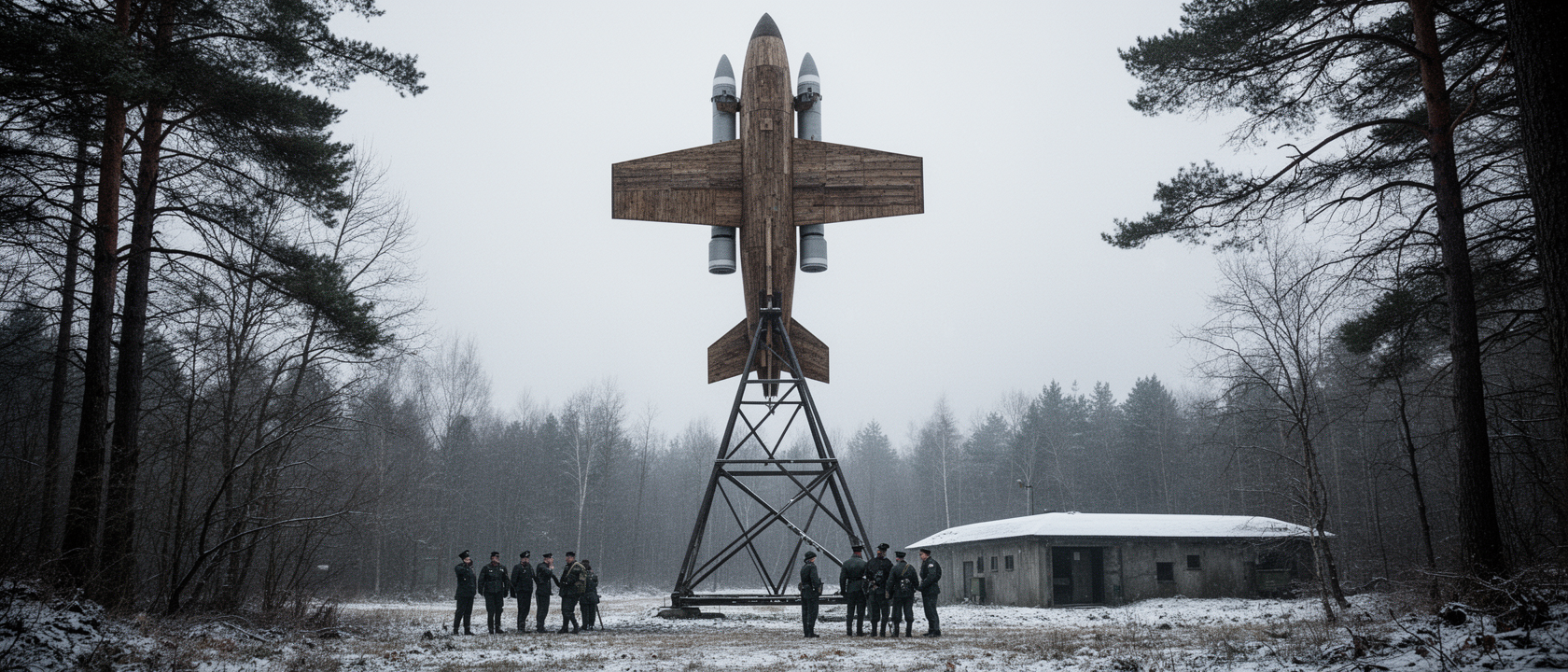
The Airplane That Was Only Meant to Fly Once
Most aircraft share one design assumption: they are supposed to come back. In the final months of World War II, German engineers built something that discarded all of that on purpose.
The Bachem Ba 349 Natter was a 6-meter wooden tube with wings barely 4 meters across, no landing gear, and a total lifespan of less than 10 minutes. It was designed to be shot straight up into the sky, used once, and then abandoned. The pilot would come back. The aircraft would not.
No Runway, No Time
On September 10, 1944, Germany’s Air Ministry issued “Emergency Fighter” requirements. Allied bombers were hitting German cities around the clock, and the Luftwaffe had run out of time. The new specifications called for something built fast, from materials not earmarked for tanks and guns, by workers who weren’t master craftsmen.
Erich Bachem, who had previously co-designed the Fieseler Fi 156 Storch, answered with a proposal almost nobody else would have dared to write. His aircraft would be made of wood and glue, need no runway, and could be assembled in roughly 1,000 man-hours by semi-skilled labor. After a single mission, the reusable engine would float down on a parachute; a fresh wooden airframe would take its place.
The Air Ministry kept rejecting him. Bachem eventually bypassed them and went to Heinrich Himmler, who ordered 150 aircraft using SS funds. The Air Ministry, realizing the SS was developing an aircraft outside their authority, placed their own order for 50 more.
From the Ground to 6,000 Meters
A 20-meter triangular tower held the Natter upright at launch. Four solid-fuel Schmidding boosters lit at liftoff alongside the Walter HWK 109-509 liquid-fuel rocket engine; the boosters burned away and were jettisoned while the Walter engine kept pushing. The climb to around 6,000 meters took approximately 4.6 minutes. During the ascent the pilot lay on his back while an autopilot handled guidance; the controls only unlocked at target altitude.
Thirty Seconds of Combat
The Natter was not built for dogfighting. Its plain rectangular wooden wings had no ailerons and no flaps. The attack concept was blunter: the pilot would glide toward a bomber formation, jettison the nose cone, and fire a salvo of unguided rockets, either 24 Henschel Hs 217 Föhn 73 mm rockets or a pack of R4M 55 mm rounds. Then the fuel ran out. A second pass was never part of the design.
Recovery required a specific sequence: unlatch the harness, jettison the canopy, release the nose lock, pull a cockpit-floor lever. Aerodynamic forces tore the nose free, a ribbon parachute deployed from the fuselage, and the pilot was pushed clear to open his own parachute independently. The Walter engine parachuted down separately for reuse. The wooden airframe was the only part nobody expected to see again.
One Crash, Then Another
The first unmanned vertical launch, on December 18, 1944, ended in a crash due to a flaw in the tower design. After eleven more unmanned trials, a full test on February 25, 1945, with a dummy pilot and the Walter engine running together for the first time went cleanly, the dummy was recovered intact, though the rear fuselage exploded on landing when residual propellants ignited.
The first manned flight came on March 1, 1945, near Stetten am kalten Markt. The pilot was Lothar Sieber, 22 years old, who had asked for the autopilot to be switched off. Around 11:00 a.m. the Natter left the tower. Between 100 and 150 meters, it pitched sharply upward into an inverted arc. Around 500 meters, the canopy left the cockpit. The craft climbed to approximately 1,500 meters, disappeared into cloud, and came back down nose-first. The flight lasted roughly 55 seconds. The most likely cause was an unsecured canopy latch; excavations at the crash site in 1998 and 1999 also revealed that one Schmidding booster had never jettisoned.
Sieber was the first human to launch vertically by rocket power. Whether he was also the first to break the sound barrier, which the flight data suggest may have occurred during the final plunge, remains a hypothesis rather than a confirmed record.
A Grass Snake, Not a Viper
An operational deployment under the code name Operation Krokus was planned at launch sites south of the Stuttgart-Munich Autobahn. It never took place. American armored units arrived first.
“Natter” is usually translated as “viper” or “adder,” but the German word actually refers to a non-venomous colubrid, a grass snake. Its top speed, in the B-variant specification, was 1,000 km/h. A wooden aircraft held together with glue, built on the calculation that replacing it would always be cheaper than saving it.