The Door Nobody Should Have Been Able to Open
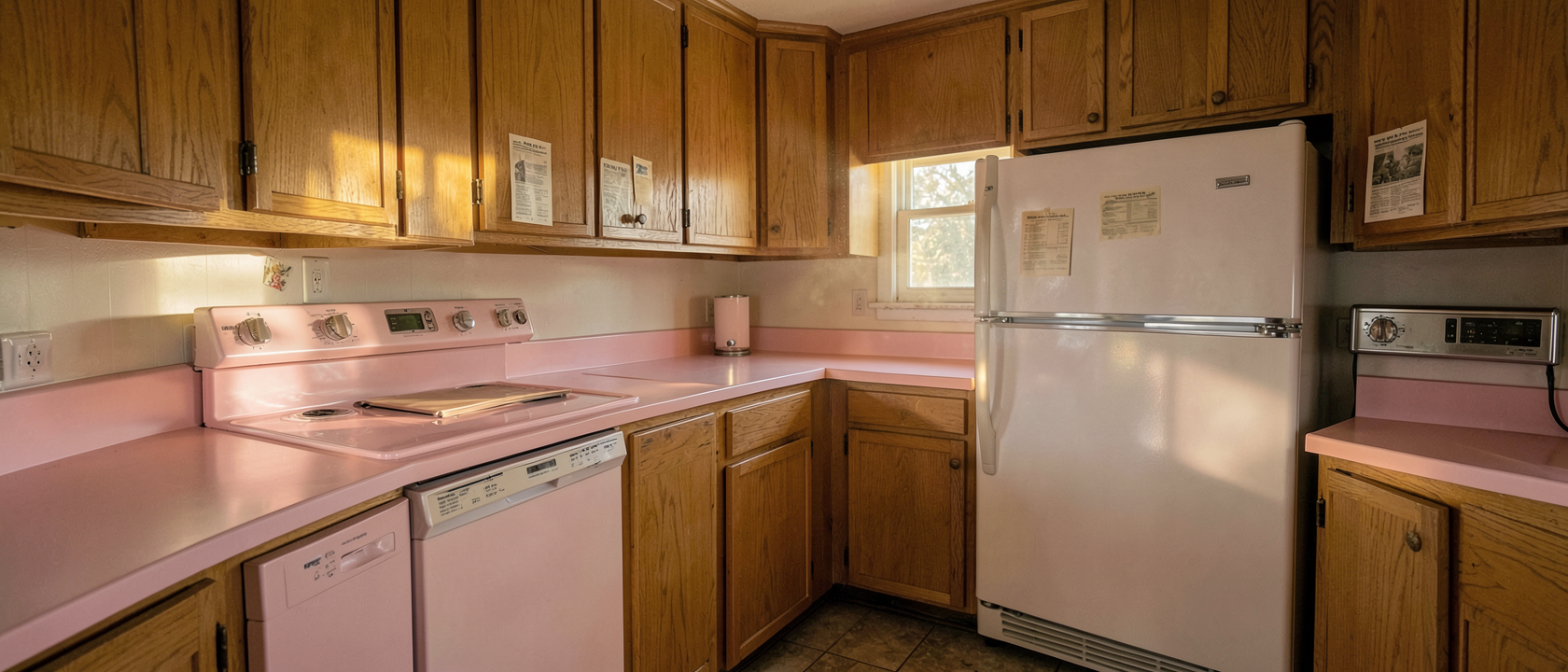
In 2010, furniture designer Nathan Chandler bought a house built in the mid-1950s. He wasn’t shopping for a museum piece, just a house. But opening the kitchen door, he found a room frozen mid-decade: pink countertops, chrome trim, light-wood cabinetry, appliances sitting exactly where they’d been installed. It looked less like a home that had stood for more than fifty years and more like a set dressed for a 1950s sitcom.
A kitchen doesn’t stay this crisp through decades of breakfasts, dinners, and birthday cakes. Something kept this room out of time, and Chandler had no idea yet what that something was.
Proof It Was Never Touched
The clue wasn’t the style. It was the paperwork. The original manuals for the GE appliances were still taped right to them, never thrown out, never even moved. People hang onto an appliance manual for a year or two, then it disappears. Hanging onto a manual for fifty years isn’t tidiness. It means the appliance was barely used.
The dishwasher makes the point best: a full pull-out, top-loading model from the era, still with its original, unopened box of detergent beside it. The stove has old-school control buttons and lettering straight out of a 1950s catalog. The refrigerator is a three-door design rarely built anymore, with the freezer mounted at eye level, so no one ever had to bend down to see what was inside. None of it is damaged or worn, just old and completely unmarked by use.
A House With No Family In It
This is the part that turns a nice vintage find into a genuine puzzle. This wasn’t an abandoned shell or a half-finished fixer-upper. The original owners built the house, furnished it, and stocked the kitchen right down to the appliance manuals. Every sign points to a family who finished the job completely.
And then, as far as anyone can tell, they never moved in. The house sat uninhabited for more than fifty years, and the reason has never been made public. One account says the original owners kept their reasons private and no one else ever took the place instead. Why finish a kitchen this complete and never once cook in it? Nobody outside the family seems to know, and that question has never been answered on the record.
The “Curse” Joke (And Why It’s Not an Answer)
Online, the story usually gets a punchline tacked on: maybe the house is cursed. It’s a fun line, repeated so often it starts to feel like part of the story, but it isn’t. There’s no incident tied to the house, no accident, no documented tragedy, nothing beyond an empty kitchen and a gap in the record.
The joke exists because people like their mysteries to end somewhere. When a true story refuses to hand over a tidy reason, a curse becomes the easiest stand-in. It’s a punchline, not a theory. Mistaking a shrug for an answer is exactly how a decent mystery gets flattened into a meme.
A Time Capsule of What America Wanted
The kitchen’s real value has nothing to do with the mystery. It’s what got preserved by accident. Every appliance and finish reflects exactly what a middle-class American family in the 1950s wanted in a brand-new home, down to the wall color. Pink kitchens and bathrooms were everywhere that decade, a trend tied to “Mamie pink,” named after First Lady Mamie Eisenhower, whose favorite color became a household obsession.
Most period kitchens on display are reconstructions pieced together after the fact, with pieces bought and matched decades later to look authentic. This one never went through that process, because nobody lived there long enough to remodel it or replace a countertop. That’s why collectors have taken real interest in pieces from the house, including fixtures Chandler later sold individually. Original, untouched 1950s hardware this complete is hard to find anywhere else.
Why This Story Traveled
Chandler eventually put together a full photo set of the kitchen, and once it reached a wider audience, it spread fast, turning a private real-estate oddity into something strangers kept sending to each other. What made people stop scrolling wasn’t the pink appliances or the vintage dishwasher alone. It was the question underneath: who finishes a whole kitchen and never turns a single knob?
A good vintage photo gets a like. A real, unsolved human mystery gets forwarded. Knowing the difference is exactly the kind of thing worth telling someone about over dinner.