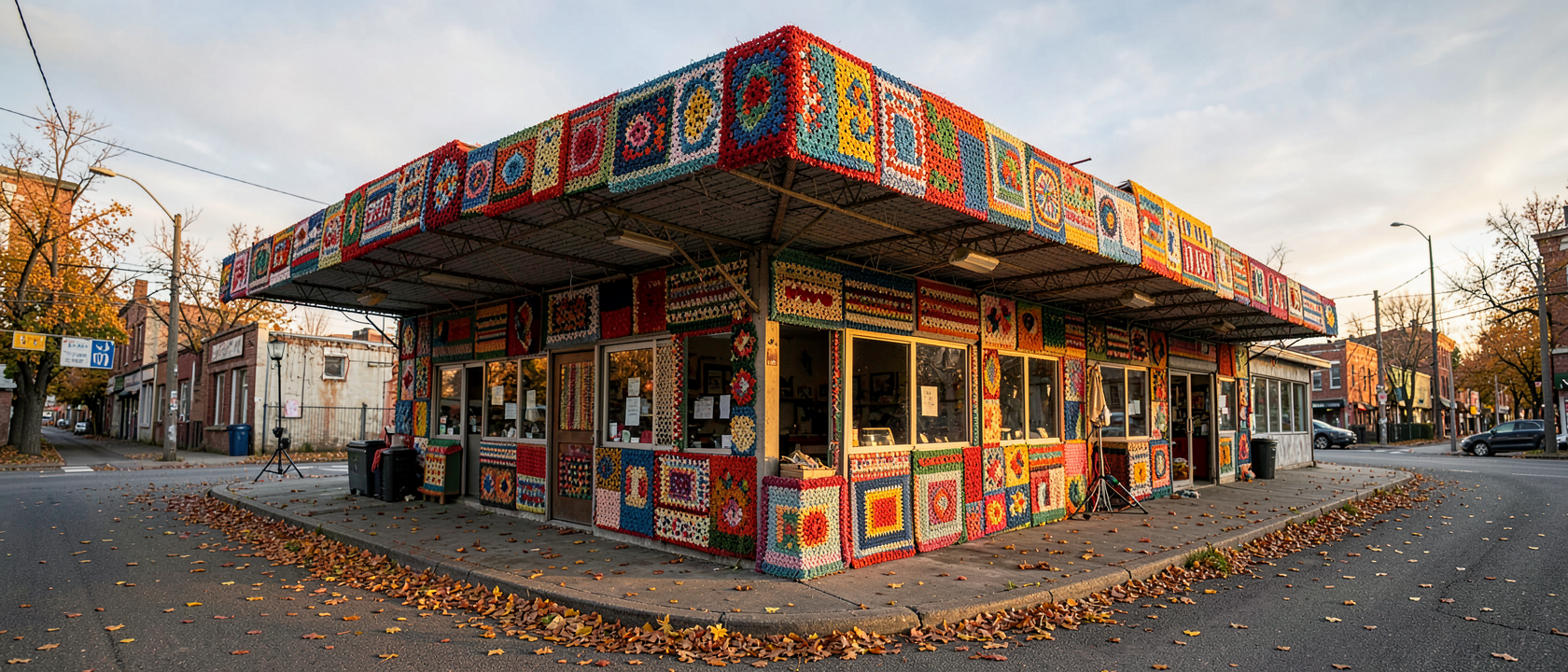
A Gas Station Wrapped, Not Torn Down
Picture a boarded-up Citgo station on a street corner in Syracuse, New York, the kind of building you’d drive past without a second glance. Now picture every inch of it covered in fabric, pumps, light poles, overhead sign, even windows, all wrapped in knitted and crocheted panels, as if the station had been pulled into a giant patchwork sweater. This wasn’t paint or a vinyl wrap. It was textile, stitched by hand, more than 3,000 panels covering roughly 5,000 square feet (464.5 square meters) of structure.
From Daily Annoyance to a Global Idea
The station had sat empty for years, a relic about 50 years old by the time artist Jennifer Marsh started driving past it on her way to her studio. She was irritated by the eyesore, by the high gas prices tied to the industry it represented, and by the sense that nobody would do anything about either.
Most people have that exact moment and let it pass, spotting the cracked sign or shuttered storefront, thinking someone should do something, then driving on. What turns that flicker of irritation into a project pulling in strangers across continents has less to do with talent than with what Marsh chose to do with a feeling most people just swallow.
How One Person’s Idea Became Thousands of People’s Project
Marsh didn’t knit all 3,000-plus panels herself. Through an organization she built, the International Fiber Collaborative, she put out an open call: anyone, anywhere, could make a fiber panel and send it in. Professional textile artists answered. So did total beginners and entire classrooms.
The project drew contributors from 15 countries and more than 2,500 grade-school students across 29 U.S. states. (By one account, roughly 450 adult artists took part, though figures vary between sources.) Each person made their panel independently, knitting, crocheting, quilting, or hand-stitching, with no way of knowing how it would sit next to anyone else’s. Marsh called the finished installation the World Reclamation Art Project, meant to draw attention to the world’s dependence on oil, and gave it a fitting canvas: the very pumps that symbolized the problem, buried under a patchwork sewn by hands that never met.
The real feat goes beyond the sewing, it’s the logistics of collecting thousands of separately made panels from across the globe and assembling them onto one structure so the whole thing reads as a single piece.
Bigger Than a Yarn-Bombed Tree
This sits inside a wider practice called yarn bombing, covering public objects like trees, bike racks, or statues in knitted or crocheted material, usually as a small, playful local gesture. Most yarn bombing wraps a single object. This wrapped an entire structure, down to the light poles and signage, with contributors spread across 15 countries and dozens of U.S. states, the difference between knitting a scarf for a lamppost and knitting a coat for an entire building.
What the Record Doesn’t Tell Us
Some details never made it into the story. Sources disagree on the exact installation date, one points to April 12, 2008, another to May 5, with the year itself uncertain. Nobody documented exactly how the panels were fastened to the metal pumps and poles, and there’s no confirmed account of how long the wrapped station stood or what happened to the panels afterward.
None of that is a flaw so much as a feature of grassroots art like this. When a project belongs to thousands of contributors scattered across 15 countries, nobody ends up holding the complete archive.
The Skill of Not Letting It Go
Almost everyone has their own version of that gas station: the pothole you drive around daily, the broken sign at the corner store, the empty lot nobody claims. You file it under “someone should do something” and keep moving.
What separates this story isn’t artistic skill, plenty of people know how to knit a panel. What’s rarer is treating a daily irritation as a starting point instead of background noise, then getting thousands of schoolkids and strangers pulling in the same direction. Noticing what everyone else has learned to ignore, and actually doing something about it, is its own kind of talent. Most people already have it. Almost nobody uses it.