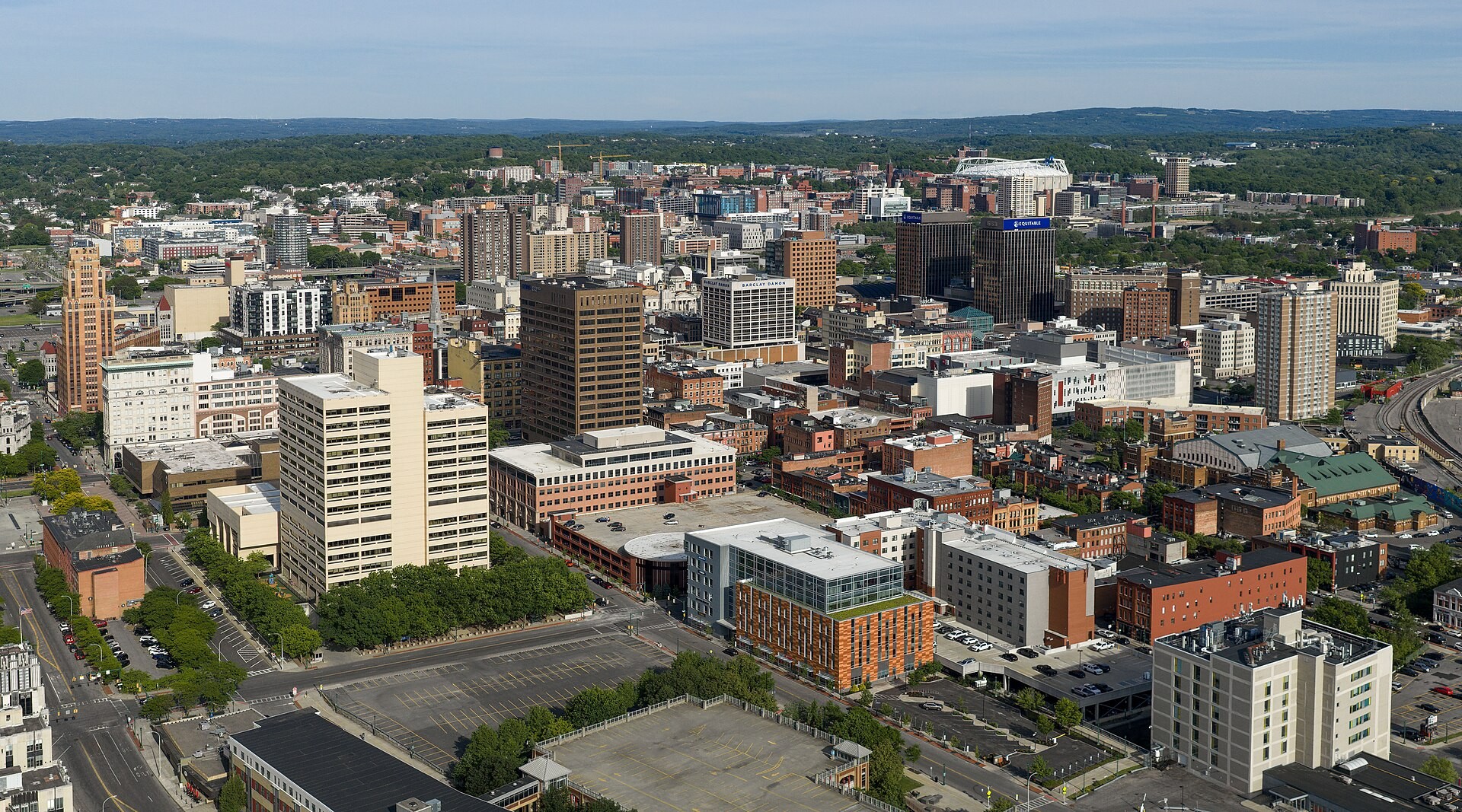
Syracuse is a city in central New York State, the county seat of Onondaga County, sitting at an elevation of 116 meters with a population of 148,620 across 66 square kilometers. Incorporated on December 14, 1847, when the villages of Syracuse and Salina merged, it was formally chartered as a city in 1848. The city built its early identity almost entirely on salt: until 1900, the bulk of the salt used across the United States came from Syracuse, a dominance that earned it the enduring nickname “The Salt City.” That industrial past left a complicated environmental legacy on Onondaga Lake, the body of water that borders the city to the northwest, while the city’s present economy rests on healthcare, education, and retail.
Key facts
- Country: United States
- Type: city in the state of New York
- Located in: Onondaga County
- Coordinates: 43.0469, -76.1444
- Population: 148,620
- Area: 66 km²
- Elevation: 116 m
- Founded: 1848
Origins and the Haudenosaunee homeland
Long before European settlement, the territory around Onondaga Lake was the historic homeland of the Onondaga Nation, whose name translates as ‘People of the Hills.’ The Onondaga are one of the original five nations of the Haudenosaunee Confederacy and hold the ceremonial role of ‘Keepers of the Central Fire,’ meaning the confederacy’s governing council fire was maintained on their territory. That geopolitical centrality shaped the landscape that European settlers later found and named.
Between 1780 and 1820, the settlement at the southern end of Onondaga Lake cycled through at least seven different names before landing on ‘Syracuse.’ The State of New York formalized its interest in the area in 1797, when it took ownership and management of the Onondaga Salt Spring Reservation, leasing land to manufacturers while retaining control of the wells, pumps, pipelines, and storage areas. That arrangement ran for more than a century, ending in 1908.
The salt economy and the Erie Canal
Salt was the engine of early Syracuse. Brines drawn from the lakeshore were boiled down in large vats, producing a commodity in steady demand across the young nation. The opening of the Erie Canal in 1825 connected those salt works directly to major markets along the East Coast and throughout the expanding western territories, allowing output to scale dramatically.
By the end of the nineteenth century, Syracuse was responsible for the majority of salt consumed in the United States. That era closed as mining operations in other states matured and undercut the local industry, but the salt heritage stuck. The nickname ‘The Salt City’ remained, and the Erie Canal itself left a physical artifact in downtown: the 1850 Weighlock Building, now home to the Erie Canal Museum, is the only remaining canal boat weigh station in the country. It sits where the Erie and Oswego Canals once met, and boats were weighed there so tolls could be assessed before continuing their journey.
Onondaga Lake: pollution and cleanup
Onondaga Lake paid the price for a century of industrial growth. Municipal and industrial discharges accumulated for generations, and in December 1994 the EPA officially listed it as a Superfund Site, ranking it among the most polluted lakes in the United States. Among the documented industrial contributions, Honeywell discharged 165,000 pounds of mercury into the lake between 1946 and 1970. The subsequent EPA Superfund cleanup capped 580 acres of lakebed.
The contamination had been visible in practical terms long before the Superfund designation. Ice harvesting on the lake was banned as early as 1901. Swimming followed in 1940, and fishing was banned in 1970. The multi-decade remediation effort that followed the 1994 listing has involved extensive dredging, capping, and monitoring.
Economy and institutions
In 2024, the three largest employment sectors in Syracuse were Health Care and Social Assistance, which employed 11,634 people; Educational Services, with 10,268; and Retail Trade, at 7,074. The 2024 median household income was $47,819.
Syracuse University anchors the educational sector. As of the 2024–2025 academic year, the university offers more than 200 majors and minors and more than 200 advanced degree programs across 13 academic units. Its athletic facilities include the JMA Wireless Dome, which opened on September 20, 1980, as the Carrier Dome, at a construction cost of $26.85 million. The domed stadium is the only one of its kind in the Northeast and the largest domed structure on a college campus in the country.
On the commercial side, Destiny USA, which opened on October 15, 1990, as Carousel Center, covers 2.4 million square feet on the shore of Onondaga Lake. It is the largest shopping mall in New York State, offering retail, dining, and entertainment.
Culture and landmarks
The Everson Museum of Art traces its founding to 1897, when it was established as the Syracuse Museum of Fine Arts. Its current building opened in 1968 as the first museum designed by architect I. M. Pei, a commission credited with launching his internationally recognized career. The museum holds a permanent collection of approximately 11,000 works and was the first museum to create a permanent ceramics collection and the first to collect video art.
Downtown’s Armory Square Historic District, designated a National Historic District in 1984, occupies converted 19th-century warehouses and functions as the city’s main concentration of shops, restaurants, and nightlife. A short distance away, the Erie Canal Museum occupies the 1850 Weighlock Building, preserving the physical infrastructure of the canal era.
Syracuse also holds a place in American fair history. The Great New York State Fair was first held in Syracuse on September 29–30, 1841, making it the first state fair in the United States. The fair has been held permanently in the city since 1890.
Climate and infrastructure
Syracuse averages 123.8 inches of snow per year, according to NOAA climate normals for 1991–2020, making it the snowiest major city in the United States. The primary driver is lake-effect snow generated by Lake Ontario, which lies 33 miles north of the city.
The most significant infrastructure change underway is the $2.25 billion Interstate 81 Viaduct Project, which the New York State Department of Transportation has identified as the largest construction project in its history. The project replaces a 1.4-mile elevated highway through downtown with a street-level design called the Community Grid. The viaduct was expected to close to through traffic by late 2026, with the Community Grid scheduled for completion by 2028.
Did you know
- The city cycled through at least seven different names between 1780 and 1820 before settling on ‘Syracuse.’ The final choice came about partly by elimination: the U.S. Postal Service refused the name ‘Corinth’ because another New York town already held it. Promoters then pointed to parallels with the ancient city of Syracuse in Sicily, which, like the new settlement, had a salt industry and a nearby village called Salina. (kids.kiddle.co)
- Onondaga Lake’s decline was gradual enough to be tracked ban by ban. Ice harvesting was prohibited on it as early as 1901. Swimming was banned in 1940. Fishing followed in 1970. Only after more than a century of compounding industrial and municipal pollution did the EPA formally list the lake as a Superfund Site in December 1994, triggering the multi-decade cleanup that followed. (cnycentral.com)
Data sources
- Wikidata
- wonderfulmuseums.com
- kids.kiddle.co
- syr-area.com
- oei2.org
- cnysignal.com
- syracuse.edu
- everson.org
- museumpedia.org
- cuse.com
- nysfair.ny.gov
- datausa.io
- statetowersyracuse.com
- eriecanalway.org
Data updated: 2026-10-28