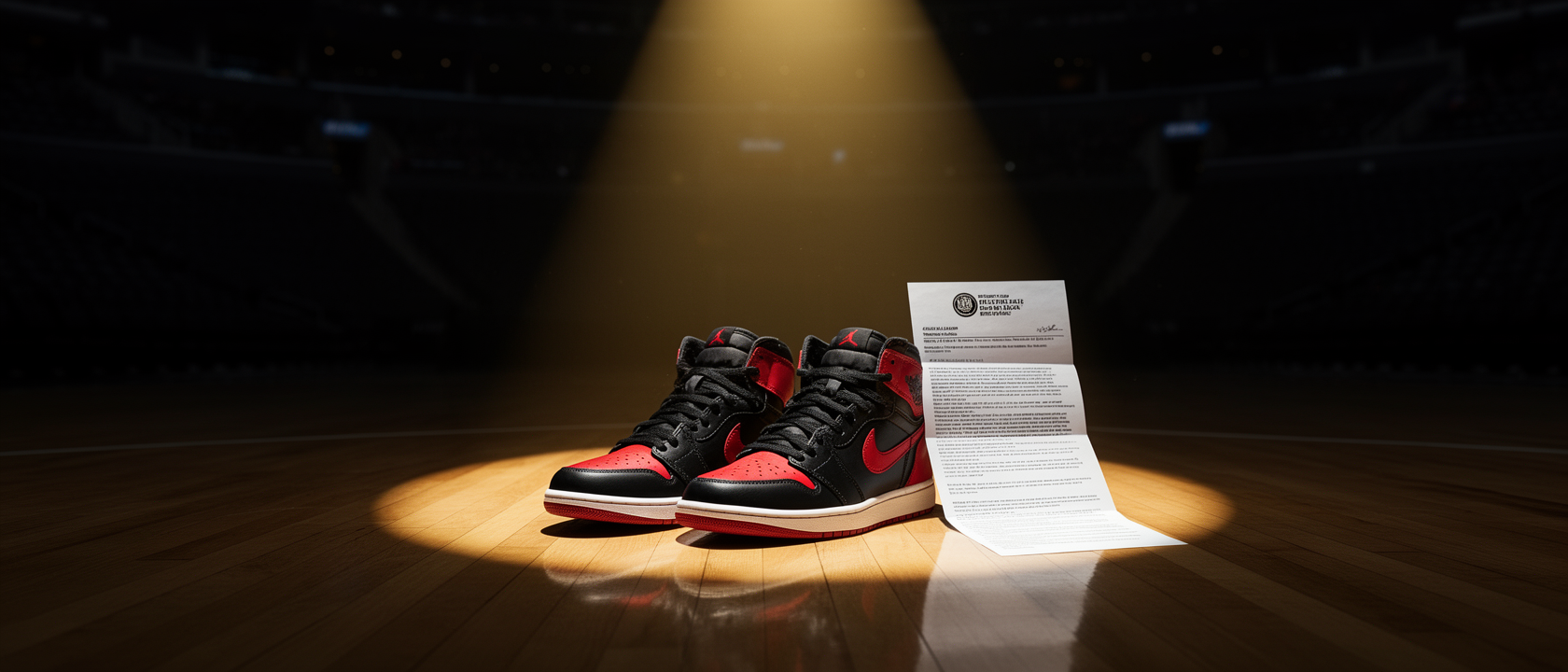
The Shoe That Was “Too Good for the NBA” (And Why That’s Not Quite True)
The story goes like this: Nike designed a basketball shoe so revolutionary that the NBA had to ban it. Michael Jordan kept wearing it anyway. The league fined him $5,000 every game. Nike paid every fine without blinking. And from that defiance, one of the most recognizable brands in sports history was born.
It’s a great story. Parts of it are even true.
What the Commercials Said
Nike’s original “Banned” ad opened with a voiceover: “On September 15th, Nike created a revolutionary new basketball shoe. On October 18th, the NBA threw them out of the game.” The dates are real. The dramatic framing around them is something else entirely.
There’s no entry in the NBA’s rulebooks banning a shoe for athletic performance. No evidence Jordan’s footwear gave him a measurable competitive edge. What triggered the warning letter had nothing to do with how the shoes performed on the court.
The 51% Rule
The NBA had a straightforward uniform policy: shoes had to be at least 51 percent white and had to match teammates’ footwear. Jordan’s black-and-red shoes clashed with his uniform. That was the violation, simple aesthetics, not biomechanics.
In February 1985, the NBA sent Nike a letter confirming that Jordan’s “red and black NIKE basketball shoes” had violated the uniform policy “on or around October 18, 1984.” The letter described the shoes by color and brand name, not by model, a vagueness Nike found very useful.
The Wrong Shoe Entirely
One detail unravels the legend entirely: Jordan wasn’t wearing Air Jordan 1s on October 18, 1984. The Air Jordan 1 wasn’t finished yet. Jordan wore the Nike Air Ship, a separate shoe designed by Bruce Kilgore, with only around 25 pairs produced specifically for him. The Air Jordan 1 didn’t reach stores until April 1, 1985, at $65.
So how did the Air Ship’s controversy attach to the Air Jordan brand? Television footage in 1984 was grainy, newspaper photos often black-and-white, and the two shoes looked similar enough that most viewers couldn’t tell them apart. Nike ran the “Banned” ad featuring the same colorway as the Air Ship, and the Air Ship’s dress code violation became the Air Jordan 1’s origin story.
Did Nike Actually Pay the Fines?
Almost no photos from Jordan’s 1984–85 regular season show him in the black-and-red colorway at all. The only confirmed appearance in black-and-red Air Jordans that season was at the 1985 NBA Dunk Contest, an exhibition where uniform rules didn’t apply. Nike VP of marketing Rob Strasser did propose paying fines as a marketing move, but Commissioner David Stern reportedly warned penalties would escalate to suspension. By most accounts, Jordan switched to league-compliant white-based colorways for regular season games. The only confirmed footwear fine on record came in 1995, when Jordan was penalized for wearing black-and-red Concord Air Jordan 11s.
What an Actual Performance Ban Looks Like
The LZR Racer swimsuit was banned after the 2008 Beijing Olympics when swimmers shattered so many world records that officials concluded the suit itself was a contributing factor. The Nike Alphafly running shoe faced restrictions after 2019 following documented concerns about sole technology. Both cases involved performance data and formal investigations.
The Air Jordan situation had none of that. No performance tests. No competitive advantage claims in the official record. Just a letter about color percentages, a marketing team that saw an opportunity, and the low-resolution media of the 1980s. Nike projected $3 million in Air Jordan revenue over three years; the line earned $126 million in the first year alone. By 2022, Jordan Brand was generating $5.1 billion annually. The 51% white rule was quietly lifted in the late 2000s, long after it had already done its job.