The Sign That Broke Physics
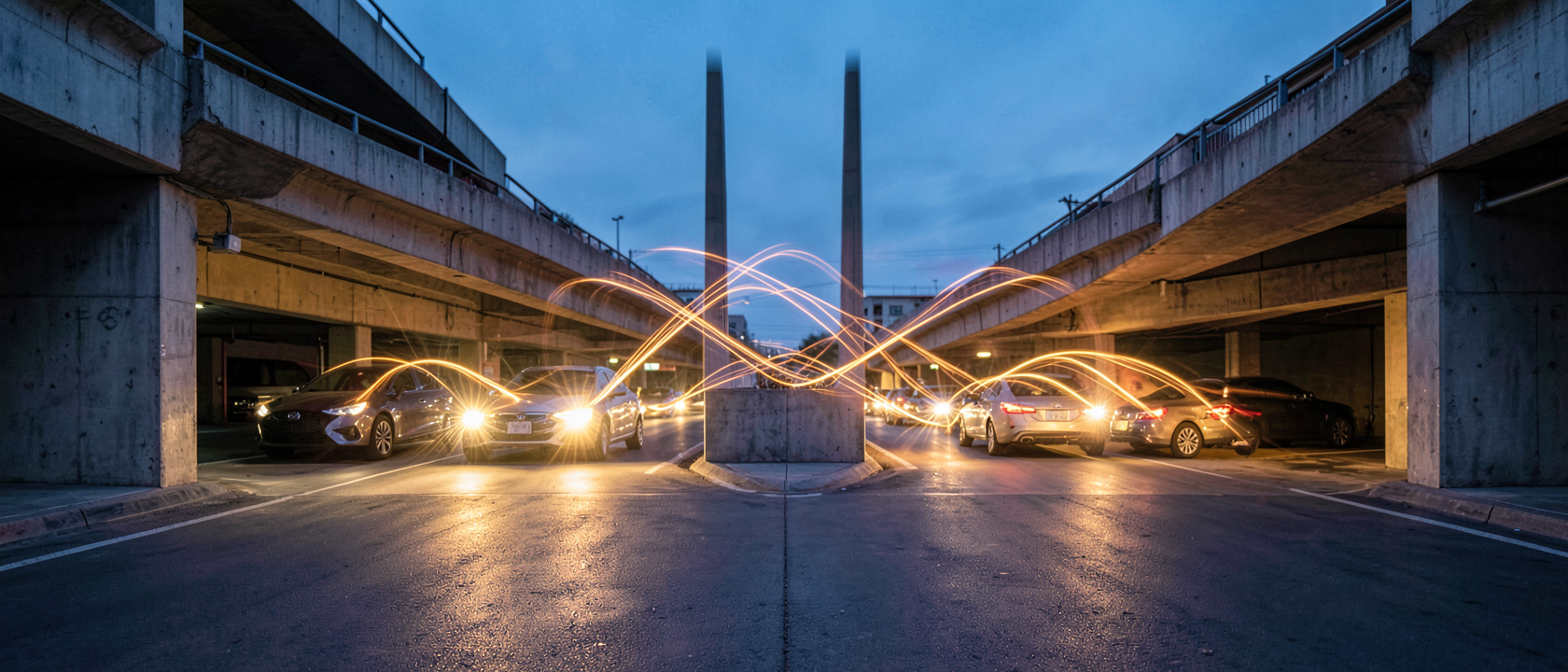
Somewhere in the parking garage at Loyola University Chicago hangs a sign: “USE BOTH EXITS WHEN LEAVING THE PARKING STRUCTURE.” It’s ordinary signage meant to keep cars from bottlenecking at one lane on the way out.
One physicist read it differently. In the Annals of Improbable Research‘s November 2001 issue, R.R. Bukrey of Loyola’s Physics Department published “The Double-Slit Garage Experiment,” claiming with a straight face that the garage had demonstrated wave-particle duality, the behavior normally reserved for electrons and photons, using nothing more exotic than ordinary cars.
What Wave-Particle Duality Actually Means
To catch the joke, you need the physics underneath it. In 1810, Thomas Young passed light through two narrow slits to measure its wavelength. What landed on the screen behind was stranger than a number: alternating bright and dark bands, the signature of waves interfering with each other.
But light also behaves like a stream of individual particles, photons, hitting a detector one at a time. Louis de Broglie extended the idea in the early 20th century, proposing that all matter carries both wave and particle properties. That’s the real strangeness the joke borrows: something can exist as a spread-out wave of possibilities until it’s observed, then collapse into one definite, particle-like outcome.
The Joke, Step by Step
Bukrey’s paper marches that framework, deadpan, into the parking garage. Read literally, a single car can’t just pick one lane: it must travel through both exit lanes at once, the way light passes through both slits in Young’s setup, briefly behaving as a wave. Once outside, the car is observed again, and every time it turns out to be one intact, ordinary automobile, the wave collapsed back into a particle, mirroring how a wavefunction collapses the moment it’s measured.
The paper credits a colleague, C.M. Brodbeck, with originating this reading of the sign, and dubs the framework the “Chicago Interpretation,” also known as the “Far-From-Copenhagen Interpretation,” a jab at the real Copenhagen interpretation, the standard explanation of wavefunction collapse. J.V. Mallow is credited with the photograph of the exit lanes, with G.P. Ramsey pictured in it. The paper also notes, dryly, that no one had apparently tested wave-particle duality on baseballs or bullets before, a detail that makes clear this is satire written by someone who knows the real physics well enough to bend it exactly where it counts.
The Sign Painter Who Never Got Credit
There’s a punchline inside the punchline. By the paper’s own logic, the anonymous worker who painted the sign is the true origin of the whole discovery: without his wording, there’s no double-slit reading, no Chicago Interpretation, no joke at all.
Yet the paper denies him co-author credit, reasoning with mock seriousness that he’d never credited the physicists on his sign either. It’s a precise jab at academic publishing culture, where who gets listed as an author can turn into its own small drama, aimed at two targets at once: quantum interpretation debates, and academia’s habit of guarding credit like it’s scarce.
Why This Joke Still Works
The piece didn’t stay buried in a 2001 journal issue. Neatorama republished it on April 12, 2012, and it has kept circulating in science-humor circles since. That staying power isn’t an accident: the joke works because its author understood real quantum mechanics precisely enough to bend it in exactly the right place, swapping a slit for an exit lane and a wavefunction collapse for a car putting itself back together.
It only lands for a reader who already knows Young’s slits, de Broglie’s matter waves, and the Copenhagen interpretation well enough to catch the substitution instantly. Finding this funny means holding two frameworks, real physics and a parking sign, in your head at once, and noticing exactly where they rhyme. That’s a narrower skill than it sounds, and the best science humor assumes you already have it.